
Decomposition of Velocity and Acceleration Vectors on Parametric Curve
Loading the math board and drawing, please wait…
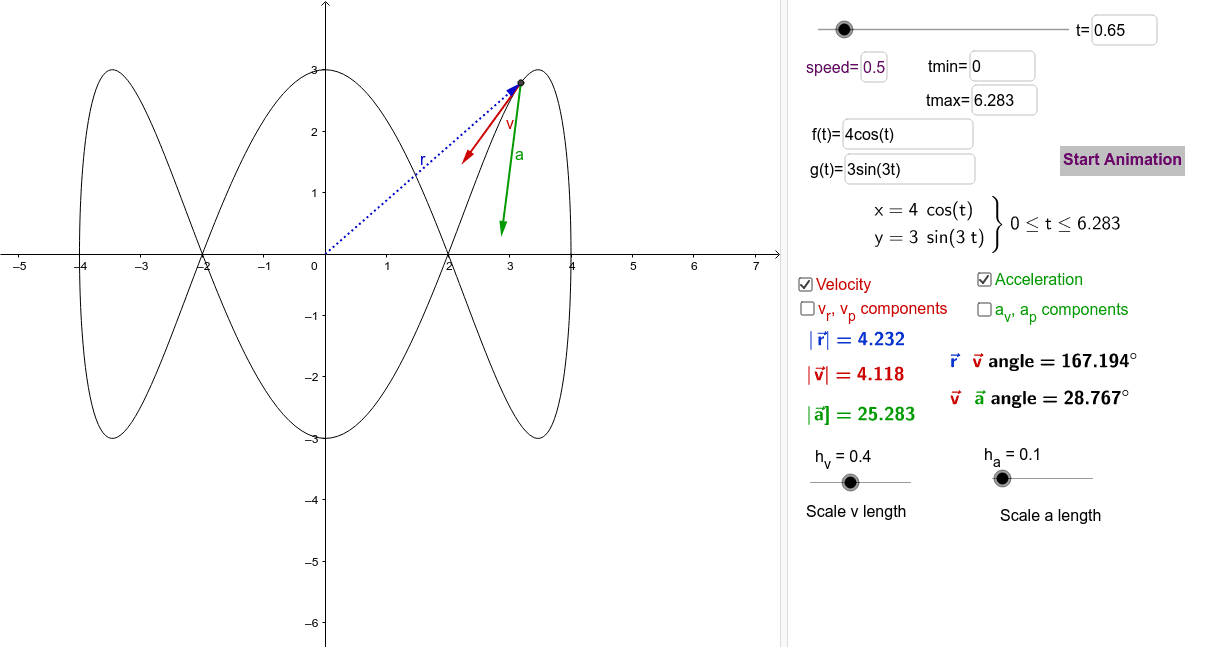
This example demonstrates the decomposition of velocity vectors into components parallel and perpendicular to the position vector, and the decomposition of acceleration vectors into components parallel and perpendicular to the velocity vector. Key mathematical concepts include vector decomposition, parametric equations, and calculus. It utilizes GeoGebra commands such as Derivative, CurveCartesian, Textfield, and If. Suitable for university-level calculus and coordinate geometry courses.
GeoGebra Commands & Parameters
Derivative(g) → g'Derivative(g') → g''Derivative(f) → f'Derivative(f') → f''CurveCartesian(f(t), g(t), t, tmin, tmax) → cCurveCartesian(f'(t), g'(t), t, tmin, tmax) → cdotCurveCartesian(f''(t), g''(t), t, tmin, tmax) → cddotTextfield(tmin) → TminTextfield(tmax) → TmaxTextfield(f) → FofTTextfield(g) → GofTIf(togA ≟ 1, "Stop Animation", "Start Animation") → AnimateTextfield(speed) → SPDTextfield(t) → tEq
AI Drawing Prompt Reference
Draw a parametric curve and demonstrate the decomposition of velocity and acceleration vectors into their parallel and perpendicular components. First, draw the parametric curve c, then draw the velocity vector component curve cdot and the acceleration vector component curve cddot. Set tmin and tmax as the parameter range, display the expressions of f(t) and g(t), and finally add an animation control button to show the expressions of speed and t.
The prompt above was compiled from the original drawing commands and is for reference only.