
Cylinder Construction by drmomentum
Loading the math board and drawing, please wait…
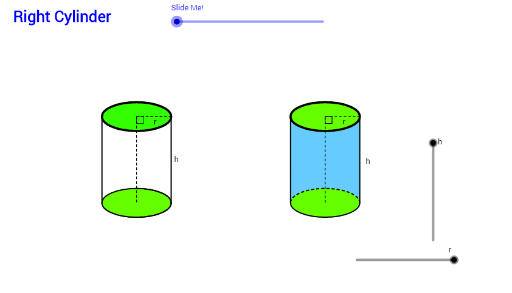
This example demonstrates the 3D geometric construction of a cylinder and its related properties. It involves core mathematical concepts such as solid geometry, functions, equations, integral calculus, and plane geometry. GeoGebra commands and objects used include Point, Circle, Ellipse, Vector, Translate, Polygon, Arc, Segment, Angle, Line, Midpoint, Rotate, Mirror, etc. It is suitable for high school students and math enthusiasts learning and exploring solid geometry and calculus.
GeoGebra Commands & Parameters
Point(xAxis) → ACircle(A, r) → cIntersect(c, xAxis) → B, CEllipse(E, D, C) → eIntersect(xAxis, yAxis) → FVector(F, G) → uTranslate(B, Vector[(u * h)]) → B'_1Translate(C, Vector[(u * h)]) → C'_1Translate(A, Vector[(u * h)]) → A'Translate(e, Vector[(u * h)]) → e'_1Polygon(B'_1, B, C, C'_1) → poly1, b', b, c_1, c'Arc(e'_1, C'_1, B'_1) → fArc(e, B, C) → gArc(e, C, B) → kArc(e'_1, C'_1, B'_1) → p_5Arc(e'_1, B'_1, C'_1) → qArc(e, B, C) → sSegment(A', A) → h_6Segment(A', C'_1) → pAngle(A, A', C'_1) → αLine(A, A') → jIntersect(e'_1, j) → H, IIntersect(k, j) → J,Circle(I, r) → tIntersect(t, j, 2) → KCircle(K, I) → d_1Circle(J, r) → e_1Intersect(e_1, j, 1) → LCircle(L, J) → f_1Intersect(f_1, j, 2) → MIntersect(d_1, j, 2) → NIntersect(s, j) → O,Vector(H, N) → vVector(O, M) → wTranslate(H, Vector[(v * n)]) → H'_1Translate(D, Vector[(u * h)]) → D'Translate(E, Vector[(u * h)]) → E'Line(B, B'_1) → lLine(C, C'_1) → mIntersect(d_1, l, 1) → PIntersect(d_1, m, 1) → QVector(B'_1, P) → zVector(C'_1, Q) → u_1Translate(B'_1, Vector[(z * n)]) → B''Translate(C'_1, Vector[(u_1 * n)]) → C''Midpoint(B'_1, A') → RMidpoint(B, A) → SLine(R, S) → a_1Intersect(q, a_1) → T,Intersect(d_1, a_1, 1) → UVector(T, U) → v_1Translate(T, Vector[(v_1 * n)]) → T'Intersect(f_1, l, 1) → VIntersect(f_1, m, 1) → WIntersect(f_1, a_1, 2) → ZIntersect(s, a_1) → A_1,Vector(B, V) → w_1Vector(A_1, Z) → z_1Vector(C, W) → b_1Translate(B, Vector[(w_1 * (n - 1))]) → B'Translate(A_1, Vector[(z_1 * (n - 1))]) → C_1Translate(O, Vector[(w * (n - 1))]) → O'Translate(C, Vector[(b_1 * (n - 1))]) → C'If(n ≟ 0.02, B'_1, If[n < 1, B'', P]) → B_1If(n ≟ 0.02, T, If[n < 1, T', U]) → D_1If(n ≟ 0.02, H, If[n < 1, H'_1, N]) → E_1If(n ≟ 0.02, C'_1, If[n < 1, C'', Q]) → F_1Conic(B_1, D_1, E_1, F_1, I) → g_1Conic(I, B_1, D_1, E_1, F_1) → h_1If(n < 1, B, If[n < 2, B', V]) → G_1If(n < 1, A_1, If[n < 2, C_1, Z]) → H_1If(n < 1, O, If[n < 2, O', M]) → I_1If(n < 1, C, If[n < 2, C', W]) → J_1Conic(G_1, H_1, I_1, J_1, J) → k_1Vector(H, O) → i_1Translate(H, Vector[(i_1 * (n - 2))]) → H'If(n < 2, H, If[n < 3, H', O]) → K_1Segment(H, K_1) → j_1Arc(e, B, C) → q_1Intersect(g, k_1) → M_1, N_1, R_1, S_1Arc(k_1, M_1, N_1) → r_1Arc(k_1, N_1, M_1) → p_1Arc(e, C, B) → s_1OrthogonalLine(I, j) → l_1OrthogonalLine(J, l) → m_1Circle(I, w_2) → t_1Intersect(t_1, l_1, 1) → L_1Intersect(t_1, l_1, 2) → O_1OrthogonalLine(O_1, l_1) → n_1OrthogonalLine(L_1, m_1) → a_2Intersect(m_1, n_1) → P_1Intersect(m_1, a_2) → Q_1Circle(H, r) → c_2Intersect(c_2, j, 2) → T_1Circle(T_1, H) → d_2OrthogonalLine(H, j) → b_2Intersect(d_2, l_1, 1) → U_1OrthogonalLine(T_1, j) → e_2Intersect(d_2, e_2, 1) → V_1Angle(U_1, T_1, V_1) → βCircle(L_1, r) → f_2Intersect(f_2, l_1, 2) → W_1Vector(I, W_1) → u_2Translate(d_2, Vector[(u_2 * (n - 3))]) → g_2Center(g_2) → Z_1Intersect(g_2, b_2) → A_2, B_3Rotate(A_2, w_3, Z_1) → B_2If(n < 3, H, If[n < 4, B_2, L_1]) → C_2Mirror(C_2, j) → D_2Mirror(E_2, j) → F_2Midpoint(I, L_1) → G_2Intersect(m, l_1) → H_2Midpoint(H_2, C'_1) → I_2Vector(H_2, G_2) → v_2OrthogonalLine(C'_1, m) → i_2Polygon(D_2, F_2, E_2, C_2) → poly2, d_3, f_3, e_3, c_3Vector(C'_1, W_1) → z_2Translate(C'_1, Vector[(z_2 * (n - 3))]) → J_2If(n < 3, C'_1, If[n < 4, J_2, W_1]) → K_2Mirror(K_2, j) → L_2Conic(D_2, L_2, I, K_2, C_2) → h_2Arc(h_2, B_2, D_2) → k_2Arc(h_2, B_2, D_2) → p_2Conic(F_2, N_2, J, M_2, E_2) → q_2Intersect(q_2, k_1) → O_2, P_2, Q_2, R_2Center(h_2) → S_2Center(q_2) → T_2OrthogonalLine(T_2, j) → j_2OrthogonalLine(S_2, j) → m_2Intersect(h_2, m_2) → U_2, V_2Intersect(q_2, j_2) → W_2, Z_2Polygon(U_2, D_2, F_2, W_2) → poly3, u_3, d_4, f_4, w_5Polygon(V_2, C_2, E_2, Z_2) → poly4, v_3, c_4, e_4, z_3Intersect(q_2, d_3, 2) → A_3Intersect(q_2, e_3, 2) → C_3Polygon(F_2, A_3, C_3, E_2) → poly5, f_5, a_3, c_5, e_5Arc(q_2, C_3, A_3) → s_2Arc(q_2, E_2, F_2) → t_2Arc(q_2, E_2, F_2) → g_3Segment(A_3, C_3) → l_2Intersect(k_1, l_2) → D_3, E_3Segment(E_3, A_3) → n_2Segment(D_3, C_3) → b_3Segment(F_2, E_2) → h_3Arc(k_1, D_3, E_3) → k_3Segment(E_3, D_3) → i_3Segment(D_2, C_2) → j_3Segment(L_2, K_2) → l_3Arc(q_2, W_2, F_2) → p_3Arc(q_2, E_2, Z_2) → q_3Arc(q_2, E_2, Z_2) → r_3Arc(q_2, W_2, F_2) → s_3Intersect(k_1, d_3) → F_3, J_3Intersect(k_1, e_3) → G_3, K_3Arc(k_1, G_3, F_3) → t_3Arc(k_1, F_3, R_2) → g_4Arc(k_1, O_2, G_3) → h_4Segment(F_2, E_2) → r_2Intersect(k_1, r_2) → H_3, I_3Segment(F_2, I_3) → m_3Segment(E_2, H_3) → n_3Arc(q_2, E_2, F_2) → k_4Arc(k_1, H_3, I_3) → p_4Segment(I_3, H_3) → a_4Segment(F_2, E_2) → b_4Segment(E_2, Z_2) → i_4Segment(D_2, F_2) → j_4Segment(C_2, E_2) → l_4Arc(k_1, N_1, M_1) → q_4Arc(k_1, N_1, M_1) → r_4Midpoint(j_4) → L_3Translate(e, Vector[(u * h)]) → e'Arc(k_1, M_1, N_1) → s_4Arc(k_1, R_2, N_1) → t_4Arc(k_1, R_2, O_2) → d_5Arc(k_1, P_2, Q_2) → g_5Center(h_1) → M_3Segment(M_3, F_1) → aMidpoint(c_1) → N_3Point(xAxis) → O_3Circle(O_3, r) → h_5Intersect(h_5, xAxis) → P_3, Q_3Ellipse(R_3, S_3, Q_3) → k_5OrthogonalLine(S_3, i_2) → iOrthogonalLine(Q_3, i_2) → m_4OrthogonalLine(P_3, i_2) → n_4OrthogonalLine(R_3, i_2) → a_5Intersect(i_2, a_5) → T_3Intersect(n_4, i_2) → U_3Intersect(i, i_2) → V_3Intersect(m_4, i_2) → W_3Ellipse(T_3, V_3, W_3) → q_5Polygon(U_3, W_3, Q_3, P_3) → poly6, u_4, w_6, q_6, p_6Ellipse(T_3, V_3, W_3) → r_5Arc(k_5, Q_3, P_3) → s_5Arc(k_5, P_3, Q_3) → t_5Center(q_5) → Z_3Segment(O_3, Z_3) → b_5Segment(Z_3, W_3) → i_5Angle(W_3, Z_3, O_3) → γIntersect(k_1, f_4) → A_4,Intersect(k_1, e_4) → B_4,Intersect(g_3, k_1) → C_4, D_4, E_4, F_4Polygon(Z_2, C_4, B_4) → poly7, b_6, z_4, c_6Polygon(F_4, A_4, W_2) → poly8, w_7, f_6, a_6Arc(q_2, W_2, F_4) → d_6Arc(q_2, C_4, Z_2) → e_6Arc(q_2, W_2, F_4) → g_6Arc(q_2, C_4, Z_2) → k_6Arc(k_1, G_3, J_3) → r_6Intersect(k_1, b) → G_4, H_4Segment(E_3, D_3) → m_5Segment(H_3, I_3) → n_5Point(c_3) → J_4Point(k_2) → K_4Point(c_3) → N_4Vector(M_4, N_4) → u_5Segment(D_2, C_2) → i_6Intersect(h_1, i_6) → O_4, V_4If(4 < n ≤ 5, Dilate[O_4, 5 - n, C_2]) → P_4Vector(O_4, P_4) → v_5Translate(h_1, v_5) → s_6Translate(E_1, v_5) → Q_4Center(s_6) → R_4Segment(O_4, P_4) → l_6Segment(O_4, P_4) → m_6If(4 < n ≤ 5, Rotate[Q_4, (((-(n - 4)) * 180))°, R_4]) → S_4CircleArc(R_4, P_4, S_4) → t_6Mirror(O_4, j_6) → T_4Mirror(P_4, j_6) → U_4Segment(T_4, U_4) → n_6Mirror(t_6, j_6) → c_7Segment(D_2, C_2) → a_7Segment(D_2, C_2) → j_5
AI Drawing Prompt Reference
Construct a 3D cylinder with its base circle on the horizontal plane, centered at a point on the x-axis. Mark the intersections of the base circle with the x-axis. Translate the center and the circle vertically to form the top ellipse and the side rectangle. Connect corresponding points on the top and bottom to show the lateral edges. Add auxiliary circles, segments, and an angle to illustrate rotation, translation, and reflection relationships. Finally, draw the cylinder's axis and several auxiliary lines to highlight the geometric and calculus concepts.
The prompt above was compiled from the original drawing commands and is for reference only.