
Cylinder and Cone Volume
Loading the math board and drawing, please wait…
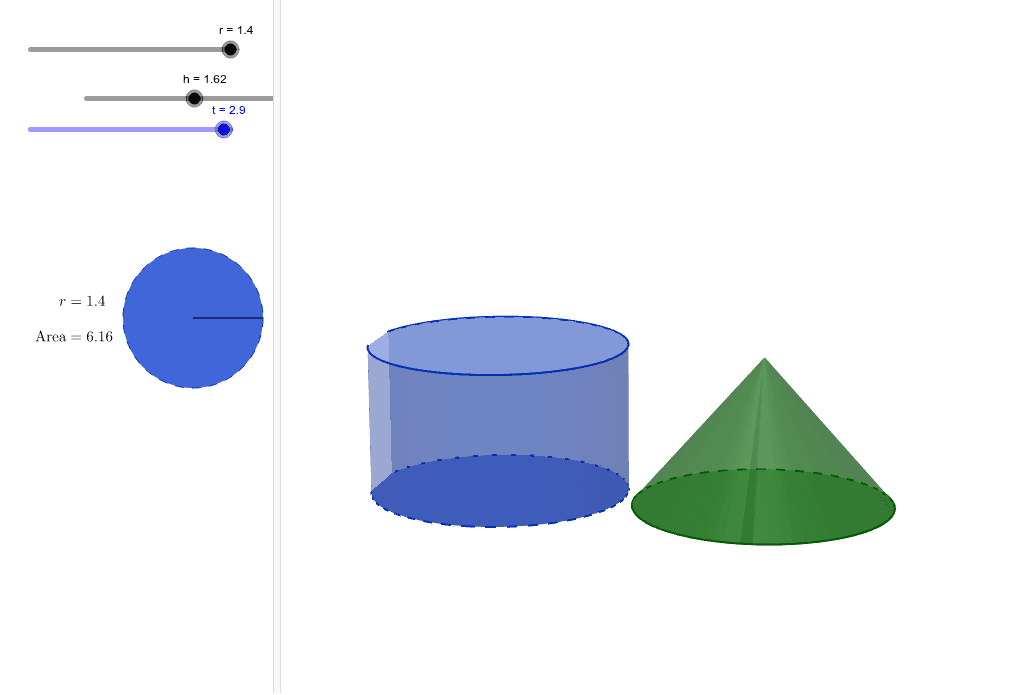
This example demonstrates the calculation of the volume of a cylinder and a cone. Key mathematical concepts include the volume formulas for cylinders and cones. Using GeoGebra commands such as Point, Circle, Cylinder, Area, Vector, Translate, Cone, Segment, Circumference, PointIn, and Volume, the process of volume calculation is visually demonstrated. Suitable for middle school and above students to learn geometry and volume calculation.
GeoGebra Commands & Parameters
Point({r, 0, 0}) → BCircle(zAxis, B) → cCylinder(c, h) → a, d, bArea(c) → ePoint({0, t, 0}) → APoint({0, 0, 0}) → OVector(O, A) → uTranslate(c, u) → d'Cone(d', h) → f, g, iSegment(O, B) → jCircumference(d) → circumferencedPointIn(d) → PointdCircumference(d') → circumferenced'PointIn(d') → Pointd'Volume(a) → volumeaPointIn(b) → PointbVolume(f) → volumefPointIn(i) → PointiTranslate(C, u) → C'
AI Drawing Prompt Reference
Draw a cylinder and a cone to demonstrate volume calculation. The cylinder consists of a base circle and height, while the cone has the same base circle and height. Start by drawing a circle, then create a cylinder based on this circle, labeling the base and height. Next, draw a cone with the same base circle and height. Connect the cone's apex to the cylinder's base center with a dashed line and label key points. Finally, calculate and label the volumes of both shapes, using different colors to distinguish them.
The prompt above was compiled from the original drawing commands and is for reference only.