
Cube Trisection Puzzle
Loading the math board and drawing, please wait…
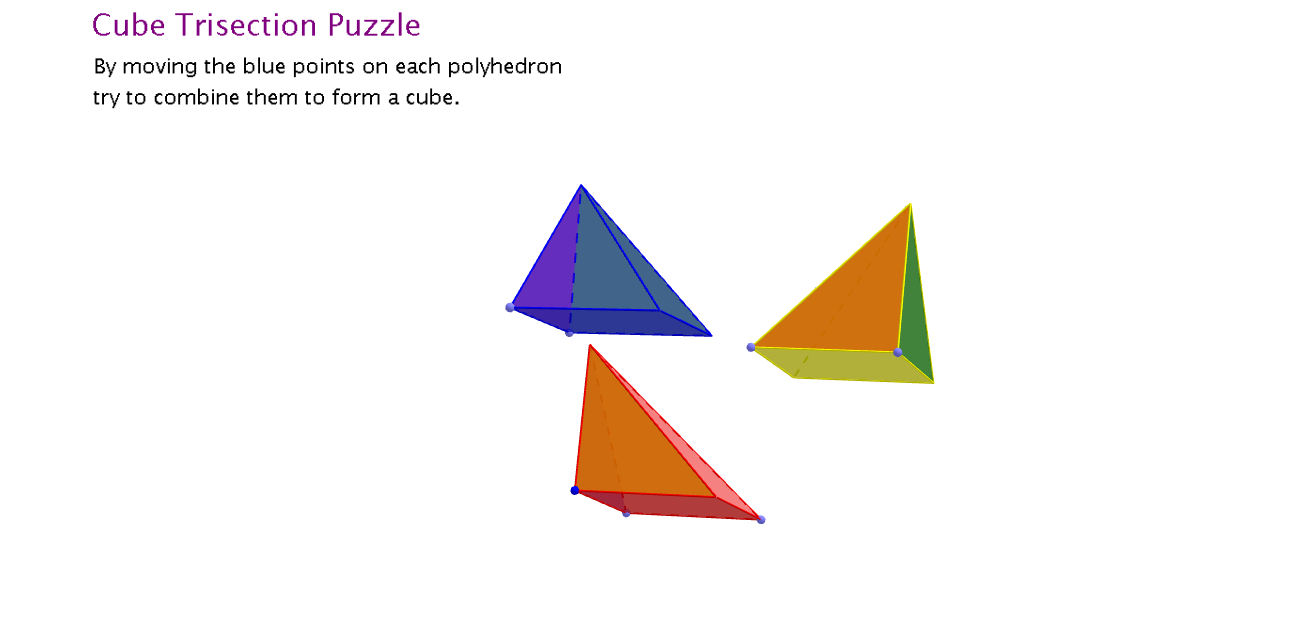
This example demonstrates the relationship between cube volume and pyramid volume, focusing on the cube trisection problem. It involves core mathematical concepts such as volume calculation, geometric construction, coordinate geometry, and matrix operations. The construction utilizes GeoGebra commands like Sphere, PointIn, Segment, OrthogonalPlane, IntersectPath, Point, Plane, Line, Intersect, Polygon, OrthogonalLine, Pyramid, and Circle. It is suitable for high school students and math enthusiasts studying solid geometry and volume calculations.
GeoGebra Commands & Parameters
Sphere(A, a) → bPointIn(b) → DSegment(A, D) → cOrthogonalPlane(D, c) → dSphere(D, a) → eIntersectPath(d, e) → fPoint(f) → EPlane(A, D, E) → gSphere(E, a) → hIntersectPath(g, h) → kLine(E, c) → iIntersect(i, k) → F, GPolygon(A, D, E, G) → poly1, a_1, d_1, e_1, g_1OrthogonalPlane(A, i) → jIntersectPath(j, b) → pOrthogonalLine(A, g) → lIntersect(l, p) → H, IPyramid(poly1, I) → m, faceADI, faceDEI, faceEGI, faceAGI, edgeAI, edgeDI, edgeEI, edgeGILine(I, Segment[A, G]) → nPoint(n) → BOrthogonalPlane(B, n) → oCircle(B, a, j) → qIntersectPath(j, o) → rLine(B, Segment[A, D]) → b_1Point(q) → CLine(B, C) → sSphere(B, a) → tIntersect(b_1, t) → J, KPlane(B, C, K) → uLine(C, b_1) → c_1Line(K, s) → f_1Intersect(f_1, c_1) → LPolygon(B, C, L, K) → poly2, b_2, c_2, l_1, k_1OrthogonalLine(B, u) → h_1Intersect(h_1, q) → M, NPyramid(poly2, N) → v, faceBCN, faceCLN, faceKLN, faceBKN, edgeBN, edgeCN, edgeLN, edgeKNOrthogonalLine(I, j) → i_1Point(i_1) → OSphere(O, a) → wPlane(I, A, D) → j_1IntersectPath(j_1, w) → q_1Point(q_1) → PSegment(O, P) → m_1Line(O, Segment[A, G]) → n_1Intersect(n_1, w) → Q, RLine(R, Segment[O, P]) → p_1Line(P, n_1) → r_1Intersect(p_1, r_1) → SPolygon(O, P, S, R) → poly3, o_1, p_2, s_1, r_2Plane(O, R, S) → t_1OrthogonalLine(O, t_1) → a_2Intersect(a_2, w) → T, UPyramid(poly3, T) → u_1, faceOPT, facePST, faceRST, faceORT, edgeOT, edgePT, edgeST, edgeRT
AI Drawing Prompt Reference
Draw a cube and an inscribed pyramid to demonstrate the relationship between the cube's volume and the pyramid's volume. Start by constructing the cube's vertices and edges. Then, create a sphere intersecting part of the cube to obtain a point. Using this point, construct a regular tetrahedron within the cube and calculate its volume. Next, draw a smaller pyramid inside the cube that is similar to the tetrahedron and calculate its volume. Finally, compare the volumes of the two pyramids to the cube's volume to verify if the cube can be completely filled by these pyramids.
The prompt above was compiled from the original drawing commands and is for reference only.