
Cube Diagonal: Volume 64 cubic inches
Loading the math board and drawing, please wait…
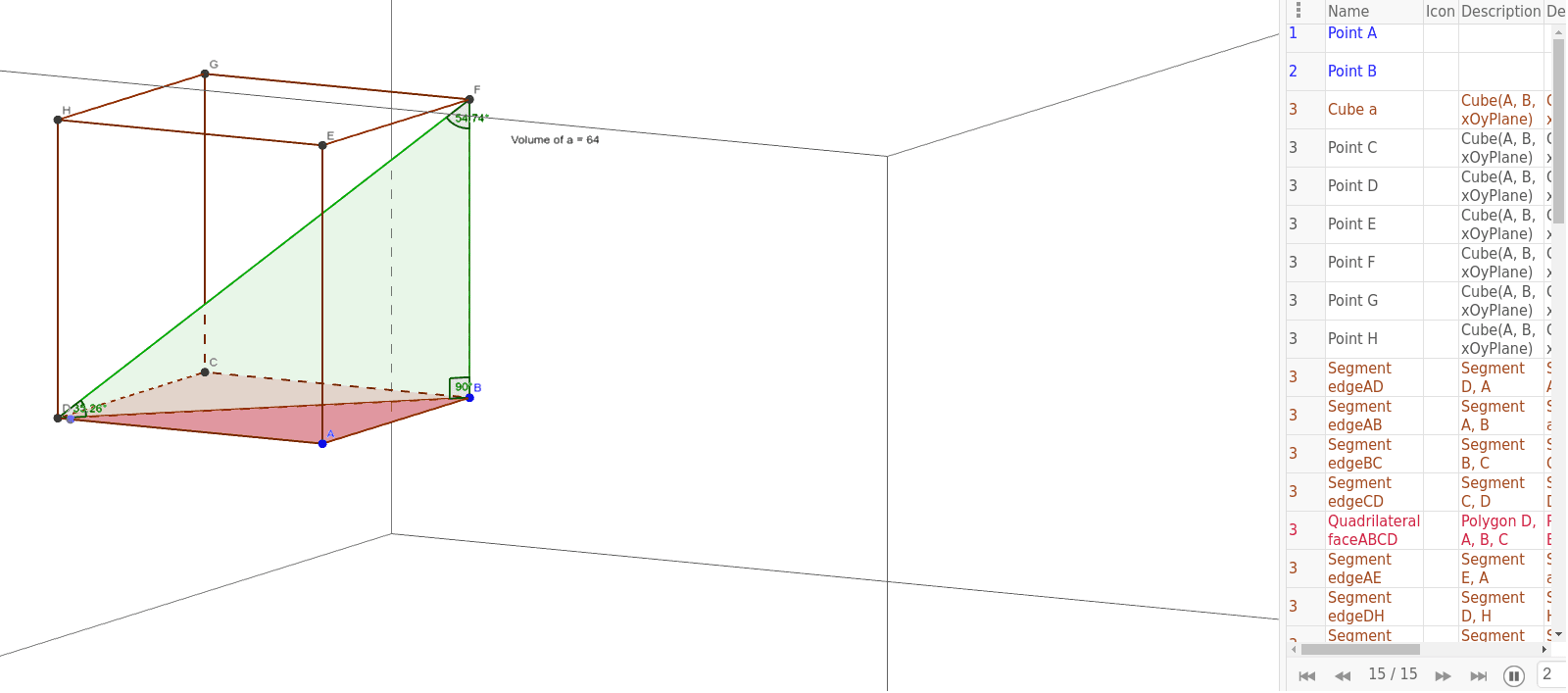
This example demonstrates how to find the length of a space diagonal (such as DF) of a cube given its volume of 64 cubic inches. The core mathematical concepts include the volume formula of a cube, calculating the edge length, and applying the Pythagorean theorem in three dimensions for the space diagonal. Construction details: the GeoGebra commands used include Cube to build the cube, Segment to create the diagonal DF, Polygon and Point to define faces and vertices, and Volume to verify the volume. Suitable for middle school advanced or high school students, this activity reinforces the relationship between volume and diagonal in solid geometry and enhances spatial reasoning.
GeoGebra Commands & Parameters
Cube(A, B, xOyPlane) → a, C, faceBCGF, faceCDHG, faceEFGH, edgeAD, edgeAB, edgeBC, edgeCD, edgeAE, edgeDH, edgeEH, D, edgeEF, edgeBF, edgeFG, edgeCG, edgeGH, E, F, G, H, faceABCD, faceADHE, faceABFESegment(F, D) → bSegment(D, B) → cPolygon(F, D, B) → poly1, b_1, f, dPoint(edgeAD) → IPolygon(D, B, A) → poly2, a_1, d_1, b_2Angle(F, D, B) → αAngle(D, F, B) → βAngle(F, B, D) → γVolume(a) → volumeaPoint(a) → Pointa
AI Drawing Prompt Reference
Draw a cube with a volume of 64 cubic inches and mark the space diagonal DF. First, draw the six faces and twelve edges of the cube, then connect vertices D and F to form the space diagonal DF. Finally, calculate and label the volume of the cube.
The prompt above was compiled from the original drawing commands and is for reference only.