
Cover 100
Loading the math board and drawing, please wait…
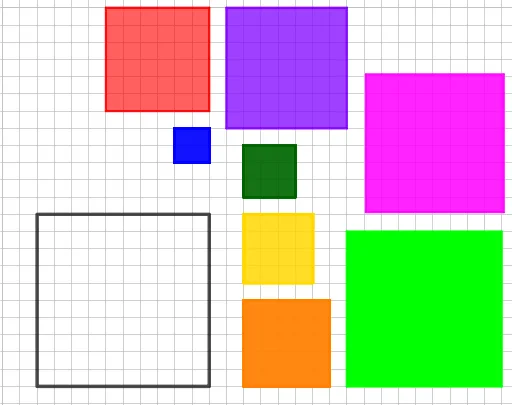
This is a number puzzle about squares by Patrick Vennebush. It involves core math concepts such as area, linear equations, and matrices. Using GeoGebra commands like Polygon, Line, and Function, users can construct geometric figures. Suitable for middle school and above students or teachers for teaching or self-study.
GeoGebra Commands & Parameters
Polygon((0, 0), (10, 0), 4) → poly1Polygon(A, A + (9, 0), 4) → poly2, f, g, h, i, B, CPolygon(D, D + (8, 0), 4) → poly3, j, k, l, m, E, FPolygon(G, G + (7, 0), 4) → poly4, n, p, q, r, H, IPolygon(J, J + (6, 0), 4) → poly5, s, t, a, b, K, LPolygon(M, M + (5, 0), 4) → poly6, c, d, e, f_1, N, OPolygon(M_1, M_1 + (5, 0), 4) → poly6_1, c_1, d_1, e_1, f_2, N_1, O_1Polygon(M_2, M_2 + (5, 0), 4) → poly6_2, c_2, d_2, e_2, f_3, N_2, O_2Polygon(M_3, M_3 + (5, 0), 4) → poly6_3, c_3, d_3, e_3, f_4, N_3, O_3Polygon(P, P + (4, 0), 4) → poly7, g_1, h_1, i_1, j_1, Q, RPolygon(P_1, P_1 + (4, 0), 4) → poly7_1, g_2, h_2, i_2, j_2, Q_1, R_1Polygon(P_2, P_2 + (4, 0), 4) → poly7_2, g_3, h_3, i_3, j_3, Q_2, R_2Polygon(P_3, P_3 + (4, 0), 4) → poly7_3, g_4, h_4, i_4, j_4, Q_3, R_3Polygon(S, S + (3, 0), 4) → poly8, k_1, l_1, m_1, n_1, T, UPolygon(S_1, S_1 + (3, 0), 4) → poly8_1, k_2, l_2, m_2, n_2, T_1, U_1Polygon(S_2, S_2 + (3, 0), 4) → poly8_2, k_3, l_3, m_3, n_3, T_2, U_2Polygon(S_3, S_3 + (3, 0), 4) → poly8_3, k_4, l_4, m_4, n_4, T_3, U_3Polygon(S_4, S_4 + (3, 0), 4) → poly8_4, k_5, l_5, m_5, n_5, T_4, U_4Polygon(S_5, S_5 + (3, 0), 4) → poly8_5, k_6, l_6, m_6, n_6, T_5, U_5Polygon(S_6, S_6 + (3, 0), 4) → poly8_6, k_7, l_7, m_7, n_7, T_6, U_6Polygon(S_7, S_7 + (3, 0), 4) → poly8_7, k_8, l_8, m_8, n_8, T_7, U_7Polygon(S_8, S_8 + (3, 0), 4) → poly8_8, k_9, l_9, m_9, n_9, T_8, U_8Polygon(V, V + (2, 0), 4) → poly9, p_1, q_1, r_1, s_1, W, ZPolygon(V_1, V_1 + (2, 0), 4) → poly9_1, p_2, q_2, r_2, s_2, W_1, Z_1Polygon(V_2, V_2 + (2, 0), 4) → poly9_2, p_3, q_3, r_3, s_3, W_2, Z_2Polygon(V_3, V_3 + (2, 0), 4) → poly9_3, p_4, q_4, r_4, s_4, W_3, Z_3Polygon(V_4, V_4 + (2, 0), 4) → poly9_4, p_5, q_5, r_5, s_5, W_4, Z_4Polygon(V_5, V_5 + (2, 0), 4) → poly9_5, p_6, q_6, r_6, s_6, W_5, Z_5Polygon(V_6, V_6 + (2, 0), 4) → poly9_6, p_7, q_7, r_7, s_7, W_6, Z_6Polygon(V_7, V_7 + (2, 0), 4) → poly9_7, p_8, q_8, r_8, s_8, W_7, Z_7Polygon(V_8, V_8 + (2, 0), 4) → poly9_8, p_9, q_9, r_9, s_9, W_8, Z_8Polygon(V_9, V_9 + (2, 0), 4) → poly9_9, p_{10}, q_{10}, r_{10}, s_{10}, W_9, Z_9Polygon(V_{10}, V_{10} + (2, 0), 4) → poly9_{10}, p_{11}, q_{11}, r_{11}, s_{11}, W_{10}, Z_{10}Polygon(V_{11}, V_{11} + (2, 0), 4) → poly9_{11}, p_{12}, q_{12}, r_{12}, s_{12}, W_{11}, Z_{11}Polygon(V_{12}, V_{12} + (2, 0), 4) → poly9_{12}, p_{13}, q_{13}, r_{13}, s_{13}, W_{12}, Z_{12}Polygon(V_{13}, V_{13} + (2, 0), 4) → poly9_{13}, p_{14}, q_{14}, r_{14}, s_{14}, W_{13}, Z_{13}Polygon(V_{14}, V_{14} + (2, 0), 4) → poly9_{14}, p_{15}, q_{15}, r_{15}, s_{15}, W_{14}, Z_{14}Polygon(V_{15}, V_{15} + (2, 0), 4) → poly9_{15}, p_{16}, q_{16}, r_{16}, s_{16}, W_{15}, Z_{15}Polygon(V_{16}, V_{16} + (2, 0), 4) → poly9_{16}, p_{17}, q_{17}, r_{17}, s_{17}, W_{16}, Z_{16}Polygon(V_{17}, V_{17} + (2, 0), 4) → poly9_{17}, p_{18}, q_{18}, r_{18}, s_{18}, W_{17}, Z_{17}Polygon(V_{18}, V_{18} + (2, 0), 4) → poly9_{18}, p_{19}, q_{19}, r_{19}, s_{19}, W_{18}, Z_{18}Polygon(V_{19}, V_{19} + (2, 0), 4) → poly9_{19}, p_{20}, q_{20}, r_{20}, s_{20}, W_{19}, Z_{19}Polygon(V_{20}, V_{20} + (2, 0), 4) → poly9_{20}, p_{21}, q_{21}, r_{21}, s_{21}, W_{20}, Z_{20}Polygon(V_{21}, V_{21} + (2, 0), 4) → poly9_{21}, p_{22}, q_{22}, r_{22}, s_{22}, W_{21}, Z_{21}Polygon(V_{22}, V_{22} + (2, 0), 4) → poly9_{22}, p_{23}, q_{23}, r_{23}, s_{23}, W_{22}, Z_{22}Polygon(V_{23}, V_{23} + (2, 0), 4) → poly9_{23}, p_{24}, q_{24}, r_{24}, s_{24}, W_{23}, Z_{23}Polygon(V_{24}, V_{24} + (2, 0), 4) → poly9_{24}, p_{25}, q_{25}, r_{25}, s_{25}, W_{24}, Z_{24}
AI Drawing Prompt Reference
Draw a stepped pattern of squares, starting with a large square of side length 10 at the bottom, then stack squares of decreasing side lengths (9, 8, 7, 6) above it, followed by multiple squares of side 5, then multiple squares of side 4, 3, and 2, each aligned horizontally with the top edge of the square below, forming a pyramid-like covering layout. All squares are solid filled with a uniform color.
The prompt above was compiled from the original drawing commands and is for reference only.