
Counting STARS: 1 to 13 Scored
Loading the math board and drawing, please wait…
In collections
Math Scored Practice
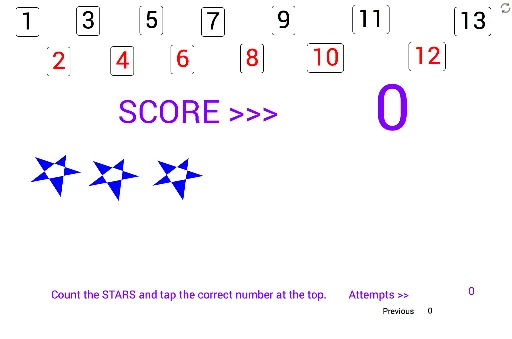
This example demonstrates how to generate star shapes randomly and count them from 1 to 13, involving core math concepts like probability & statistics, random experiments, and geometric construction. Key GeoGebra commands/objects used include Random, Polygon, Intersect, and Text, suitable for high school students learning probability & statistics and geometric construction, or for math clubs.
GeoGebra Commands & Parameters
Random(1, 13) → rPolygon(A, B, C, D, E) → star, a, b, c, d, eIntersect(d, a) → FIntersect(a, c) → GIntersect(c, e) → HIntersect(b, e) → IIntersect(b, d) → JPolygon(A_1, B_1, C_1, D_1, E_1) → star_1, a_1, b_1, c_1, d_1, e_1Intersect(d_1, a_1) → F_1Intersect(a_1, c_1) → G_1Intersect(c_1, e_1) → H_1Intersect(b_1, e_1) → I_1Intersect(b_1, d_1) → J_1Polygon(A_2, B_2, C_2, D_2, E_2) → star_2, a_2, b_2, c_2, d_2, e_2Intersect(d_2, a_2) → F_2Intersect(a_2, c_2) → G_2Intersect(c_2, e_2) → H_2Intersect(b_2, e_2) → I_2Intersect(b_2, d_2) → J_2Polygon(A_3, B_3, C_3, D_3, E_3) → star_3, a_3, b_3, c_3, d_3, e_3Intersect(d_3, a_3) → F_3Intersect(a_3, c_3) → G_3Intersect(c_3, e_3) → H_3Intersect(b_3, e_3) → I_3Intersect(b_3, d_3) → J_3Polygon(A_4, B_4, C_4, D_4, E_4) → star_4, a_4, b_4, c_4, d_4, e_4Intersect(d_4, a_4) → F_4Intersect(a_4, c_4) → G_4Intersect(c_4, e_4) → H_4Intersect(b_4, e_4) → I_4Intersect(b_4, d_4) → J_4Polygon(A_5, B_5, C_5, D_5, E_5) → star_5, a_5, b_5, c_5, d_5, e_5Intersect(d_5, a_5) → F_5Intersect(a_5, c_5) → G_5Intersect(c_5, e_5) → H_5Intersect(b_5, e_5) → I_5Intersect(b_5, d_5) → J_5Polygon(A_6, B_6, C_6, D_6, E_6) → star_6, a_6, b_6, c_6, d_6, e_6Intersect(d_6, a_6) → F_6Intersect(a_6, c_6) → G_6Intersect(c_6, e_6) → H_6Intersect(b_6, e_6) → I_6Intersect(b_6, d_6) → J_6Polygon(A_7, B_7, C_7, D_7, E_7) → star_7, a_7, b_7, c_7, d_7, e_7Intersect(d_7, a_7) → F_7Intersect(a_7, c_7) → G_7Intersect(c_7, e_7) → H_7Intersect(b_7, e_7) → I_7Intersect(b_7, d_7) → J_7Polygon(A_8, B_8, C_8, D_8, E_8) → star_8, a_8, b_8, c_8, d_8, e_8Intersect(d_8, a_8) → F_8Intersect(a_8, c_8) → G_8Intersect(c_8, e_8) → H_8Intersect(b_8, e_8) → I_8Intersect(b_8, d_8) → J_8Polygon(A_9, B_9, C_9, D_9, E_9) → star_9, a_9, b_9, c_9, d_9, e_9Intersect(d_9, a_9) → F_9Intersect(a_9, c_9) → G_9Intersect(c_9, e_9) → H_9Intersect(b_9, e_9) → I_9Intersect(b_9, d_9) → J_9Polygon(A_{10}, B_{10}, C_{10}, D_{10}, E_{10}) → star_{10}, a_{10}, b_{10}, c_{10}, d_{10}, e_{10}Intersect(d_{10}, a_{10}) → F_{10}Intersect(a_{10}, c_{10}) → G_{10}Intersect(c_{10}, e_{10}) → H_{10}Intersect(b_{10}, e_{10}) → I_{10}Intersect(b_{10}, d_{10}) → J_{10}Polygon(A_{11}, B_{11}, C_{11}, D_{11}, E_{11}) → star_{11}, a_{11}, b_{11}, c_{11}, d_{11}, e_{11}Intersect(d_{11}, a_{11}) → F_{11}Intersect(a_{11}, c_{11}) → G_{11}Intersect(c_{11}, e_{11}) → H_{11}Intersect(b_{11}, e_{11}) → I_{11}Intersect(b_{11}, d_{11}) → J_{11}Polygon(A_{12}, B_{12}, C_{12}, D_{12}, E_{12}) → star_{12}, a_{12}, b_{12}, c_{12}, d_{12}, e_{12}Intersect(d_{12}, a_{12}) → F_{12}Intersect(a_{12}, c_{12}) → G_{12}Intersect(c_{12}, e_{12}) → H_{12}Intersect(b_{12}, e_{12}) → I_{12}Intersect(b_{12}, d_{12}) → J_{12}Text(score) → text1Text(try) → text4Text(prev) → text6
AI Drawing Prompt Reference
Draw 13 pentagrams, each with 5 vertices, randomly generating the position and size of each pentagram. Start by generating a random number between 1 and 13, then draw one pentagram based on this number. Repeat this process 13 times, ensuring that the pentagrams do not overlap each time.
The prompt above was compiled from the original drawing commands and is for reference only.