
Converting Improper Fractions to Mixed Numbers by Steve Cheung
Loading the math board and drawing, please wait…
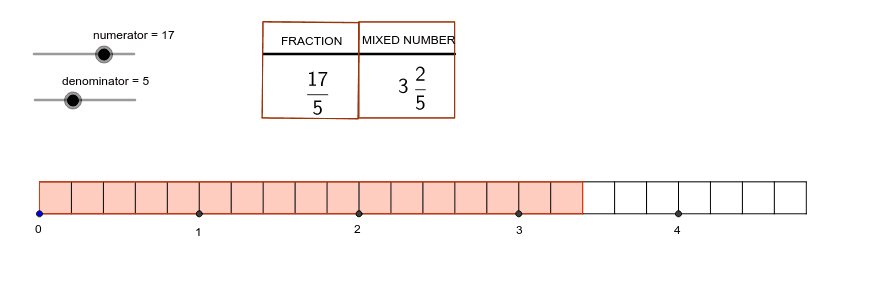
This example visually demonstrates how to convert an improper fraction into its equivalent mixed number, covering core math concepts like fraction properties, equivalent fractions, and the conversion between mixed numbers and improper fractions. It utilizes GeoGebra commands such as Circle, Line, Intersect, OrthogonalLine, Segment, and Polygon to illustrate the process. Suitable for middle school students learning fraction operations and conversions, or for educational demonstrations.
GeoGebra Commands & Parameters
Circle(A, length) → cLine(A, xAxis) → aIntersect(c, a, 2) → B_1Circle(A, height) → dOrthogonalLine(A, a) → bIntersect(d, b, 2) → C_1OrthogonalLine(B_1, a) → eOrthogonalLine(C_1, e) → fIntersect(e, f) → D_1Segment(A, B_1) → gSegment(C_1, D_1) → hSegment(A, C_1) → iSegment(B_1, D_1) → jCircle(A, unit) → kCircle(A, 2 * unit) → pCircle(A, 3 * unit) → qCircle(A, 4 * unit) → rCircle(A, 5 * unit) → sCircle(A, 6 * unit) → tCircle(A, 7 * unit) → c1Circle(A, 8 * unit) → d1Circle(A, 9 * unit) → e1Circle(A, 10 * unit) → f1Circle(A, 11 * unit) → g1Circle(A, 12 * unit) → h1Circle(A, 13 * unit) → k1Circle(A, 14 * unit) → p1Circle(A, 15 * unit) → q1Circle(A, 16 * unit) → r1Circle(A, 17 * unit) → s1Circle(A, 18 * unit) → t1Circle(A, 19 * unit) → c2Circle(A, 20 * unit) → d2Circle(A, 21 * unit) → e2Circle(A, 22 * unit) → f2Circle(A, 23 * unit) → g2Circle(A, 24 * unit) → h2Intersect(k, g, 1) → E_1Intersect(p, g, 1) → F_1Intersect(q, g, 1) → G_1Intersect(r, g, 1) → H_1Intersect(s, g, 1) → I_1Intersect(t, g, 1) → J_1Intersect(c1, g, 1) → K_1Intersect(d1, g, 1) → L_1Intersect(e1, g, 1) → M_1Intersect(f1, g, 1) → N_1Intersect(g1, g, 1) → OIntersect(h1, g, 1) → PIntersect(k1, g, 1) → QIntersect(p1, g, 1) → RIntersect(q1, g, 1) → SIntersect(r1, g, 1) → TIntersect(s1, g, 1) → UIntersect(t1, g, 1) → VIntersect(c2, g, 1) → WIntersect(d2, g, 1) → ZIntersect(e2, g, 1) → A1Intersect(f2, g, 1) → B1Intersect(g2, h2, 1) → C1Intersect(g2, g) → D1,Intersect(h2, g) → E1,Circle(A, denominator * unit) → k2Circle(A, 2 * denominator * unit) → p2Circle(A, 3 * denominator * unit) → q2Circle(A, 4 * denominator * unit) → r2Circle(A, 5 * denominator * unit) → s2Circle(A, 6 * denominator * unit) → t2Circle(A, 7 * denominator * unit) → c3Circle(A, 8 * denominator * unit) → d3Circle(A, 9 * denominator * unit) → e3Circle(A, 10 * denominator * unit) → f3OrthogonalLine(E_1, g) → lOrthogonalLine(F_1, g) → mOrthogonalLine(G_1, g) → nOrthogonalLine(H_1, g) → a1OrthogonalLine(I_1, g) → b1OrthogonalLine(J_1, g) → i1OrthogonalLine(K_1, g) → j1OrthogonalLine(L_1, g) → l1OrthogonalLine(M_1, g) → m1OrthogonalLine(N_1, g) → n1OrthogonalLine(O, g) → a2OrthogonalLine(P, g) → b2OrthogonalLine(Q, g) → i2OrthogonalLine(R, g) → j2OrthogonalLine(S, g) → l2OrthogonalLine(T, g) → m2OrthogonalLine(U, g) → n2OrthogonalLine(V, g) → a3OrthogonalLine(W, g) → b3OrthogonalLine(Z, g) → g3OrthogonalLine(A1, g) → h3OrthogonalLine(B1, g) → i3OrthogonalLine(D1, g) → j3OrthogonalLine(E1, g) → k3Intersect(k3, h) → K1Intersect(j3, h) → L1Intersect(h, i3) → M1Intersect(h, h3) → N1Intersect(h, g3) → O1Intersect(h, b3) → P1Intersect(h, a3) → Q1Intersect(h, n2) → R1Intersect(h, m2) → S1Intersect(h, l2) → T1Intersect(h, j2) → U1Intersect(h, i2) → V1Intersect(h, b2) → W1Intersect(h, a2) → Z1Intersect(h, n1) → A2Intersect(h, m1) → B2Intersect(h, l1) → C2Intersect(j1, h) → D2Intersect(i1, h) → E2Intersect(h, b1) → F2Intersect(h, a1) → G2Intersect(h, n) → H2Intersect(h, m) → I2Intersect(h, l) → J2Intersect(h, i) → K2Segment(L1, D1) → l3Segment(M1, B1) → m3Segment(N1, A1) → n3Segment(O1, Z) → p3Segment(P1, W) → q3Segment(Q1, V) → r3Segment(R1, U) → s3Segment(S1, T) → t3Segment(T1, S) → a4Segment(U1, R) → b4Segment(V1, Q) → c4Segment(W1, P) → d4Segment(Z1, O) → e4Segment(A2, N_1) → f4Segment(B2, M_1) → g4Segment(C2, L_1) → h4Segment(D2, K_1) → i4Segment(E2, J_1) → j4Segment(F2, I_1) → k4Segment(G2, H_1) → l4Segment(H2, G_1) → m4Segment(I2, F_1) → n4Segment(J2, E_1) → p4Intersect(k2, g) → B,Intersect(p2, g) → C,Intersect(q2, g) → D,Intersect(r2, g) → E,Intersect(s2, g) → F,Intersect(t2, g) → G,Intersect(c3, g) → H,Intersect(d3, g) → I,Intersect(e3, g) → J,Intersect(f3, g) → K,Circle(A, 11 * denominator * unit) → q4Circle(A, 12 * denominator * unit) → r4Intersect(q4, g) → L,Intersect(r4, g) → M,Intersect(i, h) → NCircle(N, numerator * unit) → s4Intersect(s4, h) → F1,Circle(A, numerator * unit) → t4Intersect(t4, g) → G1,Polygon(A, G1, F1, N) → poly1, a_1, g1_1, f1_1, n_1Segment(H1, I1) → a5Polygon(J1, L2, 4) → poly2, b5, c5, d5, e5, M2, N2Polygon(O2, P2, 4) → poly3, o2, g5, h5, i5, Q2, R2
AI Drawing Prompt Reference
Draw a coordinate system with a circle intersecting the x-axis, then draw a line perpendicular to the x-axis, finding its intersection with the circle. Next, draw concentric circles centered at the origin with radii from 1 to 10 units, and find their intersections with the x-axis. Finally, connect these intersection points to form a shape composed of multiple line segments, illustrating the process of converting improper fractions to mixed numbers.
The prompt above was compiled from the original drawing commands and is for reference only.