
Converting Fractions and Decimals
Loading the math board and drawing, please wait…
In collections
Bruchzahlen in endliche Dezimalzahlen umrechnen
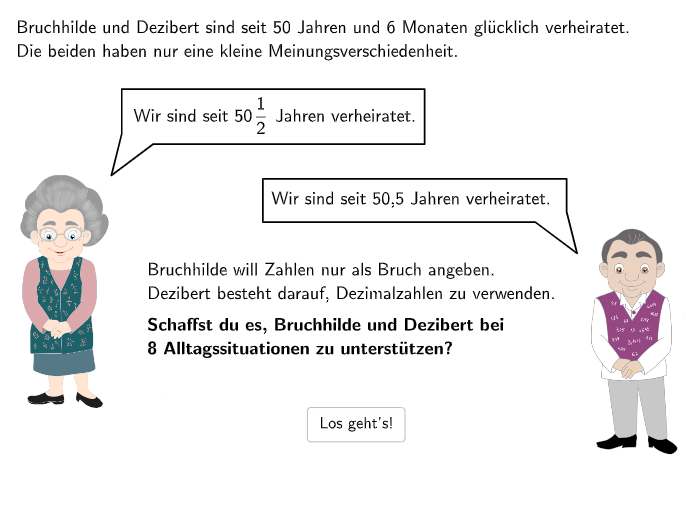
This example demonstrates how to convert fractions to decimals and vice versa. It involves the key mathematical concepts of rational numbers and fraction representation. The construction points include using GeoGebra's Join, If, and Textfield commands. It is suitable for middle school and high school mathematics education, particularly for understanding the relationship between fractions and decimals.
GeoGebra Commands & Parameters
Join({{1}, Shuffle[Sequence[2, maxexnum]], Join[Sequence[Shuffle[Sequence[1, maxexnum]], m, 1, floor(110 / maxexnum)]]}) → listExNumsIf(exnum ≤ 4, 0, If[exnum ≟ 7, 1, 2]) → formatTextfield(input6) → InputBox6Textfield(input5) → InputBox5Textfield(input3) → InputBox3Textfield(input1) → InputBox1Textfield(input2) → InputBox2Textfield(input4) → InputBox4Element({H1, H2, H3, H4, H5, H6, H7, H8}, exnum) → HIf(format ≟ 0 ∨ step ≟ 0, (-2, 1.2), (-2, 0.7)) → EShuffle(Sequence[Random[0, 10], i, 1, 100]) → randomNosForX, {8, 3, 2, 5, 1, 3, 10, 2, 9, 6, 1, 8, 8, 8, 3, 10, 0, 1, 4, 1, 3, 6, 8, 0, 7, 9, 7, 2, 0, 9, 7, 10, 8, 2, 4, 1, 7, 5, 0, 2, 1, 5, 4, 7, 5, 7, 4, 3, 9, 1, 3, 2, 0, 10, 6, 6, 10, 2, 9, 4, 8, 9, 3, 2, 4, 1, 5, 2, 2, 9, 6, 10, 7, 0, 3, 9, 6, 3, 4, 4, 6, 9, 8, 5, 3, 6, 0, 8, 6, 1, 7, 4, 8, 3, 5, 6, 3, 3, 8, 5}Element(randomNosForX, Mod[questionCount, 100] + 1) → numXShuffle(Sequence[Random[0, 10], i, 1, 100]) → randomNosForY, {3, 0, 9, 7, 1, 5, 7, 9, 10, 6, 6, 7, 3, 4, 0, 9, 0, 1, 3, 3, 1, 3, 10, 1, 1, 10, 1, 0, 1, 7, 1, 4, 10, 6, 2, 5, 2, 8, 0, 2, 0, 10, 5, 5, 1, 2, 10, 8, 3, 3, 4, 4, 9, 10, 8, 9, 9, 3, 3, 7, 0, 2, 9, 3, 9, 9, 1, 6, 4, 0, 3, 6, 9, 1, 9, 7, 1, 0, 9, 8, 4, 4, 4, 9, 1, 9, 4, 3, 8, 5, 9, 8, 8, 8, 5, 4, 8, 6, 9, 9}Element(randomNosForY, Mod[questionCount, 100] + 1) → numYAppend(true, Sequence[If[randomNosForX(i) ≟ randomNosForX(i - 1), false, true], i, 2, 100]) → stayXAppend(true, Sequence[If[randomNosForY(i) ≟ randomNosForY(i - 1), false, true], i, 2, 100]) → stayYRemove(Sequence[If[stayX(i), randomNosForX(i), 0], i, 1, 100], Sequence[0, i, 1, 100]) → randomNosForXwithoutRepeatRemove(Sequence[If[stayY(i), randomNosForY(i), 0], i, 1, 100], Sequence[0, i, 1, 100]) → randomNosForYwithoutRepeatElement(randomNosForXwithoutRepeat, Mod[questionCount, Length[randomNosForXwithoutRepeat]] + 1) → numXwithoutRepeatElement(randomNosForYwithoutRepeat, Mod[questionCount, Length[randomNosForYwithoutRepeat]] + 1) → numYwithoutRepeatIf(step ≟ 0, A0, Element[{A1, A2, A3, A4, A5, A6, A7, A8}, exnum]) → AIf(step ≟ 0, S0, Element[{S1, S2, S3, S4, S5, S6, S7, S8}, exnum]) → SIf(step ≟ 0, B0, Element[{B1, B2, B3, B4, B5, B6, B7, B8}, exnum]) → BIf(step ≟ 0, T0, Element[{T1, T2, T3, T4, T5, T6, T7, T8}, exnum]) → TIf(format ≠ 0 ∧ step ≠ 0, (5, 2.5), (5, 0.5)) → F
AI Drawing Prompt Reference
Create a visual representation showing the conversion between fractions and decimals, featuring randomly generated number pairs connected by lines if they match, with text boxes displaying the values, and adjust layout positions based on conditions to illustrate mathematical concepts.
The prompt above was compiled from the original drawing commands and is for reference only.