
Construct an Angle Bisector: Geometric Construction Exercise
Loading the math board and drawing, please wait…
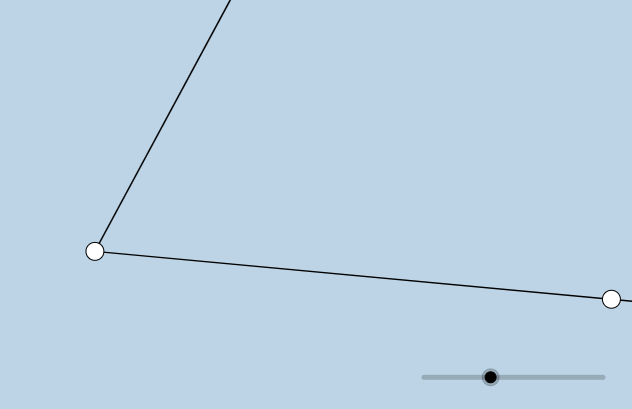
This example demonstrates how to construct the bisector of an angle using geometric construction techniques, and verifies its property of dividing the angle into two equal parts. The core mathematical concept is the definition of an angle bisector and the principles of straightedge-and-compass construction. Key construction steps involve using GeoGebra commands such as Point to create the vertex and points on the sides, Rotate to generate one side from another by a given angle, Angle to measure the angle, and Segment or Ray to draw the bisector. The construction summary lists objects including α (angle), A, B, B' (points), β (angle), and f, g, h, i (segments or rays). This activity is suitable for middle school geometry classes, helping students understand the construction of angle bisectors and their role in geometric proofs.
GeoGebra Commands & Parameters
Point(xAxis) → ARotate(B, α, A) → B'Angle(B, A, B') → βSegment(A, B) → fRay(A, B') → gRay(A, B') → hRay(A, B) → i