
Congruence Modulo Demonstration
Loading the math board and drawing, please wait…
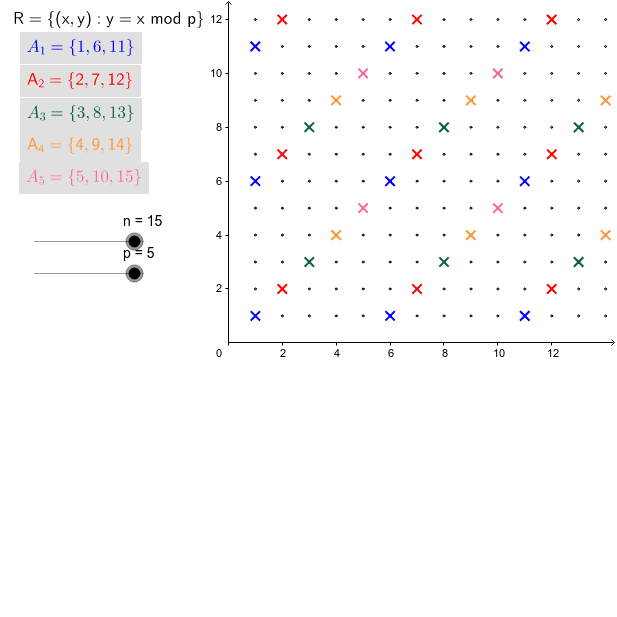
This example illustrates the congruence modulo relation among natural numbers. It involves core mathematical concepts like congruence and modular arithmetic. Construction highlights include the use of Mod, Sequence, and LaTeX commands, with objects such as p, a, n, r, q, etc. It is suitable for high school mathematics education or self-study on number theory fundamentals.
GeoGebra Commands & Parameters
Mod(7, p) → aSequence(Sequence[(i, j), i, 1, n], j, 1, n) → list1Sequence(Sequence[(i, j), i, 1, n, p], j, 1, n, p) → list2Sequence(Sequence[(i, j), i, 2, n, p], j, 2, n, p) → list3Sequence(Sequence[(i, j), i, 3, n, p], j, 3, n, p) → list4Sequence(Sequence[(i, j), i, 4, n, p], j, 4, n, p) → list5Sequence(Sequence[(i, j), i, 5, n, p], j, 5, n, p) → list6Sequence(i, i, p, n, p) → A_0Sequence(i, i, 1, n, p) → A_1LaTeX("R=\{(x,y):y=x\ mod\ p\}") → text2
AI Drawing Prompt Reference
Illustrate the congruence modulo relation among natural numbers with geometric constructions involving multiple sequences of points, starting from modulo operation results, generating sets with varying starting points and steps, and finally labeling the congruence relation with a formula, suitable for high school mathematics education or number theory study.
The prompt above was compiled from the original drawing commands and is for reference only.