
Conditional Probability & Equilateral Triangle Circumcircle Demo
Loading the math board and drawing, please wait…
In collections
Symmetry, Transformation and Tessellation
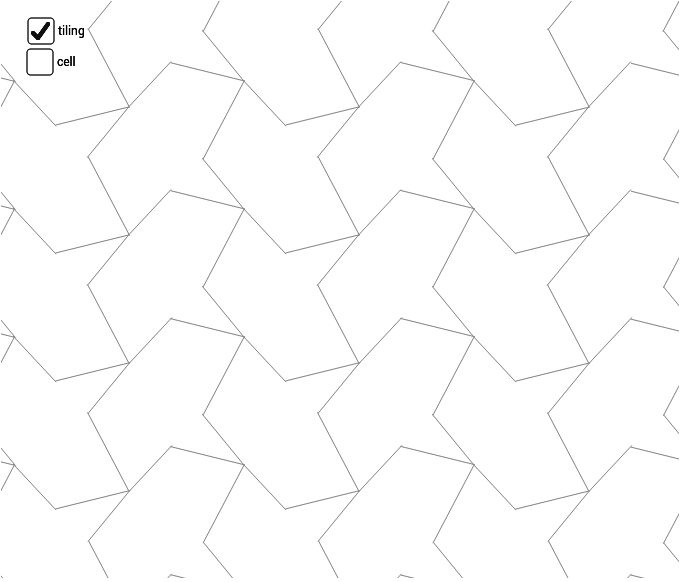
This example demonstrates the geometric relationship between conditional probability, equilateral triangles, and circumcircles. Core math concepts include conditional probability, circumcircle, equilateral triangles, random experiments, and trigonometric functions. Construction involves commands like Segment, Midpoint, Point, Vector, Line, Mirror, Translate, Sequence. Suitable for high school mathematics teaching, illustrating the integration of probability and geometry.
GeoGebra Commands & Parameters
Segment(K, N) → hSegment(K, M) → gSegment(K, L) → fSegment(J, K) → eMidpoint(C, A) → HPoint(xAxis) → BVector(A, B) → uMidpoint(B, D) → FLine(H, F) → nMirror(cell1, n) → cell1aMidpoint(A, B) → EMidpoint(D, C) → GMidpoint(C, B) → IVector(A, C) → vVector(C, D) → wVector(B, D) → aSegment(H, F) → bSegment(E, G) → cTranslate(cell1a, Vector[u / 2]) → cell2Sequence(Translate[Sequence[Translate[tile, Vector[(n * u)]], n, -3, 3], Vector[(m * v)]], m, -3, 3) → tiling
AI Drawing Prompt Reference
Draw a geometric relationship demonstrating conditional probability, equilateral triangles, and circumcircles. Start by constructing an equilateral triangle and its circumcircle. Then, show how to mirror one vertex of the triangle across the diameter of the circumcircle based on conditional probability. Use vector tools and mirror operations to create a pattern of multiple equilateral triangles, illustrating the integration of probability and geometry.
The prompt above was compiled from the original drawing commands and is for reference only.