
Comparison of A, B, and C Series Paper Ratios
Loading the math board and drawing, please wait…
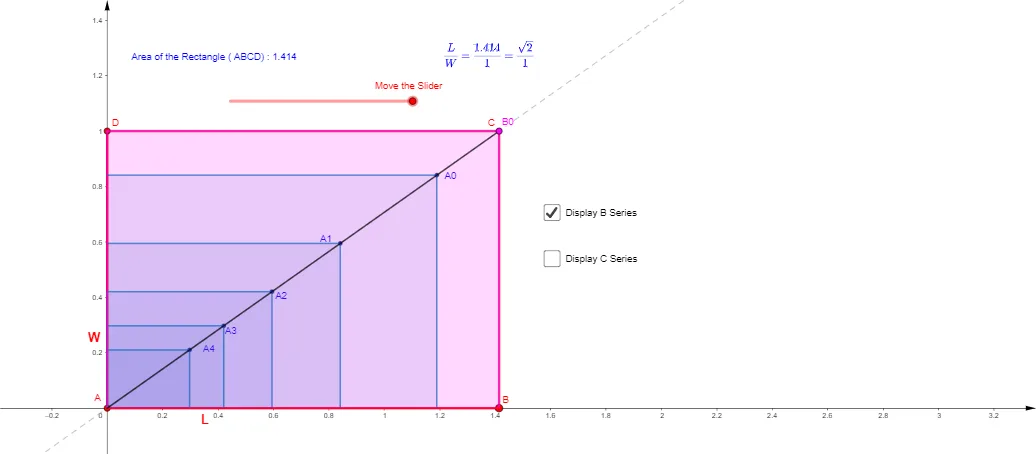
This example demonstrates the size ratio relationships and area comparisons among A, B, and C series paper sizes. It involves core mathematical concepts such as ratios, area calculations, geometric mean, sequences, and functions. GeoGebra commands like IterationList, Sequence, Intersect, Polygon, Line, PointIn, and Segment are used in the construction. Suitable for high school mathematics education to understand geometric shapes and function applications.
GeoGebra Commands & Parameters
IterationList({Element[v, 2], Element[v, 1] / 2}, v, {{sqrt(2), 1}}, N) → m2Sequence((Element[m2, i, 1], Element[m2, i, 2]), i, 1, N + 1) → l2IterationList({Element[v, 2], Element[v, 1] / 2}, v, {{sqrt(sqrt(2)), 1 / sqrt(sqrt(2))}}, N) → m1Sequence((Element[m1, i, 1], Element[m1, i, 2]), i, 1, N + 1) → l1Intersect(xAxis, yAxis) → APolygon(A, B, C, D) → q1, b1, a1, c, dLine(A, A0) → gPointIn(q1) → Pointq1Intersect(g, b1) → ESegment(A, C) → fPolygon((0, 0), (0, y(A5)), A5, (x(A5), 0)) → A5Rect, h, i, a5, jPolygon((0, 0), (0, y(A4)), A4, (x(A4), 0)) → A4Rect, k, l, a4, mPolygon((0, 0), (0, y(A3)), A3, (x(A3), 0)) → A3Rect, n, p, a3, qPolygon((0, 0), (0, y(A2)), A2, (x(A2), 0)) → A2Rect, r, s, a2, tPolygon((0, 0), (0, y(A1)), A1, (x(A1), 0)) → A1Rect, a, b, e, f_1Polygon((0, 0), (0, y(A0)), A0, (x(A0), 0)) → A0Rect, g_1, h_1, a0, i_1Segment(E, C) → j_1Polygon((0, 0), (0, y(B0)), B0, (x(B0), 0)) → B0Rect, k_1, l_1, b0, m_1Polygon((-0.0019494078812289928, 0), (0, y(B1)), B1, (x(B1), 0)) → B1Rect, n_1, p_1, q_1, r_1Polygon((0, 0), (0, y(B2)), B2, (x(B2), 0)) → B2Rect, s_1, t_1, b2, a_1Polygon((0, 0), (0, y(B3)), B3, (x(B3), 0)) → B3Rect, b_1, c_1, b3, d_1Polygon((0, 0), (0, y(B4)), B4, (x(B4), 0)) → B4Rect, e_1, f_2, b4, g_2Segment(B, E) → h_2IterationList({Element[v, 2], Element[v, 1] / 2}, v, {{sqrt((sqrt(2) * areaC0)), sqrt(areaC0 / sqrt(2))}}, N) → m3Sequence((Element[m3, i, 1], Element[m3, i, 2]), i, 1, N + 1) → l3Sequence(Polygon[A, (x(l3(i)), 0), l3(i), (0, y(l3(i)))], i, 1, N) → l4