
Comparing Fractions by Cina
Loading the math board and drawing, please wait…
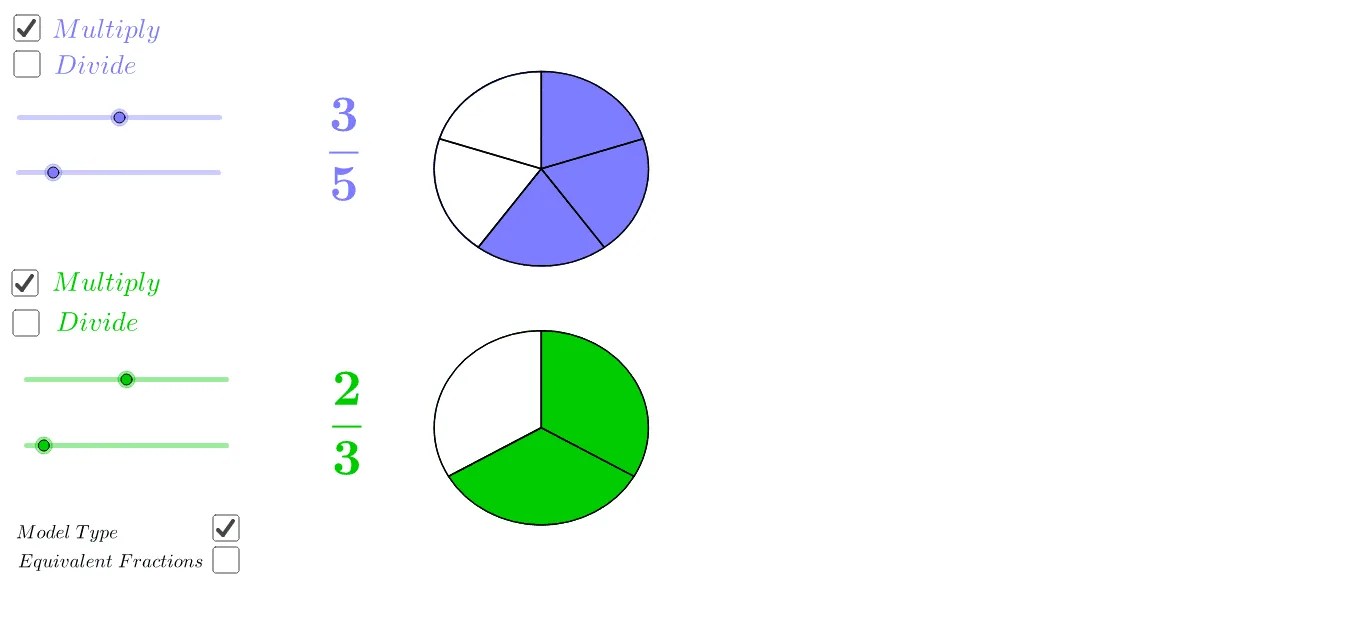
This example visually demonstrates methods for comparing fractions. Key mathematical concepts include least common multiple and greatest common divisor. Using GeoGebra commands such as If, Division, and Intersect, the example dynamically illustrates the process of comparing fractions. Suitable for high-grade elementary and junior high school students.
GeoGebra Commands & Parameters
If(m, (a_1 * b), If[d, a_1 / b, If[a, a_1 + b, If[s, a_1 - b]]]) → iIf(m, (n * g), If[d, n / g, If[a, n + g, If[s, n - g]]]) → jDivision(a_1, n) → list8Intersect(xAxis, yAxis) → APoint(yAxis) → BSequence(Rotate[B, (((-i) * 360) * ° / n), A], i, 0, n) → list1Circle(A, B) → cSequence(Rotate[D, (((-i) * 360) * ° / If[m, (n * g), If[d, n / g, If[a, n + g, If[s, n - g]]]]), C], i, 0, If[m, (n * g), If[d, n / g, If[a, n + g, If[s, n - g]]]]) → list4Circle(C, D) → fSequence(Sector[c, Element[list1, i + 1], Element[list1, i]], i, 1, n) → list2Sequence(Sector[f, Element[list4, i + 1], Element[list4, i]], i, 1, If[m, (n * g), If[d, n / g, If[a, n + g, If[s, n - g]]]]) → list5Division(i, j) → list11If(n > a_1, Sequence[Sector[c, Element[list1, i + 1], Element[list1, i]], i, 1, a_1], Sequence[Sector[c, Element[list1, i + 1], Element[list1, i]], i, 1, a_1]) → list3Circle(E, G) → pCircle(F, H) → qSequence(Rotate[G, (((-i) * 360) * ° / o), E], i, 0, o) → list14Sequence(Sector[p, Element[list14, i + 1], Element[list14, i]], i, 1, o) → list12If(l > o, Sequence[Sector[p, Element[list14, i + 1], Element[list14, i]], i, 1, l], Sequence[Sector[p, Element[list14, i + 1], Element[list14, i]], i, 1, l]) → list15Sequence(Sector[p, Element[list14, i + 1], Element[list14, i]], i, 1, o) → list16Sequence(Rotate[H, (((-i) * 360) * ° / If[u, (o * t), If[w, o / t, If[a, o + t, If[s, o - t]]]]), F], i, 0, If[u, (o * t), If[w, o / g, If[a, o + t, If[s, o - t]]]]) → list17Sequence(Sector[q, Element[list17, i + 1], Element[list17, i]], i, 1, If[u, (o * t), If[w, o / t, If[a, o + t, If[s, o - t]]]]) → list18If(u, (l * r), If[w, l / r, If[a, a_1 + b, If[s, a_1 - b]]]) → b_1If(u, (o * t), If[w, o / t, If[a, n + g, If[s, n - g]]]) → c_1Division(b_1, c_1) → list20Sequence(Element[list10, i] - (0, 8), i, 1, Length[list10]) → list22If(j ≥ i, Sequence[Sector[f, Element[list4, n + 1], Element[list4, n]], n, 1, i], Sequence[Sector[f, Element[list4, i + 1], Element[list4, i]], i, 1, Element[list11, 2]]) → list6If(i > j, Sequence[Circle[Element[list10, i], 0.8], i, 0, Element[list11, 1], 1]) → list9If(b_1 > c_1, Sequence[Circle[Element[list22, i], 0.8], i, 0, Element[list20, 1], 1]) → list21Translate({list3, list15}, (v, 0)) → list13Translate({list6}, (0, g_1)) → list23BarFraction(a_1, n, I) → list24, list25BarFraction(l, o, J) → list26, list27If(m ≟ 1, (a_1 * b), a_1 / b) → r_5If(m ≟ 1, (n * g), n / g) → s_5If(u ≟ 1, (o * t), o / t) → v_5If(u ≟ 1, (l * r), l / r) → t_5Translate(list24, (v, ((1 / 20 * v) * (v - 8)))) → list25'Translate(list26, (v, ((1 / 20 * v) * (v - 8)))) → list26'If(c_1 ≥ b_1, Sequence[Sector[q, Element[list17, o + 1], Element[list17, o]], o, 1, b_1], Sequence[Sector[q, Element[list17, i + 1], Element[list17, i]], i, 1, Element[list20, 2]]) → list19Improp(v_5, t_5, L) → list31_3, list31, list32If(t_5 > v_5, Sequence[Polygon[P - (0, i), P - (0, i) + (3, 0), P - (0, i) + (3, 0.5), P - (0, i) + (0, 0.5)], i, 0, Element[list32, 1] - 1]) → list30If(t_5 > v_5, Sequence[Polygon[P - (0, i), P - (0, i) + (3, 0), P - (0, i) + (3, 0.5), P - (0, i) + (0, 0.5)], i, 0, Element[list32, 1] - 1]) → list33Improp(s_5, r_5, K) → list28, list29, list34If(r_5 > s_5, Sequence[Polygon[O - (0, i), O - (0, i) + (3, 0), O - (0, i) + (3, 0.5), O - (0, i) + (0, 0.5)], i, 0, Element[list34, 1] - 1]) → list35If(r_5 > s_5, Sequence[Polygon[O - (0, i), O - (0, i) + (3, 0), O - (0, i) + (3, 0.5), O - (0, i) + (0, 0.5)], i, 0, Element[list34, 1] - 1]) → list36If(i > j, Sequence[Circle[Element[list10, i], 0.8], i, 0, Element[list11, 1], 1]) → list37If(b_1 > c_1, Sequence[Circle[Element[list22, i], 0.8], i, 0, Element[list20, 1], 1]) → list38Translate(list28, (0, (1.045 * g_1))) → list28'
AI Drawing Prompt Reference
Draw a comparison of two fractions using circles and sectors. Start by plotting points A and B on the coordinate axes, then rotate B around A to form a circle. Next, rotate sectors around the circle's center. Then, based on the numerators and denominators of the two fractions, draw a second circle and sectors, rotating them around the first circle's center. Finally, use circles to represent the larger fraction and sectors to represent the smaller fraction, completing the drawing.
The prompt above was compiled from the original drawing commands and is for reference only.