
Coin Flip Probability Demo
Loading the math board and drawing, please wait…
In collections
ΠΙΘΑΝΟΤΗΤΕΣ
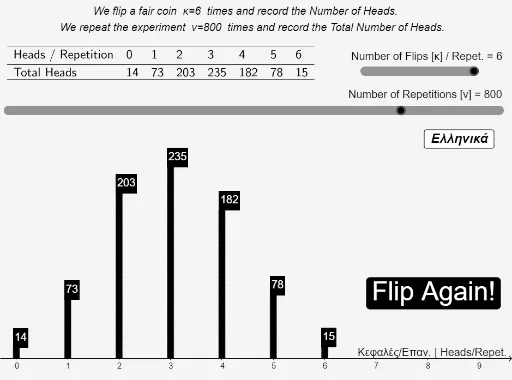
This example demonstrates the probability distribution and statistical outcomes of flipping a coin. It involves core math concepts like probability statistics, random events, and frequency analysis. Construction highlights the use of GeoGebra commands: Sequence (sequence generation), TableText (table text), Join (string concatenation), Element (element selection), DotPlot (dot plot creation), and CountIf (conditional counting). Suitable for high school probability statistics teaching or introductory mathematical modeling.
GeoGebra Commands & Parameters
Sequence(ν, ν, 0, aaa) → l1TableText(l1) → k2Sequence(RandomBinomial[aaa, 0.5], a, 1, aa) → l5Join({{"Συνολικές Κεφαλές"}, Sequence[CountIf[x ≟ a, l5], a, 0, aaa]}) → l8TableText({l7, l8}, "l_h") → k1Element(l1, aaa) → aDotPlot(l5, false, 0.03) → l6CountIf(x ≤ 5, l1) → bSequence(CountIf[x ≟ a, l5], a, 0, aaa) → l2Sequence(CountIf[x ≟ a, l5], a, 0, aaa) → l3Sequence(Text[l3(w - 1), (w - 2.037, (0.03 * l3(w - 1.2)) + 0.18)], w, 2, 13) → l4Join({{"Total Heads"}, Sequence[CountIf[x ≟ a, l5], a, 0, aaa]}) → l10TableText({l9, l10}, "l_h") → k7