
Coefficient Beta in Quadratic Function
Loading the math board and drawing, please wait…
In collections
Quadratic functions
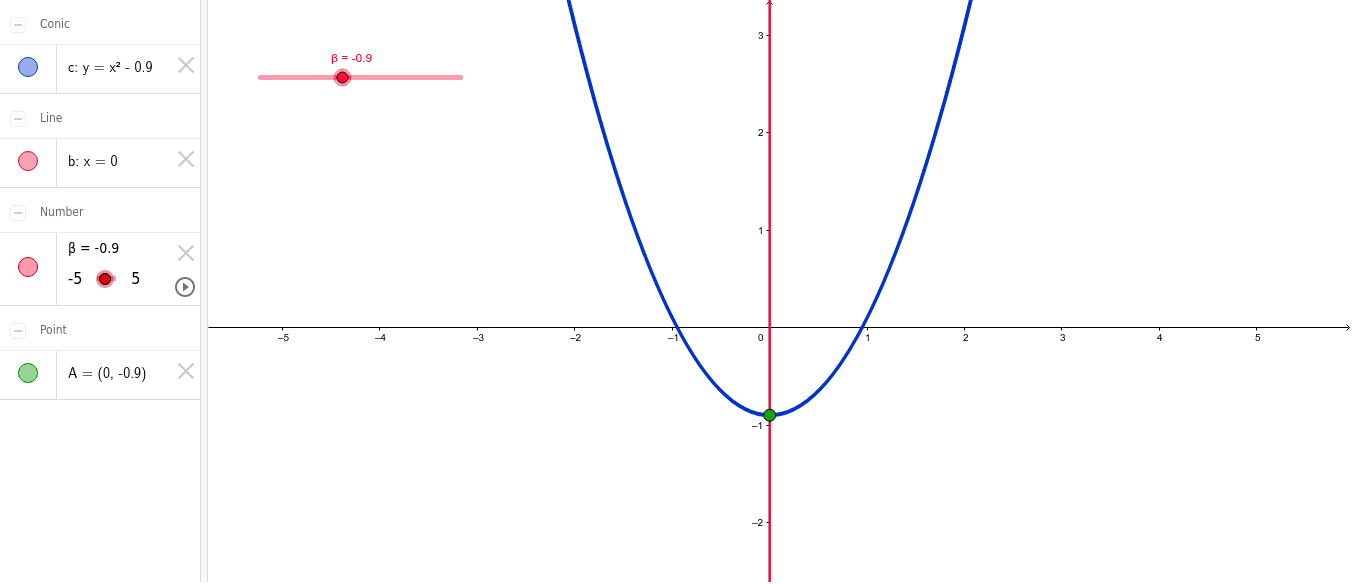
This example demonstrates the effect of coefficient beta (β) in the quadratic function y=ax²+bx+c on the graph's opening direction and axis of symmetry. Key math concepts include quadratic functions, coefficients, symmetry axes, and graph transformations. GeoGebra commands used to construct objects b(β), c, and A allow dynamic adjustment of β to observe graph changes. Suitable for high school mathematics education to understand coefficient properties and parameter influence on function graphs.
GeoGebra Commands & Parameters
x = 0Numeric β(-0.9)y = x^(2) + β(0, β)
AI Drawing Prompt Reference
Draw a Cartesian coordinate plane with a parabola given by y = x² + β, where β is a variable parameter currently set to -0.9. The parabola opens upward, with its vertex at the point (0, -0.9) on the y-axis. Include the y-axis as the axis of symmetry and mark the vertex point clearly. The graph should illustrate how changing β shifts the parabola vertically, allowing observation of the parameter's effect on the curve.
The prompt above was compiled from the original drawing commands and is for reference only.