
Circumcenter and Circumcircle Construction Quiz
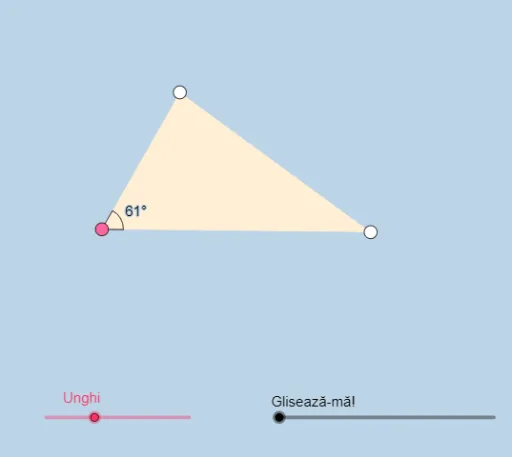
Loading the math board and drawing, please wait…
① This GeoGebra applet dynamically demonstrates the construction of the circumcircle of a triangle, followed by key questions as an interactive quiz. ② The core mathematical concept is the circumcenter—the intersection point of the perpendicular bisectors of a triangle's sides, equidistant from all three vertices, which uniquely defines the circumcircle. ③ Construction details: from the summary, commands such as Rotate, Angle, Ray, Segment, Point, Polygon, Midpoint, OrthogonalLine, Intersect, Dilate, and CircleArc are used. Objects include triangle vertices A, B, C; side midpoints D, E, F; perpendicular lines h, i, j; intersection point G (the circumcenter); and the circumcircle d. The applet illustrates the classic steps: construct perpendicular bisectors of two sides, find their intersection, then draw the circle centered at that point with radius to any vertex. ④ Suitable for middle school geometry lessons or self-study, helping students grasp the properties of the circumcenter, the uniqueness of the circumcircle, and the integration of dynamic construction with verification. It also serves as a ready-made quiz for classroom assessment.
GeoGebra Commands & Parameters
Rotate(B, (Unghi * π / 180), A) → B'Angle(B, A, B') → αRay(A, B') → fSegment(A, B) → gPoint(f) → CPolygon(B, A, C) → t1, c, b, a_1Segment(A, C) → hSegment(C, B) → iMidpoint(g) → DMidpoint(i) → EMidpoint(h) → FOrthogonalLine(E, i) → jOrthogonalLine(D, g) → kOrthogonalLine(F, h) → lIntersect(j, k) → GDilate(A, If[0 < d ≤ 1, 1 - d, 0], D) → A'Segment(A, A') → mRotate(A, If[1 < d ≤ 2, ((-(d - 1)) * π), (-π)], D) → A'_1Segment(D, A'_1) → nDilate(B, If[2 < d ≤ 3, 3 - d, 0], E) → D'Segment(B, D') → pRotate(B, If[3 < d ≤ 4, ((-(d - 3)) * π), (-π)], E) → B'_1Segment(E, B'_1) → qDilate(C, If[4 < d ≤ 5, 5 - d, 0], F) → C'Segment(C, C') → rRotate(C, If[5 < d ≤ 6, ((-(d - 5)) * π), (-π)], F) → C'_1Segment(F, C'_1) → sDilate(D, If[6 < d ≤ 7, 7 - d, 0], G) → D'_1Segment(D, D'_1) → tAngle(G, D, A) → βDilate(E, If[7 < d ≤ 8, 8 - d, 0], G) → E'Segment(E, E') → ePoint(j) → HAngle(H, E, B) → γDilate(F, If[8 < d ≤ 9, 9 - d, 0], G) → F'Segment(F, F') → f_1Angle(G, F, C) → δDilate(G, If[10 < d ≤ 11, 11 - d, 0], C) → G'Segment(G, G') → g_1Angle(C, G, A) → εAngle(A, G, B) → ζRotate(G, If[11 < d ≤ 12, ((d - 11) * ε), ε], G) → G'_1Rotate(G', If[11 < d ≤ 12, ((d - 11) * ε), ε], G) → G''Segment(G'_1, G'') → h_1CircleArc(G, C, G'') → c_1Rotate(G'_1, If[12 < d ≤ 13, ((d - 12) * ζ), ζ], G) → IRotate(G'', If[12 < d ≤ 13, ((d - 12) * ζ), ζ], G) → G'''Segment(I, G''') → i_1CircleArc(G, A, G''') → d_1Rotate(I, If[13 < d ≤ 14, ((d - 13) * ((2 * π) - ε - ζ)), (2 * π) - ε - ζ], G) → I'Rotate(G''', If[13 < d ≤ 14, ((d - 13) * ((2 * π) - ε - ζ)), (2 * π) - ε - ζ], G) → JSegment(I', J) → j_1CircleArc(G, B, J) → e_1