
Circle Area Dissection and Unrolling Animation
Circle Area Dissection and Unrolling Animation
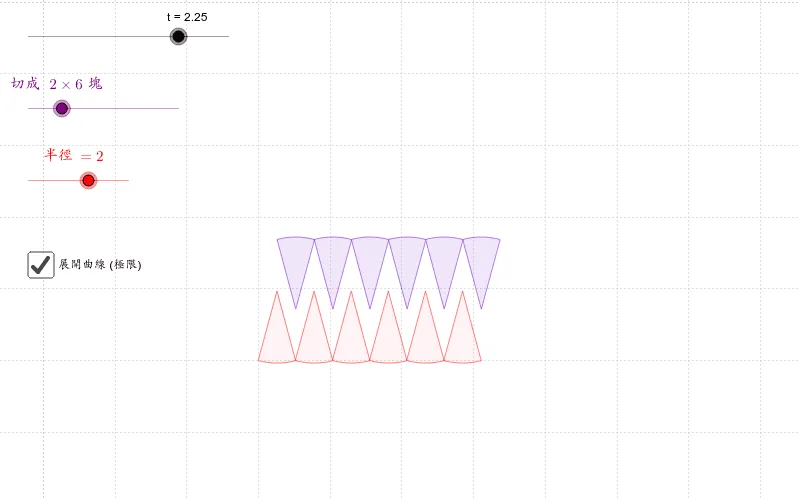
This GeoGebra applet provides an interactive, dynamic demonstration of how the area of a circle can be derived through geometric dissection and rearrangement. The applet visually transforms a circle into a familiar rectangle-like shape by cutting it into multiple wedge-shaped sectors and then re arranging those sectors side by side in an interlocking pattern. This elegant construction bridges elementary geometry and the limit ideas of calculus, making it a powerful teaching tool for students encountering area formulas and introductory analysis.
Users interact with the model through adjustable parameters. The first slider controls the number of equal cuts, denoted by n, which determines how many扇形 (sectors) the circle is divided into. As the user increases n, each sector becomes progressively narrower, and the re arranged figure gradually approaches a true rectangle. The second slider, labeled t, serves as an unrolling parameter that animates the transition from the original circular arrangement to the flat, rectangular configuration. By manipulating both sliders, learners can observe in real time how the geometric transformation unfolds and how the approximation improves with finer divisions.
The mathematical foundations underlying the applet include sequences, trigonometric relationships, and parametric equations. The positions of the sector vertices are computed using parametric formulas derived from the circle equation, while trigonometric functions determine the heights and angles of individual wedges. As n grows without bound, the sequence of re arranged figures converges to a rectangle whose base equals half the circumference of the circle and whose height equals the radius. This limiting process directly leads to the well-known area formula A equals pi times r squared.
For classroom use, the applet supports lessons in both geometry and calculus. In a geometry setting, teachers can use it to motivate why the circle area formula works rather than presenting it as a memorized fact. In a calculus context, the animation provides a concrete illustration of the limit concept, showing visually how a curved boundary can be approximated by straight edges as the partition becomes infinitely fine. Students benefit from the immediate visual feedback and the ability to control the animation speed and precision themselves, which promotes active exploration and deeper conceptual understanding.
Overall, this GeoGebra demonstration combines interactive experimentation with rigorous mathematical content, offering an engaging way for students to connect geometric intuition with analytical reasoning and to appreciate the elegance of the circle area derivation.
In collections
微積分
Loading the math board and drawing, please wait…