
Linking SHM to Uniform Circular Motion via Oscillation Animation
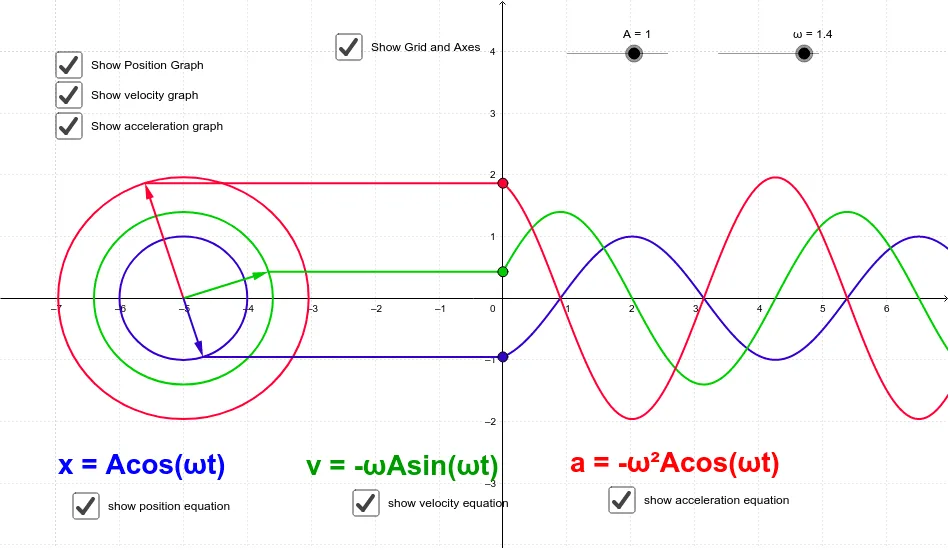
This GeoGebra example uses an animation to demonstrate how simple harmonic motion (SHM) emerges from uniform circular motion: the oscillating displacement corresponds to the projection of a point moving on a circle. It highlights the core math and physics connection between circular motion parameters (angular speed and phase) and SHM properties (period/frequency) through trigonometric relationships (sin/cos via projection). The construction employs commands such as Point, Circle, and Intersect to build the circle and key points; Tangent and Derivative to obtain instantaneous slope and rate-of-change information; Segment and Vector to form geometric links and projection relationships; and it uses objects and parameters like ω, ϕ, f, f', f'', along with auxiliary points/labels to coordinate the animation and annotate quantities. Suitable for secondary school through early undergraduate learning, especially for teaching trigonometry, function modeling, and derivative-based interpretation of oscillatory motion.
Loading the math board and drawing, please wait…