
Ch 16 Problem 2: Reflection Points and Orthocenter on One Line
Loading the math board and drawing, please wait…
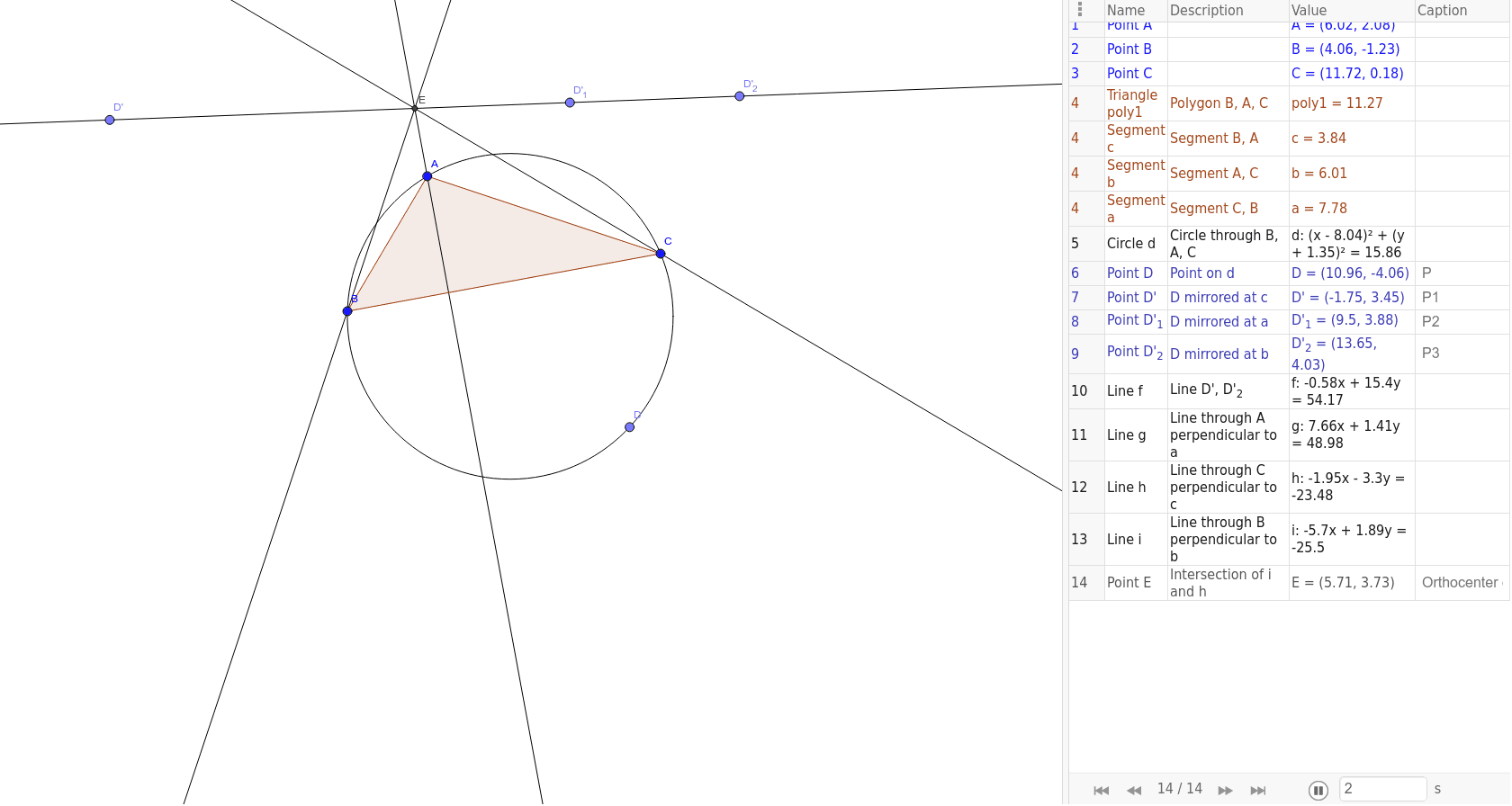
This example demonstrates the geometric phenomenon that in a triangle, the three reflection points obtained by reflecting each vertex across its opposite side, together with the orthocenter, lie on a single straight line. The core mathematical concepts involve the orthocenter of a triangle, reflection transformations, and collinearity. Construction details: using GeoGebra commands such as Polygon to construct triangle ABC, Circle for the circumcircle, Point for vertices, Mirror to reflect vertices across opposite sides producing points D, D', etc., Line to connect relevant points, OrthogonalLine to construct altitudes, and Intersect to find the orthocenter E. By observing the collinearity of the reflection points and the orthocenter, the theorem is verified. Suitable for high school geometry courses or competition mathematics when studying orthocenter properties and reflections, and also useful as a dynamic geometry exploration example.
GeoGebra Commands & Parameters
Polygon(B, A, C) → poly1, c, b, aCircle(B, A, C) → dPoint(d) → DMirror(D, c) → D'Mirror(D, a) → D'_1Mirror(D, b) → D'_2Line(D', D'_2) → fOrthogonalLine(A, a) → gOrthogonalLine(C, c) → hOrthogonalLine(B, b) → iIntersect(i, h) → E
AI Drawing Prompt Reference
Draw a triangle with its circumcircle. Pick a point on the circle and reflect it across each of the three sides, producing three reflected points. Connect two of these reflected points with a line. Then construct the three altitudes of the triangle by drawing perpendiculars from each vertex to the opposite side; their intersection is the orthocenter. The final figure shows that the three reflected points and the orthocenter all lie on the same straight line, which coincides with the line connecting the two reflected points.
The prompt above was compiled from the original drawing commands and is for reference only.