
Cavalieri's Principle for Two Triangular Prisms
Loading the math board and drawing, please wait…
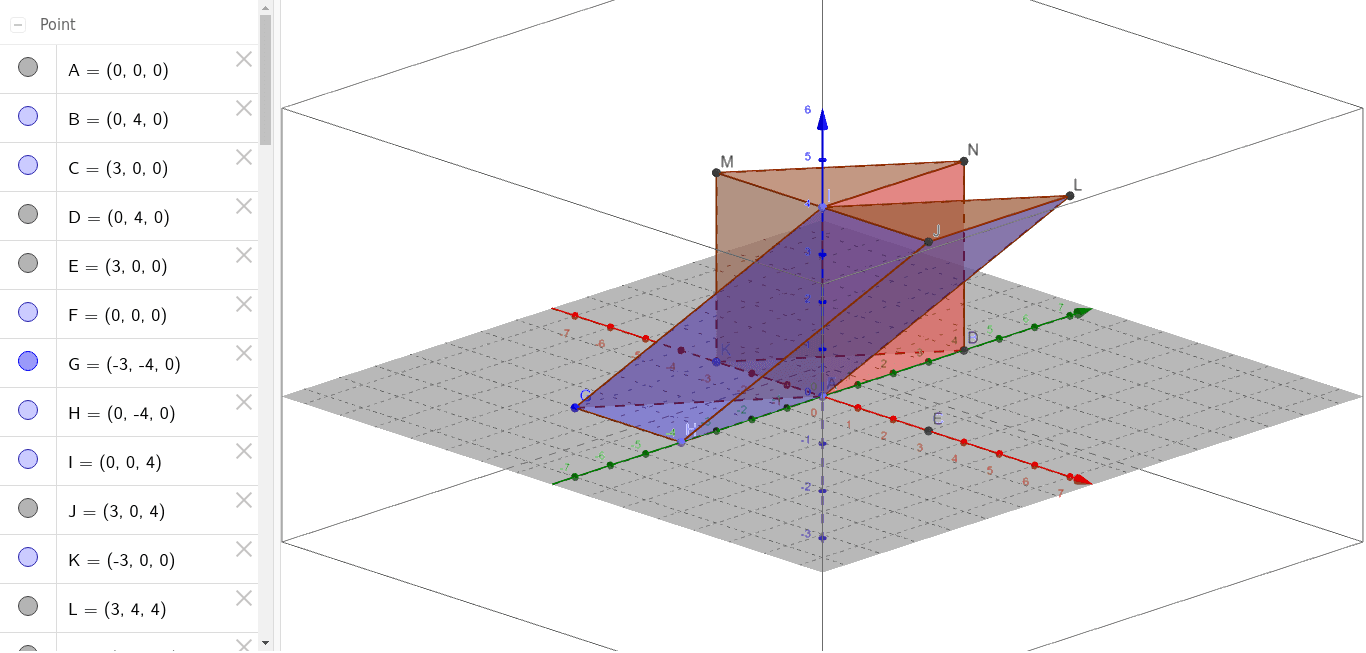
This example demonstrates Cavalieri's principle for two triangular prisms. Cavalieri's principle is a fundamental theorem in solid geometry used to compare the volumes of two solids. By constructing two triangular prisms and observing their base areas and heights, one can intuitively understand the principle. The example uses commands like Polygon and Prism in GeoGebra. Suitable for high school mathematics education and students learning solid geometry.
GeoGebra Commands & Parameters
Intersect(xAxis, yAxis) → APoint(yAxis) → BPoint(xAxis) → CPolygon(A, B, C) → poly1, c, a, bPoint(zAxis) → FPrism(poly1, F) → d, D, edgeDF, edgeDE, edgeEF, E, faceABDF, faceBCED, faceACEF, faceDEF, edgeAF, edgeBD, edgeCEPoint(yAxis) → HPolygon(G, H, A) → poly2, a_1, g, hPoint(xAxis) → KPolygon(F, K, D) → poly3, d_1, f, kPoint(zAxis) → IPrism(poly2, I) → e, J, edgeIJ, edgeJL, edgeIL, L, faceGHJI, faceAHJL, faceAGIL, faceIJL, edgeGI, edgeHJ, edgeALPrism(poly3, I) → i, M, edgeIM, edgeMN, edgeIN, N, faceFIMK, faceDKMN, faceDFIN, faceIMN, edgeFI, edgeKM, edgeDN
AI Drawing Prompt Reference
Draw two triangular prisms to demonstrate Cavalieri's principle. Start by constructing a triangle in the xy-plane, then extend it upward to form the first prism. Next, create another triangle in the same plane and extend it upward to form the second prism. Both prisms share the same height, allowing for a visual comparison of their base areas and heights to intuitively understand the principle.
The prompt above was compiled from the original drawing commands and is for reference only.