
Calculus: Volume Integration Example
Loading the math board and drawing, please wait…
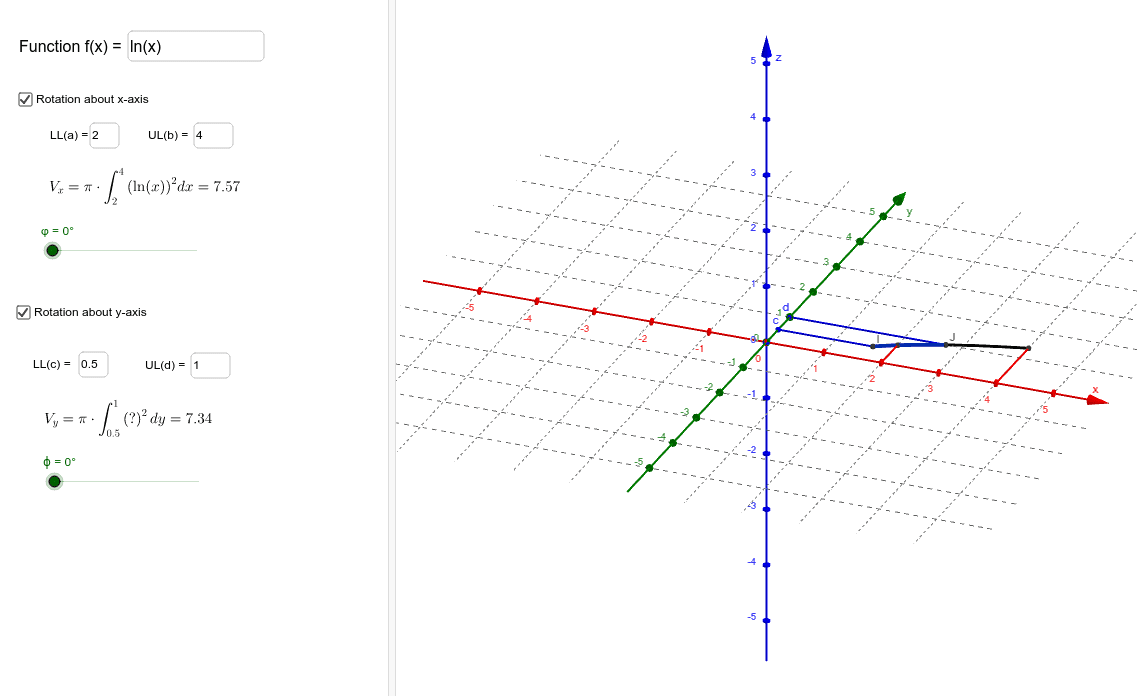
This GeoGebra example demonstrates the calculation of volumes using integration techniques, specifically focusing on solids with equilateral triangular cross-sections. The core mathematical concepts involved include calculus, integral calculus, limits, polynomial functions, and geometric volume properties. In terms of construction, it utilizes GeoGebra commands such as Textfield for input fields, CurveCartesian for curve plotting, Ray and Intersect for geometric intersections, Segment for line segments, Surface for creating surfaces, and Invert for transformations. Objects include function definitions, parameters like a and b, geometric points like A, B, G, and volume-related variables like V_x and V_y. This example is suitable for university-level calculus students or math enthusiasts seeking to visualize volume computation processes.
GeoGebra Commands & Parameters
Textfield(f) → FunctionTextfield(a) → Textfeld2Textfield(b) → Textfeld3CurveCartesian(t, (f(t) * cos(φ)), (f(t) * sin(φ)), t, a, b) → k_xRay((0, c), Vector[(1, 0)]) → g_1Intersect(f, g_1, (1, f(1))) → IRay((0, d), Vector[(1, 0)]) → g_2Intersect(f, g_2, (d, f(d))) → JCurveCartesian((t * cos(ϕ)), f(t), (t * sin(ϕ)), t, x(I), x(J)) → k_yCurveCartesian(t, f(t), 0, t, -5, 5) → kTextfield(c) → Textfeld4Textfield(d) → Textfeld5Segment(A, G) → s_1Segment(B, F) → s_2Surface(u, (f(u) * cos(w)), (f(u) * sin(w)), u, a, b, w, 0, φ) → f_xSurface((uu * cos(ww)), f(uu), (uu * sin(ww)), uu, x(I), x(J), ww, 0, ϕ) → f_yInvert(f) → f_uSegment(C, I) → s_3Segment(D, J) → s_4CurveCartesian(x(B), t, t, y(B), f(x(B))) → LineCapRightCurveCartesian(x(A), t, t, y(A), f(x(A))) → LineCapLeftSurface(x(A), y(A) + ((s * (f(x(A)) - y(A))) * cos(t)), ((s * (f(x(A)) - y(A))) * sin(t)), s, 0, 1, t, 0, φ) → CapLeftSurface(x(B), y(B) + ((s * (f(x(B)) - y(B))) * cos(t)), ((s * (f(x(B)) - y(B))) * sin(t)), s, 0, 1, t, 0, φ) → CapRightCurveCartesian(t, y(C), t, x(C), f_u(y(C))) → LineCapBottomCurveCartesian(t, y(D), t, x(D), f_u(y(D))) → LineCapTop