
Calculating Area of Rhombus
Loading the math board and drawing, please wait…
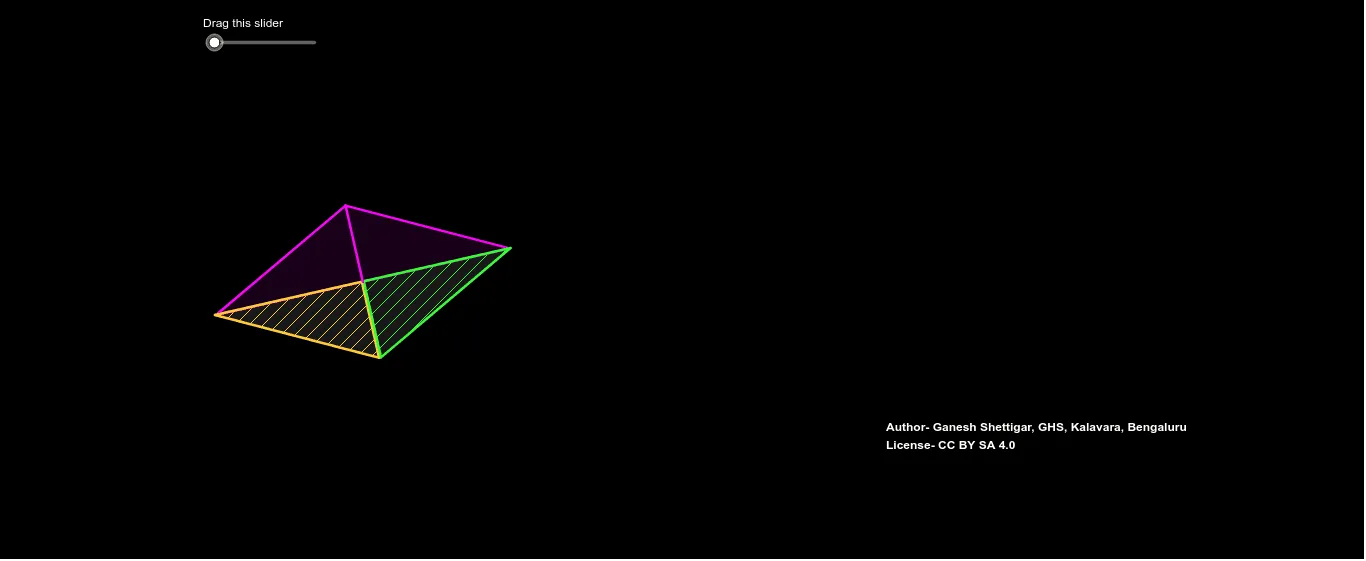
This example demonstrates how to calculate the area of a rhombus by constructing its diagonals. Key math concepts include the geometric properties of rhombuses, the diagonals being perpendicular bisectors, the Pythagorean theorem, and trigonometric functions. GeoGebra commands/objects used in construction are Segment, LineBisector, Intersect, Point, Circle, Polygon, Vector, Translate, Line, OrthogonalLine, and Mirror. Suitable for high school students learning and understanding the derivation of the rhombus area formula, as well as geometric construction teaching.
GeoGebra Commands & Parameters
Segment(A, B) → aLineBisector(a) → bIntersect(b, a) → CPoint(b) → DCircle(C, D) → cIntersect(c, b, 2) → EPolygon(A, C, E) → poly2, e_1, a_2, c_1Polygon(C, B, E) → poly3, e_2, c_2, b_2Polygon(D, A, B) → poly1, b_1, d, a_1Vector(A, ((r * x(D)), (r * y(D)))) → uTranslate(A, u) → A'Translate(C, u) → C'_1Translate(E, u) → E'_1Polygon(A', C'_1, E'_1) → poly2', e', a', c'Line(D, B) → eTranslate(B, u) → B'_1Vector(B, B'_1) → vOrthogonalLine(B, d) → fMirror(B'_1, f) → B''Vector(B, B'') → wTranslate(C, w) → C'Translate(B, w) → B'Translate(E, w) → E'Polygon(C', B', E') → poly3', e'_1, c'_1, b'Segment(D, C) → gOrthogonalLine(F, b') → hCircle(F, (0.1 * b')) → kIntersect(k, h) → G, HLine(H, b') → iCircle(H, (0.5 * b')) → pIntersect(p, i) → I, JVector(H, J) → zVector(H, I) → jCircle(D, (0.1 * b')) → qIntersect(q, b) → K, LLine(L, e') → lCircle(L, e') → sIntersect(s, l) → M, NVector(L, M) → mVector(L, N) → n
AI Drawing Prompt Reference
Draw a rhombus and demonstrate its area calculation. Start by constructing the two diagonals of the rhombus, which are perpendicular bisectors of each other. Use the endpoints of one diagonal as centers to draw circles, and connect their intersection with the diagonal's midpoint to form the rhombus. Then, create a translated copy of the rhombus using vectors, and add relevant auxiliary lines and circles. Finally, visually demonstrate the derivation of the area formula, incorporating the Pythagorean theorem and trigonometric functions.
The prompt above was compiled from the original drawing commands and is for reference only.