
Boat Coordinate Game
Loading the math board and drawing, please wait…
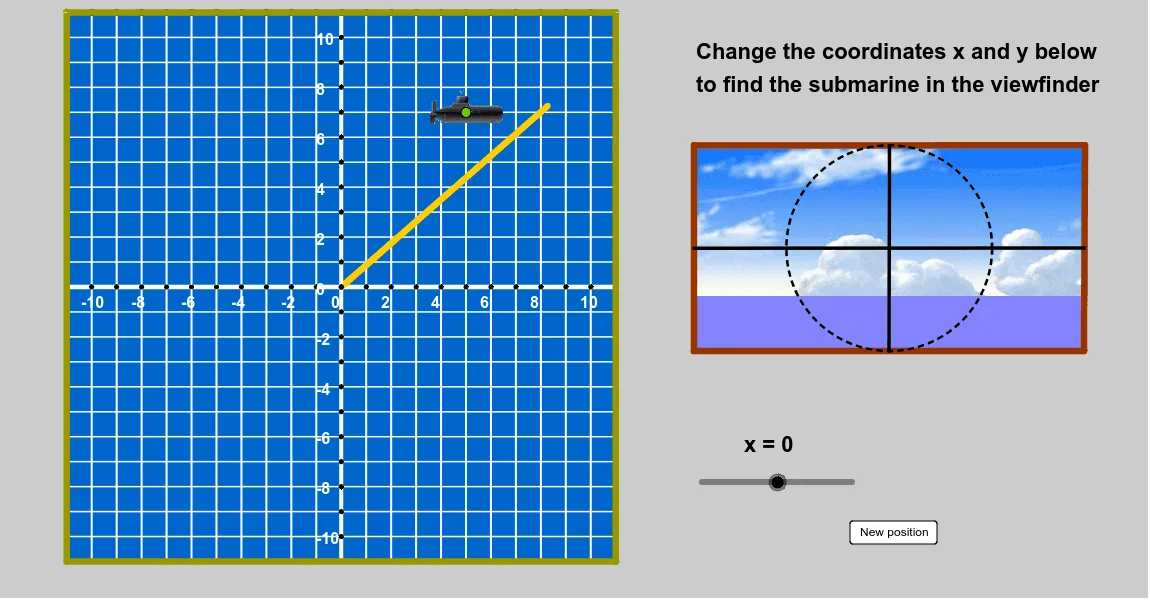
This example demonstrates coordinate system usage through a submarine searching game. Core math concepts include coordinate position determination, equilateral triangles, circles, exponential functions, random experiments, and integral calculus. Construction highlights the use of GeoGebra commands/objects like Random, Circle, Ray, OrthogonalLine, Intersect, CircumcircleArc, Midpoint, Sequence, If, Segment, Polygon, Line, Rotate, Mod, Point. Suitable for middle school and above students for coordinate learning and practice.
GeoGebra Commands & Parameters
Random(-10, 10) → bbRandom(-10, 10) → aaRandom(-10, 10) → ccRandom(4, 15) → rrCircle(A, (1.5 * v - 1) * rr) → c'Ray(A, (0, 0)) → aOrthogonalLine(A, a) → bIntersect(c', b) → B, CIntersect(c', a) → D, TCircumcircleArc(B, D, C) → dMidpoint(C, D) → EMidpoint(B, D) → F_2Ray(A', E) → eRay(A', F_2) → fIntersect(d, e) → G,Intersect(d, f) → H,CircumcircleArc(G, D, H) → gCircle(I, 1) → hSequence(Text[If[s < 10, " ", ""] + (s), (21.6 + 2 * Mod[s - 1, 3], 7.75 - 2 * Div[s - 1, 3])], s, 1, 12) → liste3Circle(J, 1) → kSequence(Text[If[s ≟ 1, " ", If[s < 5, " ", ""]] + (30 * (s - 1)) + "º", (21.25 + 2 * Mod[s - 1, 3], -6.25 - 2 * Div[s - 1, 3])], s, 1, 12) → liste4If(yB > -5, 5*°, (((xB - 3 * yB) / 2 - 19 - 1) * 30)°) → angIf(ang ≟ α ∧ dist ≟ rr, true, false) → razSegment(O, N) → mCircle(A, (2 * v - 1) * rr - n) → pSequence(Circle[A, (1.5 * v - 1) * rr - i], i, 0, n, n / 10) → liste5Polygon(P, Q, R, S) → poly1, p_1, q, r_1, sCircle((0, 0), If[2 * v * rr > 12, 0, 2 * v * rr]) → cMidpoint(K, L) → UMidpoint(U, L) → VMidpoint(U, V) → WMidpoint(V, L) → ZSegment(K, C_1) → lLine(A, l) → iSegment(A, U) → tIntersect(c, t) → A_1, B_1Segment(U, A_1) → a_1Rotate(C_1, 6 * v, U) → L'Segment(U, L') → b_1Mod(v * 100, 2) → abSegment(O, D_1) → jCircle(O, C_1) → g_1Point(g_1) → E_1Segment(O, E_1) → h_1Circle(F_1, 6.5 - abs(r / 4.5)) → q_1Line(F_1, l) → i_1Intersect(q_1, i_1) → G_1, H_1Line(J_1, r_1) → j_1Point(j_1) → N_1Line(N_1, l) → l_1Line(J_1, l) → m_1Point(m_1) → O_1Point(l_1) → P_1Intersect(l_1, r_1) → M_1Polygon(M_1, N_1, J_1, F) → poly2, m_2, n_1, j_2, f_2Point(l_1) → Q_1Point(m_1) → R_1Polygon(P_1, Q_1, R_1, O_1) → poly3, p_2, q_2, r_2, o_1Point(j_1) → S_1Polygon(S_1, T_1, O_1, J_1) → poly4, s_1, t_1, o_2, j_3Midpoint(s_1) → V_1Midpoint(o_2) → W_1Midpoint(S_1, J_1) → Z_1Midpoint(t_1) → A_2Segment(V_1, W_1) → a_2Segment(Z_1, A_2) → b_2Intersect(b_2, a_2) → B_2Circle(B_2, V_1) → c_2Sequence((x(O) + i, y(D_1)), i, -11, 11, 1) → liste1Sequence((x(N) + i, y(N)), i, -11, 11, 1) → liste6Sequence((x(C_1), y(C_1) + i), i, -11, 11, 1) → liste7Sequence((x(E_1), y(E_1) + i), i, -11, 11, 1) → liste8Ray(M_1, T_1) → c_1Sequence(Segment[Element[liste8, i], Element[liste7, i]], i, 0, 22) → liste10Sequence((x(D_1) + i, 0), i, -11, 11) → liste2Sequence(Segment[Element[liste1, i], Element[liste6, i]], i, 0, 22) → liste9Line(S, P) → d_1Line(J_1, S_1) → e_1Line(Q_1, e_1) → f_1Intersect(d_1, s) → MIntersect(d_1, f_1) → C_2Line(R, d_1) → k_1Intersect(e_1, k_1) → D_2Polygon(S, C_2, Q_1, S_1, D_2, R) → poly5, s_2, c_3, q_3, s_3, d_2, r_3Point(d_1) → E_2Line(E_2, p_1) → e_2Intersect(k_1, e_2) → G_2Polygon(E_2, P, Q, G_2) → poly6, e_3, p_3, q_4, g_2Sequence(O + (i, 0), i, -10, 10) → liste11Sequence(O + (0, i), i, -10, 10) → liste12Sequence(i, i, -10, 10) → liste13Sequence(Text[Element[liste13, i], (x(Element[liste11, i] - 0.42), y(Element[liste11, i] - 0.85))], i, 1, Length[liste13], 2) → liste14Sequence(Text[Element[liste13, i], (x(Element[liste12, i] - 1), y(Element[liste12, i] - 0.31))], i, 1, Length[liste13], 2) → liste15