
Basic Sine, Cosine, and Tangent Introduction
Loading the math board and drawing, please wait…
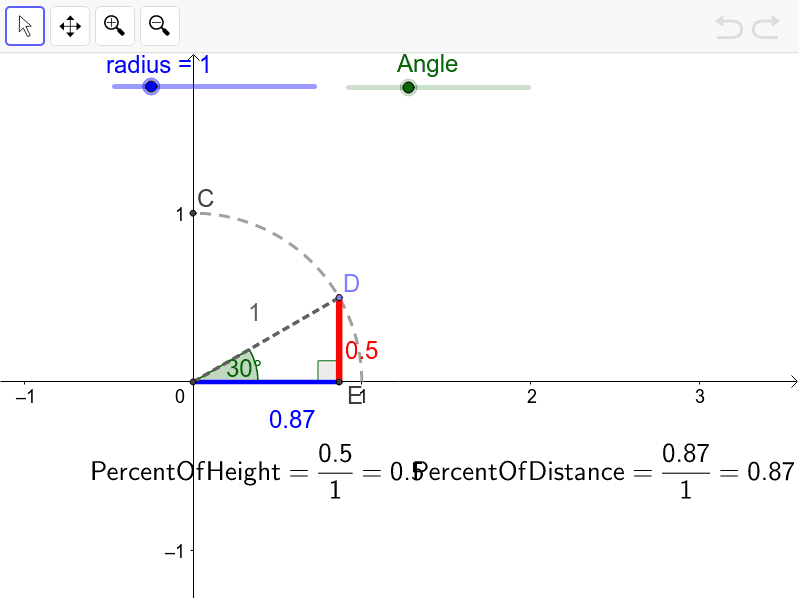
①This example dynamically demonstrates the definitions and geometric meanings of the three basic trigonometric functions—sine, cosine, and tangent—using a unit circle and right triangles, showing how function values change as the angle varies. ②Core mathematical concepts include trigonometric definitions, similar triangles, the unit circle, angle-radian correspondence, and the relationship between side ratios in right triangles and function values. ③Construction highlights: using GeoGebra commands such as Intersect to find circle-line intersections, CircleArc to draw arcs, OrthogonalLine to create perpendiculars for right triangles, Segment to connect key sides, Angle to mark angles, and Line for reference lines; objects include radius, angles α, β, γ, δ, points A–H, and segments a–j, with sliders to adjust angles and observe value changes. ④Suitable for high school or pre-university students learning trigonometry, and useful for classroom demonstrations or self-exploration to build an intuitive bridge from geometry to functions.
GeoGebra Commands & Parameters
Intersect(xAxis, yAxis) → ACircleArc(A, B, C) → cOrthogonalLine(D, xAxis) → aIntersect(a, xAxis) → ESegment(D, E) → bSegment(E, A) → dOrthogonalLine(B, xAxis) → eSegment(A, D) → fAngle(E, A, D) → αLine(A, D) → gIntersect(e, g) → FSegment(F, A) → hSegment(A, B) → iSegment(F, B) → jAngle(D, E, A) → γIntersect(e, j) → GIntersect(xAxis, e) → HAngle(F, H, A) → δ
AI Drawing Prompt Reference
Draw a unit circle and a right triangle to illustrate the definitions of sine, cosine, and tangent. First, draw the unit circle and select three points A, B, and C on it to draw an arc c. Then, draw a vertical line a from point D, intersecting the x-axis at E, and connect DE and EA to form segments b and d. Draw a vertical line e from point B, connect AD to form segment f, and mark the angle ∠EAD as α. Draw a reference line g, intersecting e at F, and connect FA and AB to form segments h and i, and FB to form segment j, marking the angle ∠EDA as γ. Finally, draw the intersection G of e and j, and the intersection H of the x-axis and e, and mark the angle ∠FAH as δ.
The prompt above was compiled from the original drawing commands and is for reference only.