
ASA Triangle Congruence Theorem: Dynamic Illustration
Loading the math board and drawing, please wait…
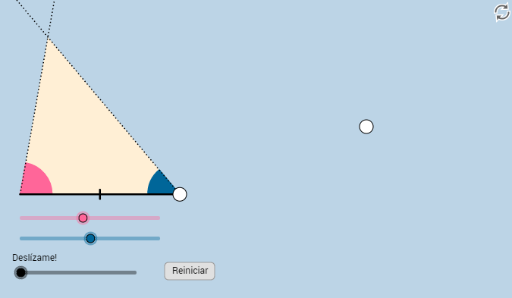
This example dynamically illustrates the ASA (Angle-Side-Angle) Triangle Congruence Theorem. It involves core mathematical concepts such as triangle congruence criteria, angle measurement, and geometric transformations. The construction utilizes GeoGebra commands like Rotate, Angle, Ray, Point, Intersect, Polygon, Segment, Min, Circle, CircleSector, Dilate, Vector, Translate, and Line. It is suitable for high school mathematics education to visually understand geometric theorems and transformation applications.
GeoGebra Commands & Parameters
Rotate(B, α, A) → B'Angle(B, A, B') → βRay(A, B') → fPoint(f) → CRotate(A, (-γ), B) → A'Angle(A', B, A) → δRay(B, A') → gIntersect(f, g) → DPolygon(A, B, D) → poly1, d, a_1, bSegment(A, B) → hSegment(D, B) → iSegment(D, A) → jMin({h, i, j}) → cCircle(A, (0.2 * c)) → eCircle(B, (0.2 * c)) → kIntersect(e, h) → E,Intersect(e, j) → F, IIntersect(k, h) → G,Intersect(k, i) → H, JCircleSector(A, E, F) → pCircleSector(B, H, G) → qRotate(K, β, L) → K'Angle(K, L, K') → εCircle(L, h) → rRay(L, K) → mIntersect(r, m, 1) → MRay(L, K') → nRotate(L, (-γ), M) → L'Angle(L', M, L) → ζRay(M, L') → sIntersect(n, s) → NDilate(A, If[0 < l ≤ 1, 1 - l, 0], L) → A'_1Vector(A, A'_1) → uTranslate(p, u) → p'Line(L, h) → tTranslate(F, u) → F'Point(t) → OAngle(M, L, O) → ηRotate(p', If[1 < l ≤ 2, ((-(l - 1)) * η), (-η)], L) → p''Point(t) → PAngle(P, L, M) → θDilate(B, If[2 < l ≤ 3, 3 - l, 0], L) → B'_1Vector(B, B'_1) → vTranslate(A, v) → A'_2Translate(B, v) → B'_2Segment(A'_2, B'_2) → h'Rotate(A'_2, If[3 < l ≤ 4, ((l - 3) * θ), θ], L) → QRotate(B'_2, If[3 < l ≤ 4, ((l - 3) * θ), θ], L) → RSegment(Q, R) → h''Dilate(B, If[4 < l ≤ 5, 5 - l, 0], M) → B'_3Vector(B, B'_3) → wTranslate(q, w) → q'Line(M, g) → f_1Point(f_1) → SAngle(N, M, S) → τRotate(q', If[5 < l ≤ 6, ((l - 5) * ((2 * π) - τ)), (2 * π) - τ], M) → q''Dilate(B, If[6 < l ≤ 7, 7 - l, 0], M) → B'_4Vector(B, B'_4) → u_1Translate(A, u_1) → A'_3Translate(B, u_1) → B'_5Translate(D, u_1) → D'Polygon(A'_3, B'_5, D') → poly1', d', a'_3, b'_5Rotate(A'_3, If[7 < l ≤ 8, ((-(l - 7)) * τ), (-τ)], M) → TRotate(B'_5, If[7 < l ≤ 8, ((-(l - 7)) * τ), (-τ)], M) → URotate(D', If[7 < l ≤ 8, ((-(l - 7)) * τ), (-τ)], M) → D''Polygon(T, U, D'') → poly1'', d'', t_1, u_2