
Arrange fractions, decimals, and percents
Loading the math board and drawing, please wait…
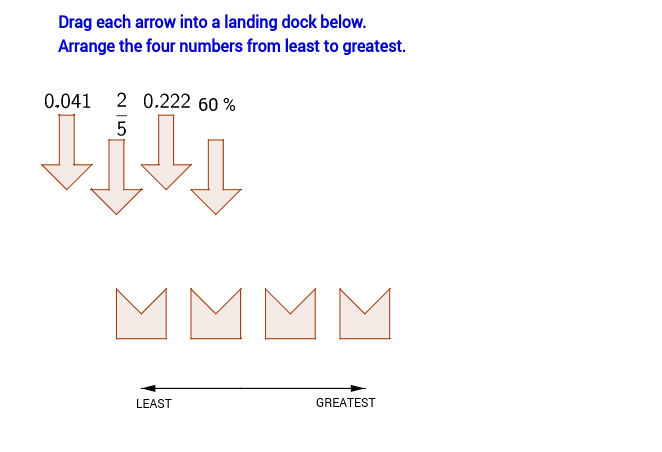
This GeoGebra example demonstrates the process of arranging four numbers, including fractions, decimals, and percents, from least to greatest, using interactive visualization to enhance numerical comparison skills. The core math concepts involved include conversion between different numerical representations, ordering of values, logical reasoning, and mental math techniques. In terms of construction, the summary indicates the use of commands such as OrthogonalLine, Line, Intersect, Vector, Mirror, Polygon, Translate, Segment, Point, and If, generating objects like points, segments, and polygons (e.g., A, B, C_2) to create graphical aids for the arrangement task. It is suitable for elementary or middle school mathematics education, aimed at reinforcing number sense and comparative abilities.
GeoGebra Commands & Parameters
OrthogonalLine(A, xAxis) → bLine(C_2, B_2) → cIntersect(b, c) → D_2Vector((x(A), y(A)), (x(A) + a, y(A) + a)) → uLine(J, xAxis) → fOrthogonalLine(B, f) → gIntersect(f, g) → KMirror(L, g) → L'Mirror(J, g) → J'Mirror(M, g) → FLine(O, xAxis) → hOrthogonalLine(C, h) → iIntersect(h, i) → PMirror(Q, i) → Q'Mirror(O, i) → O'Mirror(R, i) → GPolygon(A, B_2, E_2, E, G_2, F_2, C_2) → poly1, a_1, b_1, e_1, h_1, g_1, f_1, c_1Polygon(C, O', Q', G, R, Q, O) → poly2, n, o', q', r', r, q, oPolygon(B, J', L', F, M, L, J) → poly3, i_1, j', l', m', m, l, jLine(T, xAxis) → kOrthogonalLine(D, k) → pIntersect(k, p) → UMirror(V, p) → V'Mirror(T, p) → T'Mirror(W, p) → HPolygon(D, T', V', H, W, V, T) → poly4, s, t', v', w', w, v, tLine(A_1, xAxis) → d_1OrthogonalLine(Z, d_1) → j_1Intersect(d_1, j_1) → C_1Mirror(A_1, j_1) → D_1Mirror(B_1, j_1) → E_1Vector((0, 0), (z, 0)) → u_1Translate(A_1, u_1) → F_1Translate(B_1, u_1) → G_1Translate(Z, u_1) → Z'Translate(E_1, u_1) → H_1Translate(D_1, u_1) → I_1Translate(F_1, u_1) → J_1Translate(G_1, u_1) → K_1Translate(Z', u_1) → Z''Translate(H_1, u_1) → L_1Translate(I_1, u_1) → M_1Translate(J_1, u_1) → N_1Translate(K_1, u_1) → O_1Translate(Z'', u_1) → Z'''Translate(L_1, u_1) → P_1Translate(M_1, u_1) → Q_1Polygon(Z, A_1, B_1, E_1, D_1) → poly5, z_1, a_2, b_2, e_2, d_2Polygon(Z', F_1, G_1, H_1, I_1) → poly6, z', f_2, g_2, h_2, i_2Polygon(Z'', J_1, K_1, L_1, M_1) → poly7, z'', j_2, k_1, l_1, m_1Polygon(Z''', N_1, O_1, P_1, Q_1) → poly8, z''', n_1, o_1, p_1, q_1Segment(R_1, S_1) → r_1Point(r_1) → T_1Vector(T_1, S_1) → v_1Vector(T_1, R_1) → w_1If(decimal > fracadjusted, 1, 0) → Ascore_1If(decimal > decimaltwo, 1, 0) → Ascore_2If(decimal > percentadjusted, 1, 0) → Ascore_3If(fracadjusted > decimal, 1, 0) → Bscore_1If(fracadjusted > decimaltwo, 1, 0) → Bscore_2If(fracadjusted > percentadjusted, 1, 0) → Bscore_3If(decimaltwo > decimal, 1, 0) → Cscore_1If(decimaltwo > fracadjusted, 1, 0) → Cscore_2If(decimaltwo > percentadjusted, 1, 0) → Cscore_3