
Area of Rectangles and Squares by Enhmunh
Loading the math board and drawing, please wait…
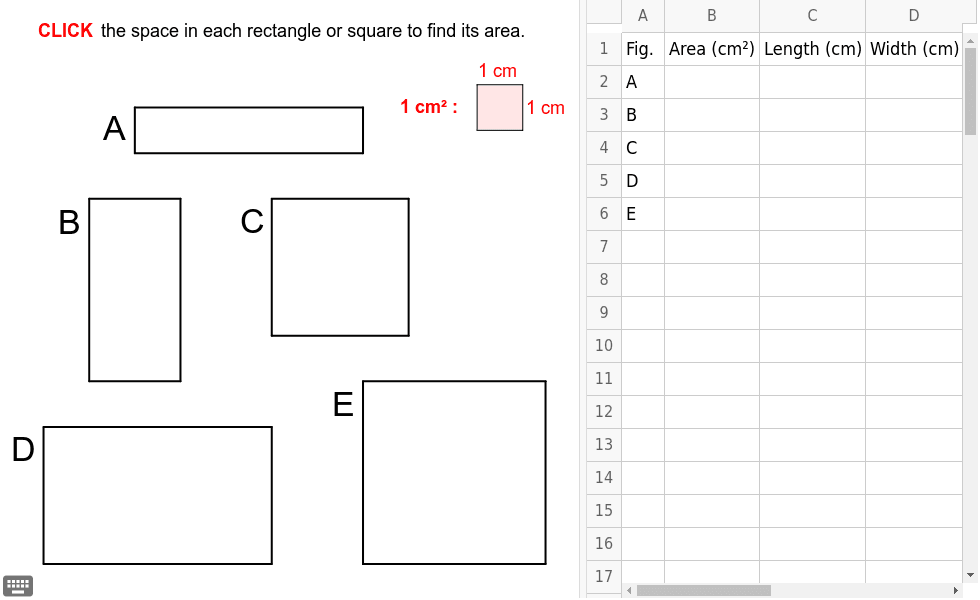
Explore the formula for the area of a rectangle by tessellating its space using unit squares. This example demonstrates how to calculate the area of a rectangle by counting the number of unit squares that fit within it. Key math concepts include area, rectangle, square, and unit square. It is constructed using GeoGebra's Polygon and Segment commands. Suitable for middle school mathematics education to help students visually understand the derivation of the area formula.
GeoGebra Commands & Parameters
Polygon((2, 0), (3, 0), (3, 1), (2, 1)) → sqr_1, a_1, b_1, c_1, d_1Polygon((3, 0), (4, 0), (4, 1), (3, 1)) → sqr_2, a_2, b_2, c_2, d_2Polygon((4, 0), (5, 0), (5, 1), (4, 1)) → sqr_3, a_3, b_3, c_3, d_3Polygon((5, 0), (6, 0), (6, 1), (5, 1)) → sqr_4, a_4, b_4, c_4, d_4Polygon((6, 0), (7, 0), (7, 1), (6, 1)) → sqr_5, a_5, b_5, c_5, d_5Polygon((1, -2), (2, -2), (2, -1), (1, -1)) → sqr_6, a_6, b_6, c_6, d_6Polygon((2, -2), (3, -2), (3, -1), (2, -1)) → sqr_7, a_7, b_7, c_7, d_7Polygon((1, -3), (2, -3), (2, -2), (1, -2)) → sqr_8, a_8, b_8, c_8, d_8Polygon((2, -3), (3, -3), (3, -2), (2, -2)) → sqr_9, a_9, b_9, c_9, d_9Polygon((1, -4), (2, -4), (2, -3), (1, -3)) → sqr_{10}, a_{10}, b_{10}, c_{10}, d_{10}Polygon((2, -4), (3, -4), (3, -3), (2, -3)) → sqr_{11}, a_{11}, b_{11}, c_{11}, d_{11}Polygon((1, -5), (2, -5), (2, -4), (1, -4)) → sqr_{12}, a_{12}, b_{12}, c_{12}, d_{12}Polygon((2, -5), (3, -5), (3, -4), (2, -4)) → sqr_{13}, a_{13}, b_{13}, c_{13}, d_{13}Polygon((5, -2), (6, -2), (6, -1), (5, -1)) → sqr_{14}, a_{14}, b_{14}, c_{14}, d_{14}Polygon((6, -2), (7, -2), (7, -1), (6, -1)) → sqr_{15}, a_{15}, b_{15}, c_{15}, d_{15}Polygon((7, -2), (8, -2), (8, -1), (7, -1)) → sqr_{16}, a_{16}, b_{16}, c_{16}, d_{16}Polygon((5, -3), (6, -3), (6, -2), (5, -2)) → sqr_{17}, a_{17}, b_{17}, c_{17}, d_{17}Polygon((6, -3), (7, -3), (7, -2), (6, -2)) → sqr_{18}, a_{18}, b_{18}, c_{18}, d_{18}Polygon((7, -3), (8, -3), (8, -2), (7, -2)) → sqr_{19}, a_{19}, b_{19}, c_{19}, d_{19}Polygon((5, -4), (6, -4), (6, -3), (5, -3)) → sqr_{20}, a_{20}, b_{20}, c_{20}, d_{20}Polygon((6, -4), (7, -4), (7, -3), (6, -3)) → sqr_{21}, a_{21}, b_{21}, c_{21}, d_{21}Polygon((7, -4), (8, -4), (8, -3), (7, -3)) → sqr_{22}, a_{22}, b_{22}, c_{22}, d_{22}Polygon((0, -7), (1, -7), (1, -6), (0, -6)) → sqr_{23}, a_{23}, b_{23}, c_{23}, d_{23}Polygon((1, -7), (2, -7), (2, -6), (1, -6)) → sqr_{24}, a_{24}, b_{24}, c_{24}, d_{24}Polygon((2, -7), (3, -7), (3, -6), (2, -6)) → sqr_{25}, a_{25}, b_{25}, c_{25}, d_{25}Polygon((3, -7), (4, -7), (4, -6), (3, -6)) → sqr_{26}, a_{26}, b_{26}, c_{26}, d_{26}Polygon((4, -7), (5, -7), (5, -6), (4, -6)) → sqr_{27}, a_{27}, b_{27}, c_{27}, d_{27}Polygon((0, -8), (1, -8), (1, -7), (0, -7)) → sqr_{28}, a_{28}, b_{28}, c_{28}, d_{28}Polygon((1, -8), (2, -8), (2, -7), (1, -7)) → sqr_{29}, a_{29}, b_{29}, c_{29}, d_{29}Polygon((2, -8), (3, -8), (3, -7), (2, -7)) → sqr_{30}, a_{30}, b_{30}, c_{30}, d_{30}Polygon((3, -8), (4, -8), (4, -7), (3, -7)) → sqr_{31}, a_{31}, b_{31}, c_{31}, d_{31}Polygon((4, -8), (5, -8), (5, -7), (4, -7)) → sqr_{32}, a_{32}, b_{32}, c_{32}, d_{32}Polygon((0, -9), (1, -9), (1, -8), (0, -8)) → sqr_{33}, a_{33}, b_{33}, c_{33}, d_{33}Polygon((1, -9), (2, -9), (2, -8), (1, -8)) → sqr_{34}, a_{34}, b_{34}, c_{34}, d_{34}Polygon((2, -9), (3, -9), (3, -8), (2, -8)) → sqr_{35}, a_{35}, b_{35}, c_{35}, d_{35}Polygon((3, -9), (4, -9), (4, -8), (3, -8)) → sqr_{36}, a_{36}, b_{36}, c_{36}, d_{36}Polygon((4, -9), (5, -9), (5, -8), (4, -8)) → sqr_{37}, a_{37}, b_{37}, c_{37}, d_{37}Polygon((7, -6), (8, -6), (8, -5), (7, -5)) → sqr_{38}, a_{38}, b_{38}, c_{38}, d_{38}Polygon((8, -6), (9, -6), (9, -5), (8, -5)) → sqr_{39}, a_{39}, b_{39}, c_{39}, d_{39}Polygon((9, -6), (10, -6), (10, -5), (9, -5)) → sqr_{40}, a_{40}, b_{40}, c_{40}, d_{40}Polygon((10, -6), (11, -6), (11, -5), (10, -5)) → sqr_{41}, a_{41}, b_{41}, c_{41}, d_{41}Polygon((7, -7), (8, -7), (8, -6), (7, -6)) → sqr_{42}, a_{42}, b_{42}, c_{42}, d_{42}Polygon((8, -7), (9, -7), (9, -6), (8, -6)) → sqr_{43}, a_{43}, b_{43}, c_{43}, d_{43}Polygon((9, -7), (10, -7), (10, -6), (9, -6)) → sqr_{44}, a_{44}, b_{44}, c_{44}, d_{44}Polygon((10, -7), (11, -7), (11, -6), (10, -6)) → sqr_{45}, a_{45}, b_{45}, c_{45}, d_{45}Polygon((7, -8), (8, -8), (8, -7), (7, -7)) → sqr_{46}, a_{46}, b_{46}, c_{46}, d_{46}Polygon((8, -8), (9, -8), (9, -7), (8, -7)) → sqr_{47}, a_{47}, b_{47}, c_{47}, d_{47}Polygon((9, -8), (10, -8), (10, -7), (9, -7)) → sqr_{48}, a_{48}, b_{48}, c_{48}, d_{48}Polygon((10, -9), (11, -9), (11, -8), (10, -8)) → sqr_{49}, a_{49}, b_{49}, c_{49}, d_{49}Polygon((7, -9), (8, -9), (8, -8), (7, -8)) → sqr_{50}, a_{50}, b_{50}, c_{50}, d_{50}Polygon((8, -9), (9, -9), (9, -8), (8, -8)) → sqr_{51}, a_{51}, b_{51}, c_{51}, d_{51}Polygon((9, -9), (10, -9), (10, -8), (9, -8)) → sqr_{52}, a_{52}, b_{52}, c_{52}, d_{52}Polygon((10, -8), (11, -8), (11, -7), (10, -7)) → sqr_{53}, a_{53}, b_{53}, c_{53}, d_{53}Polygon((9.5, 0.5), (10.5, 0.5), (10.5, 1.5), (9.5, 1.5)) → poly6, f_1, g_1, h_1, i_1Segment((2, 0), (7, 0)) → aSegment((2, 0), (2, 1)) → bSegment((2, 1), (7, 1)) → cSegment((7, 0), (7, 1)) → dSegment((1, -1), (3, -1)) → eSegment((1, -1), (1, -5)) → fSegment((3, -5), (3, -1)) → gSegment((3, -5), (1, -5)) → hSegment((5, -4), (5, -1)) → iSegment((0, -6), (0, -9)) → mSegment((5, -9), (0, -9)) → nSegment((5, -9), (5, -6)) → pSegment((0, -6), (5, -6)) → qSegment((7, -5), (11, -5)) → rSegment((7, -5), (7, -9)) → sSegment((11, -9), (7, -9)) → tSegment((11, -9), (11, -5)) → e_1Segment((5, -1), (8, -1)) → kSegment((8, -4), (8, -1)) → lSegment((5, -4), (8, -4)) → j
AI Drawing Prompt Reference
Draw a rectangle composed of unit squares arranged in a grid. The squares should be placed in a clear pattern to illustrate the concept of area. Ensure the layout is neat and easy to understand. The goal is to visually demonstrate how unit squares combine to form a rectangle.
The prompt above was compiled from the original drawing commands and is for reference only.