
Area Model for Factoring Quadratics
Loading the math board and drawing, please wait…
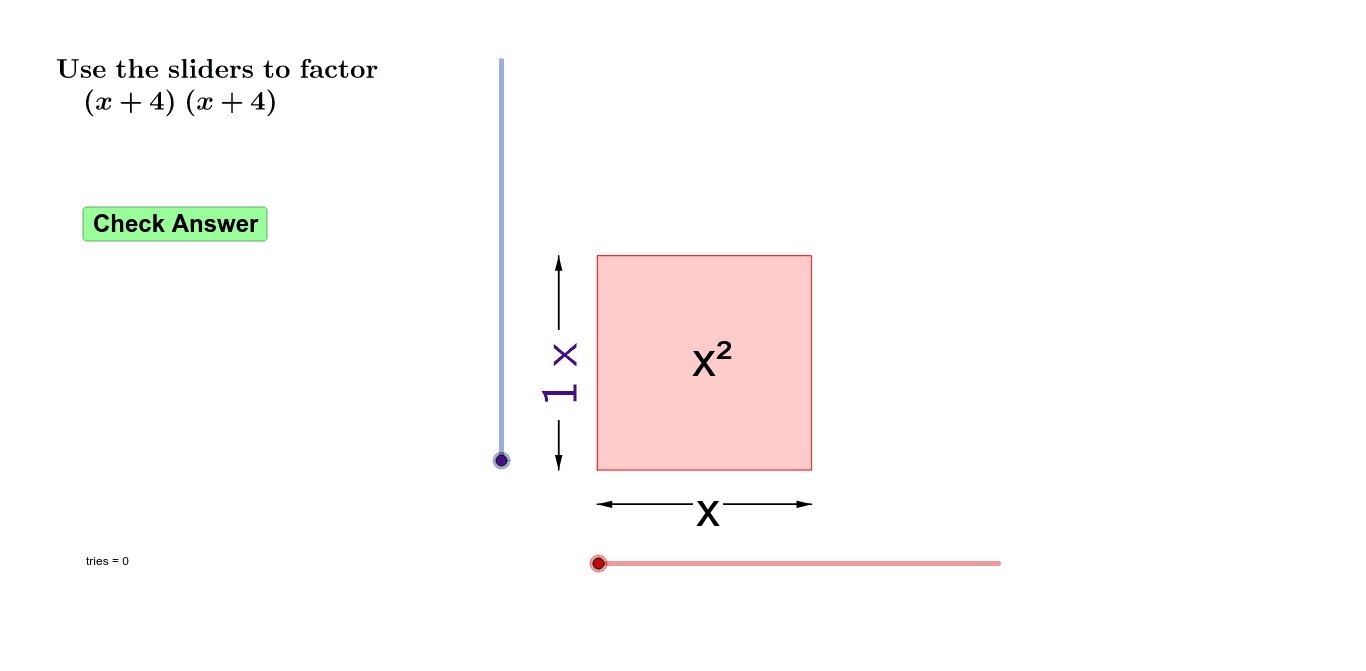
This example demonstrates factoring quadratics using an area model. Interactive sliders allow users to find the factors of a given quadratic expression. Key math concepts include quadratic functions, factoring, and area models. Constructed with GeoGebra commands like LeftSum, Sequence, Text, Simplify, Vector, and objects such as a, b, c, d, width, RectXX, RectY, RectX, Rect1, etc. Suitable for middle school and high school students learning quadratic factoring and area models.
GeoGebra Commands & Parameters
LeftSum(width, 0, width, 1) → RectXXLeftSum(width, width, width + d, d) → RectYSequence(Polygon[(0, width + i), (width, width + i), (width, width + 1 + i), (0, width + 1 + i)], i, 0, b - 1) → RectXSequence(Sequence[Polygon[(width + j, width + i), (width + j + 1, width + i), (width + j + 1, width + 1 + i), (width + j, width + 1 + i)], i, 0, b - 1], j, 0, d - 1) → Rect1Text(x^(2), (width / 2 - 0.3, width / 2 - 0.3)) → text2Sequence(Text[x, (width / 2 - 0.2, width + 0.2 + i)], i, 0, b - 1) → text5Sequence(Text[x, (width + 0.3 + i, width / 2 - 0.3)], i, 0, d - 1) → text3Sequence(Sequence[Text[1, (width + 0.3 + i, width + 0.15 + j)], i, 0, d - 1], j, 0, b - 1) → text4Simplify((a * x) + b) → f1Simplify((c * x) + d) → f2Simplify((f1(x) * f2(x))) → fVector(A, B) → eVector(B, A) → uVerticalText(LaTeX[f1], ((-1.5), width / 2 + 1.7 + (b - 1) / 2 - Max[1 - b, 0] / 2)) → text6Vector(C, D) → vVector(D, C) → wText(LaTeX[f2], (width / 2 - 0.2 + Max[(d - 1) / 2, 0], (-1.3))) → text7Simplify(((x + Random[0, 5]) * (x + Random[0, 5]))) → t