
Area Model for Drug and Medical Testing
Loading the math board and drawing, please wait…
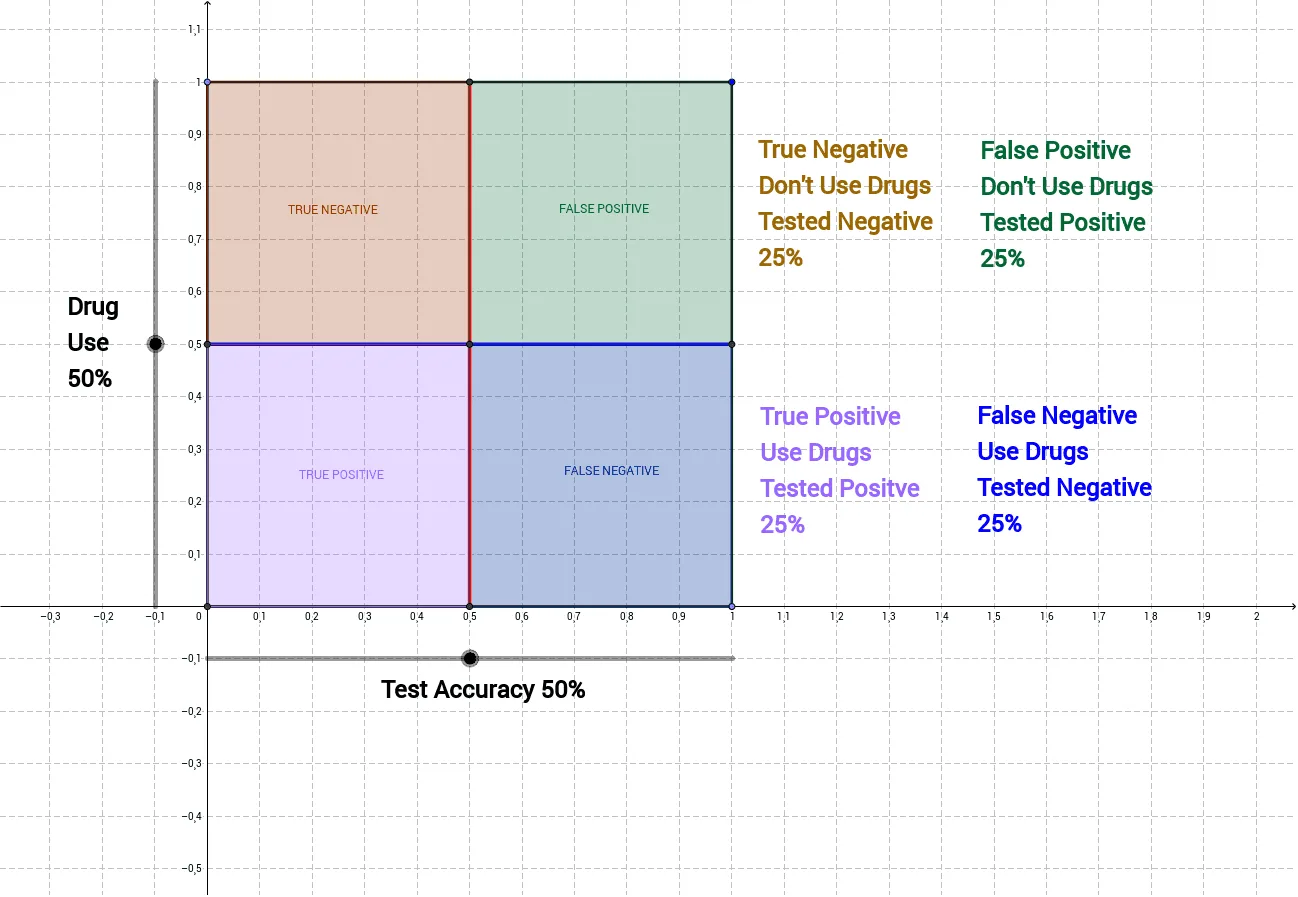
This example demonstrates the probability relationship between drug use and test accuracy using a dynamic area model. Key mathematical concepts include probability statistics, geometric construction, and Hypergeometric Distribution. The construction involves using GeoGebra commands like Intersect, Point, Segment, and Polygon to create objects such as DrugUse, TestAccuracy, and others. Suitable for high school students or college undergraduates to understand the integration of probability and geometry.
GeoGebra Commands & Parameters
Intersect(xAxis, yAxis) → APoint(xAxis) → BPoint(yAxis) → CSegment(C, D) → aSegment(A, C) → bSegment(A, B) → cSegment(D, B) → dIntersect(e, b) → EIntersect(e, d) → FSegment(E, F) → fIntersect(g, c) → GIntersect(g, a) → HSegment(H, G) → hIntersect(h, f) → IPolygon(E, A, G, I) → TRUE_POSITIVE, TRUE_1, a_1, g_1, iPolygon(C, E, I, H) → TRUE_NEGATIVE, c_1, e_1, i_1, h_1Polygon(H, I, F, D) → FALSE_POSITIVE, h_2, i_2, f_1, d_1Polygon(I, G, B, F) → FALSE_NEGATIVE, i_3, g_2, b_1, f_2
AI Drawing Prompt Reference
Draw a probability model for drug and medical testing. Start by drawing the x-axis and y-axis, then create point B on the x-axis and point C on the y-axis. Draw line segments BC, AC, AD, BD, and CD. Find the intersection points E, F, I, and G of the line segments as described, and use them to draw quadrilaterals EAGI, CEFI, HIGF, and IBGF representing true positive, true negative, false positive, and false negative areas, respectively.
The prompt above was compiled from the original drawing commands and is for reference only.