
Area and Perimeter Challenge: Construct Shapes with Given Area and Perimeter
Loading the math board and drawing, please wait…
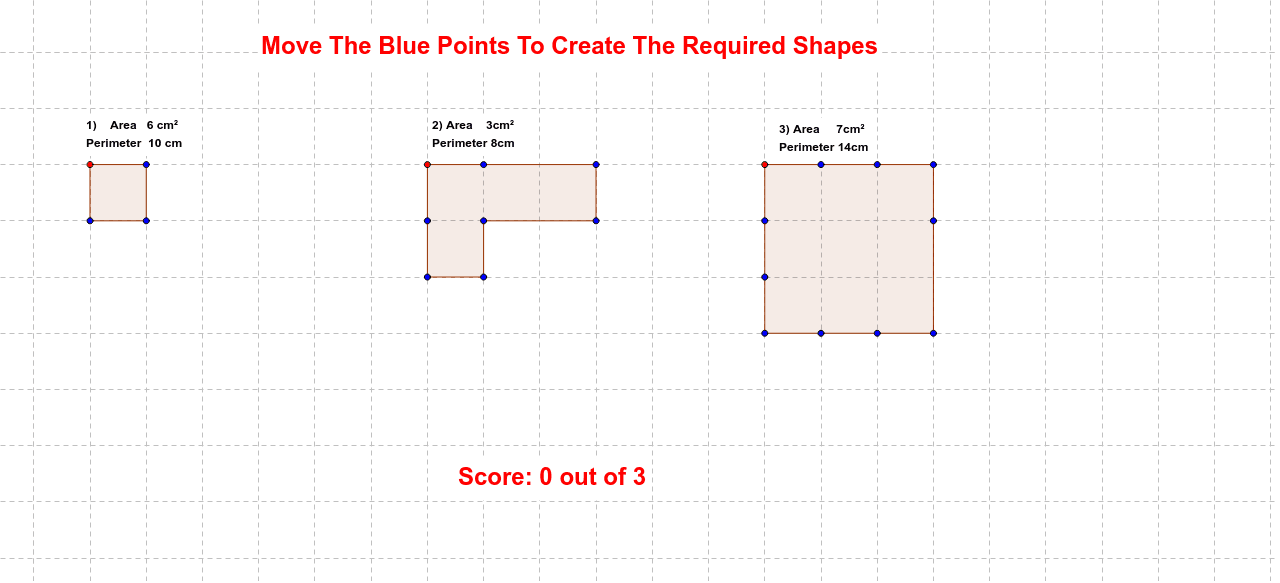
This GeoGebra example demonstrates an interactive challenge in which learners construct plane figures that satisfy prescribed area and perimeter requirements. Core mathematical concepts include polygon area computation, perimeter summation, conditional logic, and piecewise function reasoning. The construction relies on GeoGebra commands such as Polygon to generate shape objects such as poly2 and poly3, Perimeter to compute total side length, If for conditional checks and answer validation, and Sum for aggregating segment values. Relevant objects include points P through W and variables m through w. Suitable for middle school and high school geometry and algebra courses, as well as independent exploration of the relationship between area and perimeter.
GeoGebra Commands & Parameters
Polygon(M, N, W, O, P, Q, R, S, T, U, V) → poly3, m, v, w, n, o, p, q, r, s, t, uPerimeter(poly3) → Perimeter3If(Perimeter3 ≟ 14 ∧ poly3 ≟ 7, 1, 0) → Answer3Polygon(E, F, G, H, I, J, K, L) → poly2, e, f, g, h, i, j, k, lPerimeter(poly2) → Perimeter2If(Perimeter2 ≟ 8 ∧ poly2 ≟ 3, 1, 0) → Answer2Polygon(A, B, C, D) → poly1, a, b, c, dPerimeter(poly1) → Perimeter1If(Perimeter1 ≟ 10 ∧ poly1 ≟ 6, 1, 0) → Answer1Sum(A3:A5) → A2
AI Drawing Prompt Reference
Draw three plane shapes: the first is a triangle with an area of 7, calculated from three vertices; the second is a hexagon with an area of 3, calculated from six vertices; the third is a quadrilateral with an area of 6, calculated from four vertices. Each shape must compute its perimeter and ensure it meets the given conditions. Finally, sum the areas of the three shapes to get the total area.
The prompt above was compiled from the original drawing commands and is for reference only.