
Are They Congruent? #3
Loading the math board and drawing, please wait…
In collections
Congruence
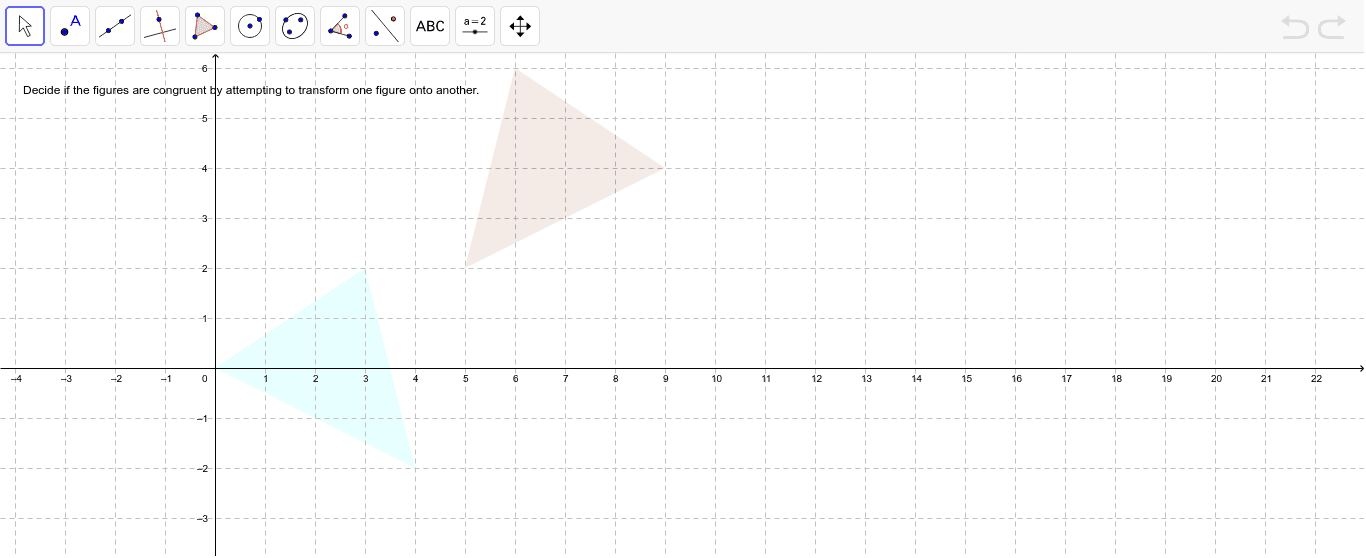
This example demonstrates how to determine if two figures are congruent. The core mathematical concept involved is the congruence of figures. Using GeoGebra commands such as Intersect, Segment, Mirror, etc., two figures can be constructed and their congruence can be determined. Suitable for middle school and above students or teachers.
GeoGebra Commands & Parameters
Intersect(xAxis, yAxis) → BSegment(A, B) → aSegment(C, B) → bSegment(A, C) → cSegment(D, E) → dMirror(A, d) → A'Mirror(B, d) → B'Segment(A', B') → a'Mirror(C, d) → C'Mirror(B, d) → B'_1Segment(C', B'_1) → b'Mirror(A, d) → A'_1Mirror(C, d) → C'_1Segment(A'_1, C'_1) → c'Vector(F, G) → uTranslate(A', u) → A''Translate(B', u) → B''Segment(A'', B'') → a''Translate(C', u) → C''Translate(B'_1, u) → HSegment(C'', H) → b''Translate(A'_1, u) → ITranslate(C'_1, u) → JSegment(I, J) → c''Polygon(A'', C'', B'') → poly1, b''_1, a''_1, c''_1Polygon(B, C, A) → poly2, a_1, b_1, c_1
AI Drawing Prompt Reference
Draw two triangles by first creating a horizontal and a vertical line, then connecting their intersection point to one end of the horizontal line and the other end of the horizontal line to the other end of the vertical line. Next, mirror one triangle across the intersection point of the horizontal and vertical lines to create the second triangle. Then, translate the first triangle along the intersection point to create the third triangle. Finally, complete the second and third triangles and observe the relationships between the four shapes.
The prompt above was compiled from the original drawing commands and is for reference only.