
Angle Investigations: Isosceles Triangles and Angle Relationships
Loading the math board and drawing, please wait…
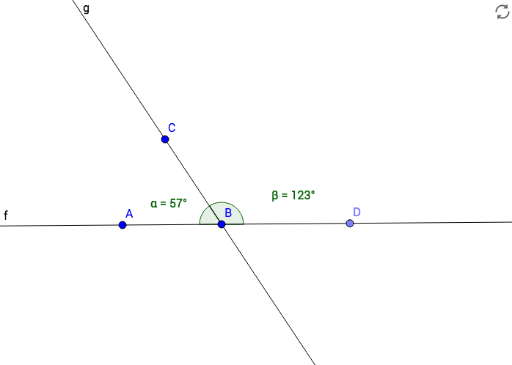
①This GeoGebra example demonstrates how to explore angle relationships within an isosceles triangle by constructing auxiliary lines and observing how angles change dynamically. ②Core mathematical concepts include properties of isosceles triangles (base angles equal), angle measurement, and angle sum/difference relationships, verified through geometric construction. ③Construction details: Based on the summary, the commands used are Line, Angle, and Point, creating objects A, B, f (line), C, g (line), α (angle), D, and β (angle). The construction involves placing points and lines to form an isosceles triangle and its internal angles, allowing dynamic dragging to investigate angle variations. ④This is suitable for middle school geometry lessons or self-study, helping students understand fundamental theorems such as base angle equality and exterior angle relations, and serving as an introductory exercise in geometric construction.
GeoGebra Commands & Parameters
Line(A, B) → fLine(B, C) → gAngle(C, B, A) → αPoint(f) → DAngle(D, B, C) → β