
Angle between two lines: Geometric construction and trigonometric functions
Loading the math board and drawing, please wait…
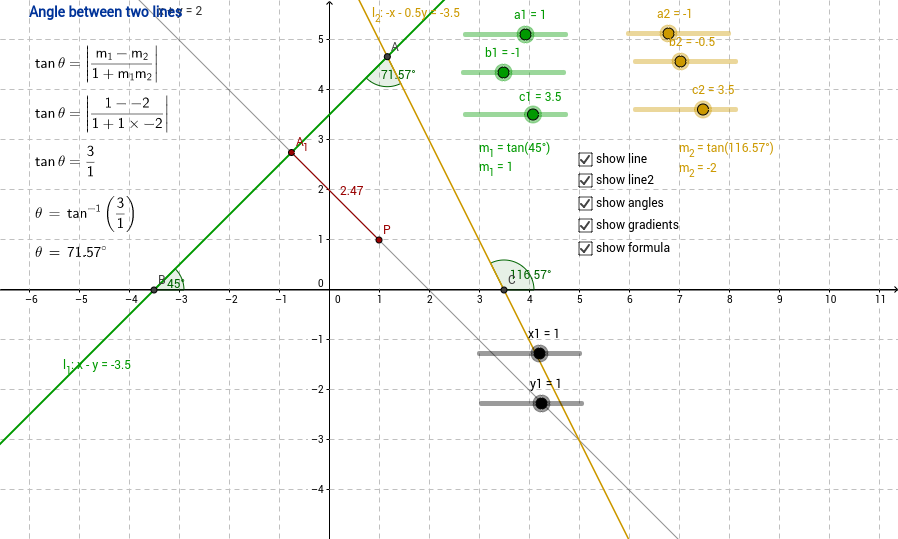
This example demonstrates how to calculate the angle between two lines using geometric construction methods. Key mathematical concepts include angle measurement, trigonometric functions, and coordinate geometry. Construction involves using GeoGebra commands such as OrthogonalLine, Intersect, Segment, and Angle to create lines, find intersection points, draw segments, and compute angles. Suitable for middle school students or high school students learning geometric foundations and trigonometric applications.
GeoGebra Commands & Parameters
OrthogonalLine(P, l_1) → dIntersect(l_1, d) → A_1Segment(A_1, P) → f_1Intersect(xAxis, yAxis) → B_1Point(xAxis) → C_1Line(B_1, C_1) → aIntersect(l_1, l_2) → AIntersect(l_1, a) → BIntersect(l_2, a) → CAngle(C, B, A) → αAngle(B, A, C) → θPoint(a) → GAngle(G, C, A) → β
AI Drawing Prompt Reference
Draw two intersecting lines l1 and l2 with their intersection point A. Construct line a through the intersection of l1 with the x-axis (B1) and the intersection of the x-axis and y-axis (C1). Line a intersects l1 and l2 at points B and C, respectively. Calculate angle α using points A, B, and C, and angle θ using points A, C, and B. Finally, calculate angle β using points A, C, and any point G on line a.
The prompt above was compiled from the original drawing commands and is for reference only.