
Ambiguous Case of Law of Sines by Mark Gentry
Loading the math board and drawing, please wait…
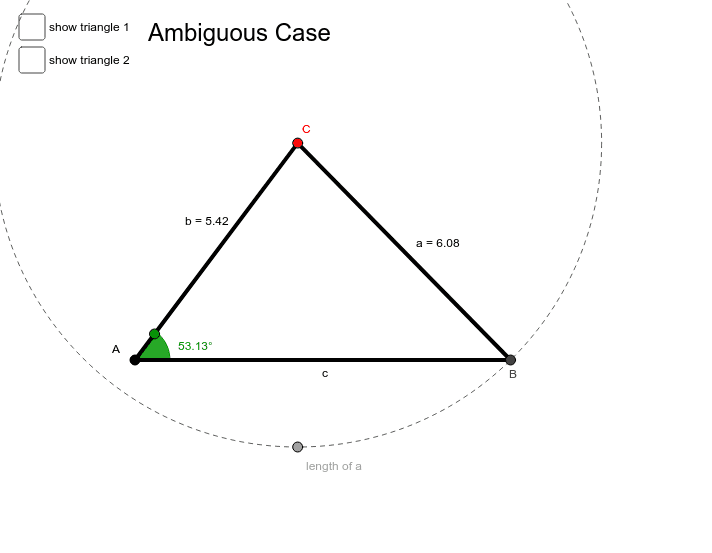
This example demonstrates the ambiguous case in the Law of Sines, where given two angles and one side, a triangle may have two possible solutions, one solution, or no solution. It involves core math concepts like the Law of Sines, triangle construction, geometric drawing, and logical reasoning. The construction uses GeoGebra commands such as Point, Line, Circle, Intersect, Semicircle, Ray, OrthogonalLine, Segment, Polygon, and Angle to dynamically illustrate the ambiguity. Suitable for high school mathematics education to help students understand the limitations and practical applications of the Law of Sines.
GeoGebra Commands & Parameters
Point(xAxis) → B_3Point(xAxis) → ALine(A, B_3) → b_1Circle(A, C_1) → c_1Intersect(c_1, b_1) → D, ESemicircle(D, E) → dPoint(d) → FRay(A, F) → ePoint(e) → COrthogonalLine(C, b_1) → kIntersect(k, b_1) → GRay(C, G) → mRay(A, B_3) → a_3Point(m) → HCircle(C, H) → fIntersect(f, a_3) → B, B_2Segment(B, C) → a_4Segment(C, B_2) → hPolygon(A, C, B) → poly1, b, a, cPolygon(A, C, B_2) → poly2, j, a_2, g_2Angle(a_3, e) → αSegment(A, B_2) → c_2Segment(G, C) → lPoint(k) → I