
Altitudes and Orthocenter of a Triangle by Mr. Cheung
Loading the math board and drawing, please wait…
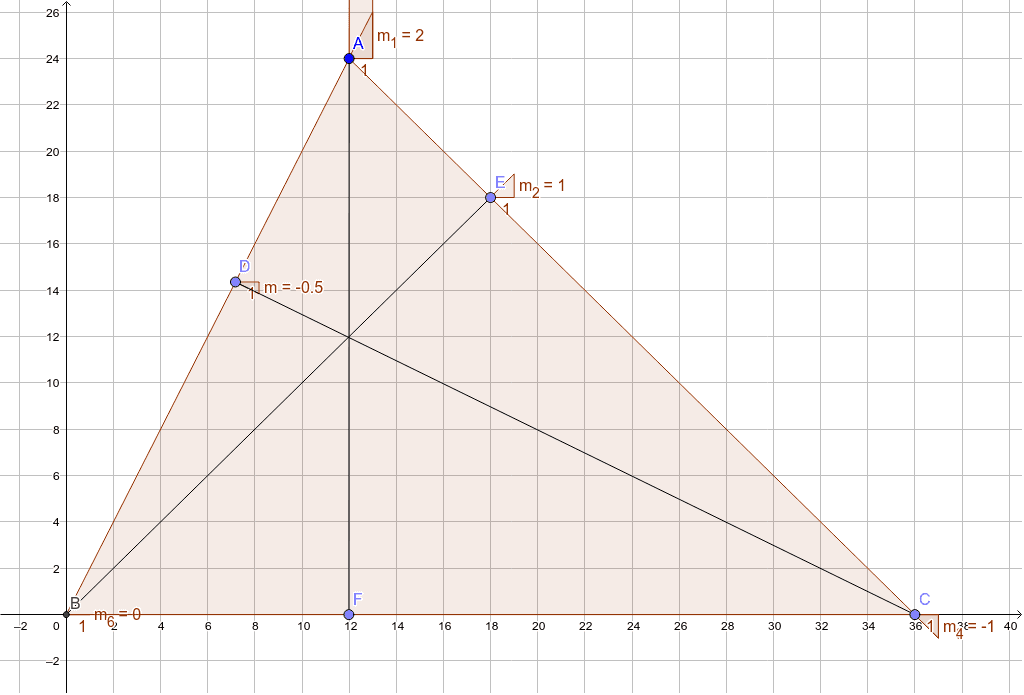
This GeoGebra example demonstrates how the three altitudes of a triangle meet at the orthocenter and how the orthocenter moves when the vertices are dragged. It covers triangle altitudes, orthocenter, perpendicularity, line segments, intersections, slopes, distances, polygon area relationships, and dynamic geometry. The construction uses Point to create vertices A, B, and C, Polygon to form triangle poly1, Segment to draw sides and altitude lines, Intersect to locate altitude feet or related intersection points D, E, and F, and Slope and Distance to check perpendicular relationships and measure lengths; objects a, b, c, d, e, f and distanceBF support quantitative exploration. Suitable for middle-school geometry, high-school analytic geometry, and classroom demonstrations of triangle centers.
GeoGebra Commands & Parameters
Intersect(xAxis, yAxis) → BPoint(xAxis) → CPolygon(A, B, C) → poly1, c, a, bPoint(c) → DPoint(b) → EPoint(a) → FSegment(A, F) → dSegment(D, C) → eSegment(E, B) → fDistance(B, F) → distanceBFDistance(F, C) → distanceFCDistance(C, E) → distanceCEDistance(E, A) → distanceEADistance(A, D) → distanceADDistance(D, B) → distanceDBSlope(e) → mSlope(c) → m_1Slope(f) → m_2Slope(b) → m_3Slope(b) → m_4Slope(d) → m_5Slope(a) → m_6
AI Drawing Prompt Reference
Draw a triangle ABC, and connect each vertex to the foot of the perpendicular on the opposite side to form three altitudes. They intersect at the orthocenter of the triangle. Use the segment tool to draw the three sides and the three altitudes, measure the lengths of the sides and altitudes, calculate the distances from the orthocenter to each vertex, and check if the altitudes are perpendicular to the corresponding sides.
The prompt above was compiled from the original drawing commands and is for reference only.