
Alphabet for Translations: Demonstrating Translation with Letters
Loading the math board and drawing, please wait…
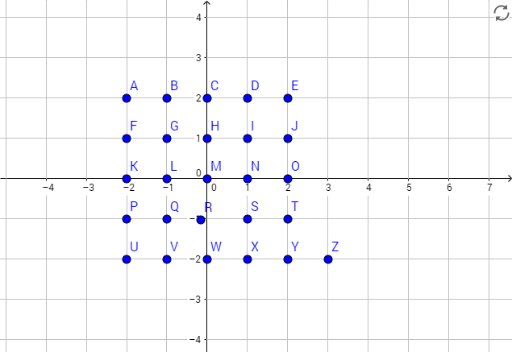
①This example uses alphabet shapes (A, B, C, etc.) as geometric objects to visually demonstrate the effect of translation transformations in the plane. ②The core mathematical concept is translation in plane geometry, involving vectors, corresponding points, congruence of figures, and the positional relationship between the original and translated shapes. ③Construction highlights: Based on the construction summary, numerous point objects (A, B, D, E, F, G, H, I, J, K, O, P, Q, R, S, T, U, V, Z, X, Y, C, L, M, N, W) define the letter outlines, and translation commands (e.g., Translate) move these points or the line segments/polygons formed by them as a whole, creating translated copies of the letters. ④This is suitable for middle school to high school students learning geometric transformations, and also for teachers to demonstrate properties of translation in class, such as corresponding points connected by parallel and equal segments, and unchanged shape and size. It can be combined with sliders to dynamically adjust the translation vector for enhanced intuitive understanding.
GeoGebra Commands & Parameters
Point A(-2, 2)Point B(-1, 2)Point D(1, 2)Point E(2, 2)Point F(-2, 1)Point G(-1, 1)Point H(0, 1)Point I(1, 1)Point J(2, 1)Point K(-2, 0)Point O(2, 0)Point P(-2, -1)Point Q(-1, -1)Point R(-0.16, -1.02)Point S(1, -1)Point T(2, -1)Point U(-2, -2)Point V(-1, -2)Point Z(3, -2)Point X(1, -2)Point Y(2, -2)Point C(0, 2)Point L(-1, 0)Point M(0, 0)Point N(1, 0)Point W(0, -2)