
Adding Fractions with Diagrams
Loading the math board and drawing, please wait…
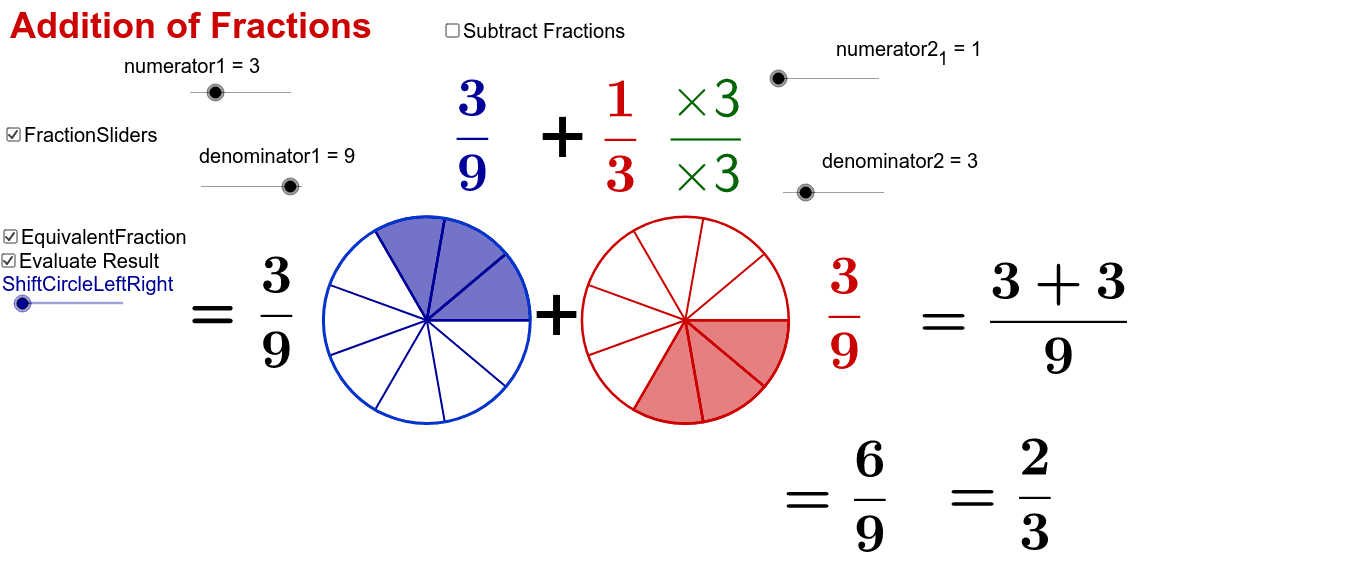
This example demonstrates the addition of fractions using diagrams, visually illustrating the process of combining fractions. Key math concepts include numerators and denominators, least common multiple (LCM), equivalent fractions, and the division/combination of shapes. GeoGebra commands and objects like Circle, Point, LCM, Sequence, Midpoint, If, Vector, and Translate are used to construct the dynamic diagrams, aiding in understanding the geometric meaning of fraction operations. Suitable for middle school and above learners to assist in grasping the concept of fraction addition and subtraction.
GeoGebra Commands & Parameters
Circle(A_1, r) → cPoint(c) → BCircle(A_2, r) → dLCM(denominator1, denominator2) → equivalentdenominatorSequence(Segment[A_2, Rotate[C_2, r°, A_2]], r, 0, 360, 360 / denominator2) → PIEALL_2Sequence(Segment[A_1, Rotate[C_1, r°, A_1]], r, 360 / denominator1, 360, 360 / denominator1) → PIEALL_1Sequence(CircleSector[A_1, Rotate[C_1, r°, A_1], Rotate[C_1, (r + 360 / denominator1)°, A_1]], r, 0, (360 / denominator1 * numerator1) - 360 / denominator1, 360 / denominator1) → PIESECTION_1Sequence(CircleSector[A_2, Rotate[C_2, ((-r) - 360 / denominator2)°, A_2], Rotate[C_2, ((-r))°, A_2]], r, 0, (360 / denominator2 * numerator2_1) - 360 / denominator2, 360 / denominator2) → PIESECTION_2Sequence(Segment[A_1, Rotate[C_1, r°, A_1]], r, 0, 360, 360 / equivalentdenominator) → PIEALL_{1E}Sequence(Segment[A_2, Rotate[C_2, r°, A_2]], r, 0, 360, 360 / equivalentdenominator) → PIEALL_{2E}Sequence(CircleSector[A_1, Rotate[C_1, r°, A_1], Rotate[C_1, (r + 360 / equivalentdenominator)°, A_1]], r, 0, (360 / equivalentdenominator * numerator_{1E}) - 360 / equivalentdenominator, 360 / equivalentdenominator) → PIESECTION_{1E}Sequence(CircleSector[A_2, Rotate[C_2, ((-r) - 360 / equivalentdenominator)°, A_2], Rotate[C_2, ((-r))°, A_2]], r, 0, (360 / equivalentdenominator * numerator_{2E}) - 360 / equivalentdenominator, 360 / equivalentdenominator) → PIESECTION_{2E}Midpoint(A_1, A_2) → A_{mid}Circle(A_1, r) → PIESECTION_{1whole}Circle(A_2, r) → PIESECTION_{2whole}If(¬subtractfractions, "+", "−") → addsign2Sequence(CircleSector[A_2, Rotate[C_2, r°, A_2], Rotate[C_2, (r + 360 / denominator2)°, A_2]], r, 0, (360 / denominator2 * numerator2_1) - 360 / denominator2, 360 / denominator2) → PIESECTION_{2subtract}Sequence(CircleSector[A_2, Rotate[C_2, r°, A_2], Rotate[C_2, (r + 360 / equivalentdenominator)°, A_2]], r, 0, (360 / equivalentdenominator * numerator_{2E}) - 360 / equivalentdenominator, 360 / equivalentdenominator) → PIESECTION_{2Esubtract}If(ShiftCircleLeftRight ≟ (2.5 * r), 1, 0) → triggerSequence(CircleSector[A_2, Rotate[C_2, r°, A_2], Rotate[C_2, (r + 360 / equivalentdenominator)°, A_2]], r, (numerator_{2E} * 360 / equivalentdenominator), (360 / equivalentdenominator * (numerator_{1E} - 1)), 360 / equivalentdenominator) → PIESECTION_{finalsubtract1}Vector(A_2, A_{2end1}) → uTranslate(PIESECTION_{finalsubtract1}, Vector[(DetachPie * u)]) → PIESECTION_{finalsubtract2}Vector(A_2, A_{2end2}) → vCircle(A_2, r) → PIESECTION_{whole1}Sequence(CircleSector[A_2, Rotate[C_2, r°, A_2], Rotate[C_2, (r + 360 / equivalentdenominator)°, A_2]], r, ((equivalentdenominator - numerator_{2E}) * 360 / equivalentdenominator), (360 / equivalentdenominator * (mixednumerator + equivalentdenominator - numerator_{2E} - 1)), 360 / equivalentdenominator) → PIESECTION_{part1}Circle(A_2, r) → PIESECTION_{whole2}Translate(PIESECTION_{whole2}, Vector[(DetachPie * v)]) → PIESECTION_{whole2v}Translate(PIESECTION_{part1}, Vector[(DetachPie * v)]) → PIESECTION_{part2}Translate(PIESECTION_{whole1}, Vector[(DetachPie * u)]) → PIESECTION_{whole1u}If(subtractfractions, "Subtraction of Fractions", "Addition of Fractions") → textTitleGCD(equivalentnumerator, equivalentdenominator) → ResultGCDGCD(abs(equivalentnumerator_{subtract}), equivalentdenominator) → ResultGCD_{subtract}If(abs(equivalentnumerator) < equivalentdenominator, If[ResultGCD ≟ 1, (4.5 * r), (3.5 * r)], If[ResultGCD ≟ 1, 0, (-2 * r)]) → x_{textEquivalentsign3}If(ResultGCD ≟ 1, (-0.25 * r), If[equivalentnumerator < equivalentdenominator, (5 * r), (-0.25 * r)]) → x_{textposition2}Sequence(CircleSector[A_2, Rotate[C_2, r°, A_2], Rotate[C_2, (r + 360 / equivalentdenominator)°, A_2]], r, (numerator_{1E} * 360 / equivalentdenominator), (360 / equivalentdenominator * (numerator_{2E} - 1)), 360 / equivalentdenominator) → PIESECTION_{negativefinalsubtract1}Vector(A_2, A_{2end3}) → wTranslate(PIESECTION_{negativefinalsubtract1}, Vector[(DetachPie * v)]) → PIESECTION_{negativefinalsubtract2}
AI Drawing Prompt Reference
Draw two concentric circles with colored sectors to illustrate fraction addition. The sectors in the first circle are divided according to the numerator proportions, while the second circle's sectors are also divided by the numerator proportions but adjusted in angle to match the least common multiple of the denominators. Visually combine and rearrange the sectors to show how fractions merge into a whole. The final image should include multiple sectors and lines, clearly demonstrating the geometric meaning of fraction addition.
The prompt above was compiled from the original drawing commands and is for reference only.