
Adding Complex Numbers and the Parallelogram Rule
Loading the math board and drawing, please wait…
In collections
complex numbers
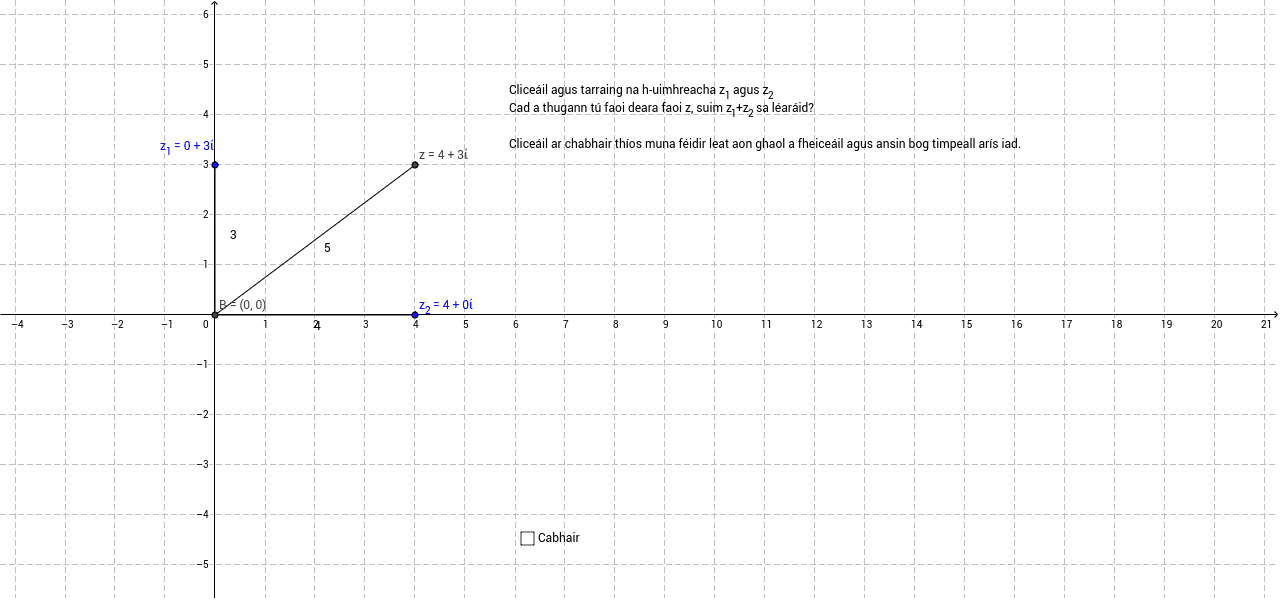
① This example demonstrates the addition of two complex numbers on the complex plane and shows the parallelogram formed by the two addends and the origin. ② Core mathematical concepts include the geometric representation of complex numbers, vector addition, the parallelogram law, and translation transformations. ③ Construction highlights: GeoGebra commands Intersect, Segment, Distance, and Polygon are used to create objects z_1, z_2, z_3, a, b, c, d, poly1, representing the two addends, their sum, the vector segments, and the parallelogram region. ④ Suitable for high‑school mathematics (complex numbers elective) or introductory university courses, ideal for classroom demonstration, self‑study exploration, or inclusion in a teaching resource library.
GeoGebra Commands & Parameters
Intersect(xAxis, yAxis) → BSegment(B, z_1) → aSegment(B, z_2) → bSegment(B, z) → cDistance(a, c) → dPolygon(B, z_1, z, z_2) → poly1, b_1, a_1, z_3, c_1