
Acute, Obtuse, and Right Triangles with Pythagorean Theorem
Loading the math board and drawing, please wait…
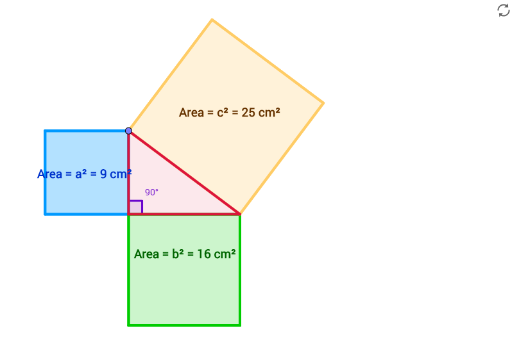
This example demonstrates the geometric properties of acute, obtuse, and right triangles along with the application of the Pythagorean Theorem. Key math concepts include the Pythagorean Theorem, triangle classification, and angle measurement. Construction highlights the use of GeoGebra commands like Intersect, Point, Semicircle, Polygon, Midpoint, and Angle. Suitable for middle school and above students to understand triangle classification and the practical application of the Pythagorean Theorem.
GeoGebra Commands & Parameters
Intersect(xAxis, yAxis) → APoint(xAxis) → BSemicircle(A, B) → cPoint(xAxis) → CPoint(c) → EPolygon(C, E, 4) → poly1, f, g, h, i, D, FPoint(xAxis) → GPolygon(G, C, 4) → poly2, j, k, l, m, H, IPolygon(E, G, 4) → poly3, n, p, q, r, J, KMidpoint(E, J) → LMidpoint(E, A) → MMidpoint(C, I) → NAngle(G, C, E) → αPolygon(E, C, G) → poly4, g_1, e, c_1
AI Drawing Prompt Reference
Draw a geometric diagram showing acute, obtuse, and right triangles with the Pythagorean Theorem. Start by plotting the intersection of coordinate axes and creating a semicircle. Then take points on the semicircle to construct three quadrilaterals representing different types of triangles. Find midpoints of key points and measure angles. Finally, connect some points to form new quadrilaterals, fully demonstrating triangle classification and the Pythagorean Theorem.
The prompt above was compiled from the original drawing commands and is for reference only.