
Acute Angles of a Right Triangle
Loading the math board and drawing, please wait…
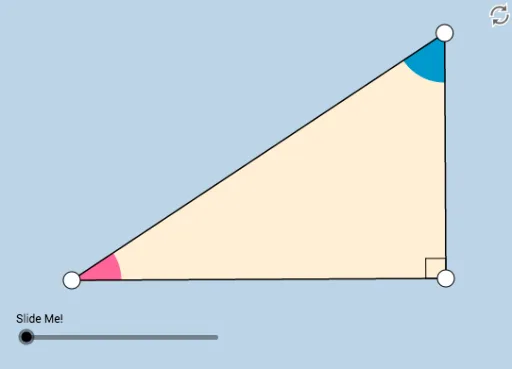
This example demonstrates the properties of acute angles in a right triangle. Core concepts include the corollary to the Triangle-Angle-Sum-Theorem. Students can explore the properties of acute angles by constructing triangles, circles, and segments. Commands used include Line, OrthogonalLine, Circle, Intersect, Ray, Point, Polygon, Segment, Angle, Min, CircleSector, Dilate, Vector, Translate, Rotate, CircleArc. Suitable for middle school and above students learning geometric construction.
GeoGebra Commands & Parameters
Line(A, B) → fOrthogonalLine(B, f) → gCircle(B, 1) → cIntersect(c, g, 2) → CRay(B, C) → hPoint(h) → DPolygon(A, B, D) → poly1, d, a, bSegment(A, B) → iSegment(B, D) → jSegment(D, A) → kAngle(D, B, A) → αMin(j, i) → eCircle(D, (0.2 * e)) → pCircle(A, (0.2 * e)) → qIntersect(p, k, 1) → EIntersect(p, j, 1) → FIntersect(q, i, 1) → GIntersect(q, k, 1) → HCircleSector(D, E, F) → rCircleSector(A, G, H) → sDilate(D, If[0 < l ≤ 1, 1 - l, 0], B) → D'Vector(D, D') → uTranslate(r, u) → r'Angle(E, D, F) → βAngle(G, A, H) → γRotate(r', If[1 < l ≤ 2, ((-(l - 1)) * (π / 2 + γ)), (-(π / 2 + γ))], B) → r''Circle(A, 1) → tRotate(s, If[2 < l ≤ 3, ((l - 2) * (π - γ)), π - γ], A) → s'Dilate(A, If[3 < l ≤ 4, 4 - l, 0], B) → A'Vector(A, A') → vTranslate(s', v) → s''CircleArc(A, G, H) → c_1CircleArc(D, E, F) → d_1
AI Drawing Prompt Reference
Draw a right triangle and label its two acute angles. With the right angle vertex as the center, draw a unit circle intersecting the two legs. Connect these intersection points to the right angle vertex to form two isosceles triangles. In each isosceles triangle, draw small circles centered at the vertices, intersecting the base. Connect these intersection points to the vertices to form sectors. Translate one sector along the base and rotate the other so they are parallel to the bases of the isosceles triangles. Finally, draw the sectors as arcs.
The prompt above was compiled from the original drawing commands and is for reference only.