
AAS Congruence Dynamic Demonstration
Loading the math board and drawing, please wait…
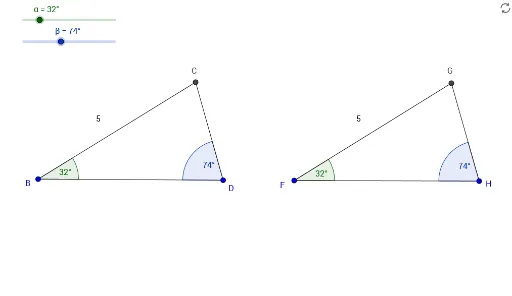
①This GeoGebra example dynamically demonstrates the AAS (Angle-Angle-Side) congruence theorem, showing that two triangles are congruent when two angles and the non-included side are equal. ②Core mathematical concepts include triangle congruence criteria, angles, sides, rotation, and distance measurement, along with the idea of congruent transformation. ③Construction highlights: uses the Rotate command to transform a triangle, Angle, Ray, Segment, and Intersect commands to build angles and sides, and Distance to measure corresponding side lengths. Objects include angles α, β, γ, δ, ε, ζ; points A, B, C, D, E, F, G, H; lines/segments f, g, h, i, j, k, l, m, n, p; and primed points B', F' to mark correspondences. ④Suitable for middle school geometry lessons, helping students grasp the AAS congruence criterion, and useful for teachers creating dynamic demonstrations or for student self-exploration.
GeoGebra Commands & Parameters
Rotate(A, (-α), B) → DAngle(D, B, A) → γRay(B, A) → fSegment(B, D) → gRotate(B, (-β), D) → B'_1Angle(B'_1, D, B) → δRay(D, B'_1) → hIntersect(f, h) → CSegment(B, C) → iSegment(C, D) → jRotate(E, (-α), F) → HAngle(H, F, E) → εSegment(F, H) → kDistance(E, k) → distanceEkRotate(F, (-β), H) → F'Angle(F', H, F) → ζRay(H, F') → lRay(F, E) → mIntersect(l, m) → GSegment(F, G) → nSegment(G, H) → p
AI Drawing Prompt Reference
Draw two triangles to demonstrate the Angle-Angle-Side (AAS) congruence criterion. For the first triangle, start with a vertex and an angle, rotate one side around the vertex to form the second angle, then intersect two rays to determine the third vertex, and connect the vertices to form the triangle. For the second triangle, use the same construction but with reversed rotation, ensuring corresponding angles are equal and the non-included side lengths match. Mark corresponding angles and sides with labels or dashed lines, and measure the corresponding side lengths to show they are equal. The overall effect should show the two triangles can be superimposed via rotation and translation.
The prompt above was compiled from the original drawing commands and is for reference only.