
AA Similarity Theorem Proof with GeoGebra
Loading the math board and drawing, please wait…
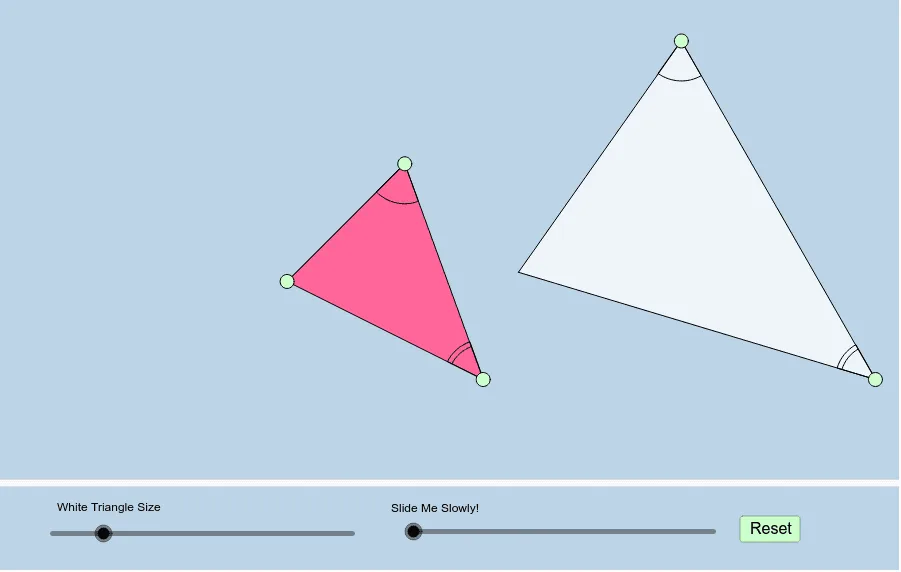
This example demonstrates the Angle-Angle Triangle Similarity Theorem ('Proof') using transformational geometry tools. It involves core math concepts like angles, congruence, similar triangles, triangles, polynomial functions, binomial distribution, division, incircle or inscribed circle, and pyramid. Constructed with commands like Segment, Circle, Point, Angle, Rotate, Ray, Intersect, Line, Dilate, Vector, Polygon, Translate, and If. Suitable for high school mathematics teaching or self-learning to understand and apply the AA Similarity Theorem.
GeoGebra Commands & Parameters
Segment(A, B) → aSegment(B, C) → bSegment(C, A) → cCircle(D, (k * a)) → dPoint(d) → ESegment(D, E) → eCircle(E, (k * b)) → fAngle(A, B, C) → αRotate(D, α, E) → D'Angle(D, E, D') → βRay(E, D') → gIntersect(f, g, 1) → FAngle(C, A, B) → γRotate(E, (-γ), D) → E'Angle(E', D, E) → δRay(D, E') → hSegment(D, E') → iSegment(E', E) → jLine(E, D') → lLine(E, D') → nCircle(D, (k * c)) → pRay(D, E') → mIntersect(p, m, 1) → GSegment(E, G) → qSegment(D, G) → rDilate(D, If[0 < s ≤ 1, 1 - s], A) → D'_1Vector(D, D'_1) → uPolygon(A, C, B) → poly1, b_1, a_1, c_1Polygon(D, E, G) → poly2, g_1, d_1, e_1Translate(D, u) → D'_2Translate(E, u) → E'_1Translate(G, u) → G'Polygon(D'_2, E'_1, G') → poly2', g', d'_2, e'_1Vector(D, A) → vTranslate(D, v) → D'_3Translate(E, v) → E'_2Translate(G, v) → G'_1Polygon(D'_3, E'_2, G'_1) → poly2'_1, g'_1, d'_3, e'_2Segment(D'_1, G') → tSegment(E'_1, D'_1) → h_1Segment(A, G'_1) → i_1Segment(G'_1, E'_2) → j_1Segment(E'_2, A) → k_1Angle(C, A, E'_2) → εIf(ε > γ, ε - γ, γ - ε) → ζRotate(D'_3, If[1 < s ≤ 2, ((-(s - 1)) * ζ), (-ζ)], A) → HRotate(E'_2, If[1 < s ≤ 2, ((-(s - 1)) * ζ), (-ζ)], A) → IRotate(G'_1, If[1 < s ≤ 2, ((-(s - 1)) * ζ), (-ζ)], A) → JPolygon(H, I, J) → poly3, j_2, h_2, i_2Segment(A, J) → l_1Segment(A, I) → m_1Segment(I, J) → n_1Dilate(J, If[2 < s ≤ 3, 3 - s, 0], C) → J'Dilate(I, If[2 < s ≤ 3, 3 - s, 0], B) → I'Segment(I', J') → p_1Angle(A, I', J') → ηAngle(A, I, J) → θAngle(D'_2, E'_1, G') → ιAngle(J, A, I) → λAngle(G', D'_1, E'_1) → μPolygon(A, J', I') → poly4, i', a_2, j'Angle(A, I, J) → νSegment(G'_1, E'_2) → q_1Segment(G', E'_1) → f_1Angle(G'_1, A, E'_2) → κAngle(A, E'_2, G'_1) → ξRotate(D'_3, ((s - 1) * ζ), A) → KRotate(D'_3, If[1 < s ≤ 2, ((s - 1) * ζ), ζ], A) → LRotate(E'_2, If[1 < s ≤ 2, ((s - 1) * ζ), ζ], A) → MRotate(G'_1, If[1 < s ≤ 2, ((s - 1) * ζ), ζ], A) → NPolygon(L, M, N) → poly5, n_2, l_2, m_2Dilate(M, If[2 < s ≤ 3, 3 - s, 0], B) → M'Dilate(N, If[2 < s ≤ 3, 3 - s, 0], C) → N'Segment(M', N') → r_1Polygon(A, M', N') → poly6, n', a_3, m'Angle(A, M', N') → οAngle(A, M, N) → ρSegment(A, M) → t_1Segment(M, N) → b_2Segment(A, N) → c_2Angle(B, A, C) → σAngle(G, E, D) → τAngle(N, M, A) → υAngle(N', M', A) → ϕ
AI Drawing Prompt Reference
Draw two triangles, one original and one constructed to be similar via rotation and scaling. Start with the original triangle's three sides. Then, using a point as center, draw circles with radii proportional to the original sides, pick a point on a circle to form one side of the new triangle. Measure two angles of the original triangle, replicate these angles by rotation onto the new triangle, and find the third vertex via intersection of a ray and a circle. Then copy the entire triangle using scaling and vector translation to create multiple translated copies. Finally, rotate these copies around a vertex to align with the original triangle, demonstrating that equal angles imply similarity.
The prompt above was compiled from the original drawing commands and is for reference only.