
3D Spiral Cluster Model
Loading the math board and drawing, please wait…
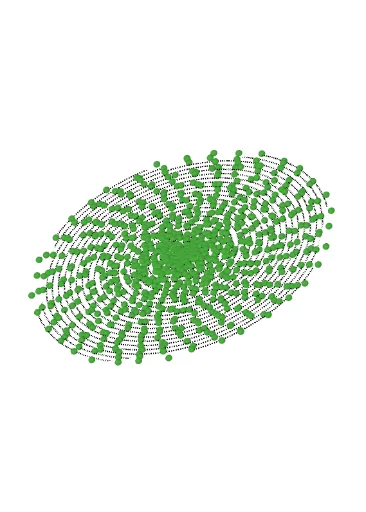
This example demonstrates the formation and variation of a 3D spiral cluster. It involves core mathematical concepts such as trigonometric functions, coordinate geometry, sequences, and parametric equations. The construction utilizes GeoGebra commands like Sequence, Length, and CurveCartesian, along with objects like length, amplitude, distance, and more. Suitable for high school students and math enthusiasts exploring the connection between spatial geometry and function graphs.
GeoGebra Commands & Parameters
Sequence((((n * amplitud) * cos(n)) + Random[s_{Min}, s_{Max}], ((n * amplitud) * sin(n)) + Random[s_{Min}, s_{Max}], 0), n, 0, (length * π), distance) → L_2Length(L_2) → StarNumberCurveCartesian(((t * amplitud) * cos(t)), ((t * amplitud) * sin(t)), 0, t, 0, (length * π)) → aSequence((((n * amplitud) * cos(n)), ((n * amplitud) * sin(n)), 0), n, 0, (length * π), distance) → L_1
AI Drawing Prompt Reference
Draw a 3D spiral cluster model with multiple spirals rotating around a central point, where the radius of each spiral increases linearly with the angle, and each spiral has a random offset at its start and end points. The total number of spirals is determined by π times the length, and the number of spirals is π times the length. The amplitude of the spirals is defined by amplitud.
The prompt above was compiled from the original drawing commands and is for reference only.