
3D Shape Rotation and Construction
Loading the math board and drawing, please wait…
In collections
Phebe Tanner Tessellation Rotation
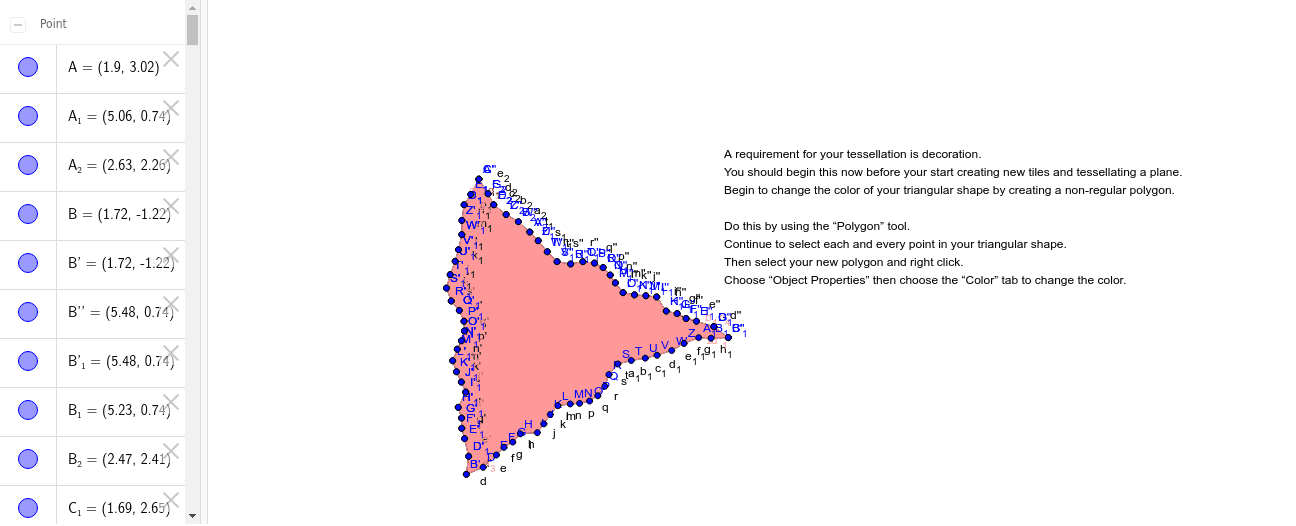
This example demonstrates the rotation construction and dynamic changes of 3D shapes like polygons; involves core math concepts including solid geometry, rotation transformation, polygon construction, and optimization problems; constructed using GeoGebra commands/objects such as Polygon, Segment, Rotate; suitable for high school and above learning solid geometry, geometric construction, and transformation applications.
GeoGebra Commands & Parameters
Polygon(A, B, 3) → poly1, a, b, c, CSegment(B, D) → dSegment(D, E) → eSegment(E, F) → fSegment(F, G) → gSegment(G, H) → hSegment(H, I) → iSegment(I, J) → jSegment(J, K) → kSegment(K, L) → lSegment(L, M) → mSegment(M, N) → nSegment(N, O) → pSegment(O, P) → qSegment(P, Q) → rSegment(Q, R) → sSegment(R, S) → tSegment(S, T) → a_1Segment(T, U) → b_1Segment(U, V) → c_1Segment(V, W) → d_1Segment(W, Z) → e_1Segment(Z, A_1) → f_1Segment(A_1, B_1) → g_1Segment(B_1, C) → h_1Rotate(B, 60*°, B) → B'Rotate(D, 60*°, B) → D'Segment(B', D') → d'Rotate(D, 60*°, B) → D'_1Rotate(E, 60*°, B) → E'Segment(D'_1, E') → e'Rotate(E, 60*°, B) → E'_1Rotate(F, 60*°, B) → F'Segment(E'_1, F') → f'Rotate(F, 60*°, B) → F'_1Rotate(G, 60*°, B) → G'Segment(F'_1, G') → g'Rotate(G, 60*°, B) → G'_1Rotate(H, 60*°, B) → H'Segment(G'_1, H') → h'Rotate(H, 60*°, B) → H'_1Rotate(I, 60*°, B) → I'Segment(H'_1, I') → i'Rotate(I, 60*°, B) → I'_1Rotate(J, 60*°, B) → J'Segment(I'_1, J') → j'Rotate(J, 60*°, B) → J'_1Rotate(K, 60*°, B) → K'Segment(J'_1, K') → k'Rotate(K, 60*°, B) → K'_1Rotate(L, 60*°, B) → L'Segment(K'_1, L') → l'Rotate(L, 60*°, B) → L'_1Rotate(M, 60*°, B) → M'Segment(L'_1, M') → m'Rotate(M, 60*°, B) → M'_1Rotate(N, 60*°, B) → N'Segment(M'_1, N') → n'Rotate(N, 60*°, B) → N'_1Rotate(O, 60*°, B) → O'Segment(N'_1, O') → p'Rotate(O, 60*°, B) → O'_1Rotate(P, 60*°, B) → P'Segment(O'_1, P') → q'Rotate(P, 60*°, B) → P'_1Rotate(Q, 60*°, B) → Q'Segment(P'_1, Q') → r'Rotate(Q, 60*°, B) → Q'_1Rotate(R, 60*°, B) → R'Segment(Q'_1, R') → s'Rotate(R, 60*°, B) → R'_1Rotate(S, 60*°, B) → S'Segment(R'_1, S') → t'Rotate(S, 60*°, B) → S'_1Rotate(T, 60*°, B) → T'Segment(S'_1, T') → i_1Rotate(T, 60*°, B) → T'_1Rotate(U, 60*°, B) → U'Segment(T'_1, U') → j_1Rotate(U, 60*°, B) → U'_1Rotate(V, 60*°, B) → V'Segment(U'_1, V') → k_1Rotate(V, 60*°, B) → V'_1Rotate(W, 60*°, B) → W'Segment(V'_1, W') → l_1Rotate(W, 60*°, B) → W'_1Rotate(Z, 60*°, B) → Z'Segment(W'_1, Z') → m_1Rotate(Z, 60*°, B) → Z'_1Rotate(A_1, 60*°, B) → C_1Segment(Z'_1, C_1) → n_1Rotate(A_1, 60*°, B) → D_1Rotate(B_1, 60*°, B) → E_1Segment(D_1, E_1) → p_1Rotate(B_1, 60*°, B) → F_1Rotate(C, 60*°, B) → C'Segment(F_1, C') → q_1Rotate(B', 60*°, A) → B''Rotate(D', 60*°, A) → D''Segment(B'', D'') → d''Rotate(D'_1, 60*°, A) → G_1Rotate(E', 60*°, A) → E''Segment(G_1, E'') → e''Rotate(E'_1, 60*°, A) → H_1Rotate(F', 60*°, A) → F''Segment(H_1, F'') → f''Rotate(F'_1, 60*°, A) → I_1Rotate(G', 60*°, A) → G''Segment(I_1, G'') → g''Rotate(G'_1, 60*°, A) → J_1Rotate(H', 60*°, A) → H''Segment(J_1, H'') → h''Rotate(H'_1, 60*°, A) → K_1Rotate(I', 60*°, A) → I''Segment(K_1, I'') → i''Rotate(I'_1, 60*°, A) → L_1Rotate(J', 60*°, A) → J''Segment(L_1, J'') → j''Rotate(J'_1, 60*°, A) → M_1Rotate(K', 60*°, A) → K''Segment(M_1, K'') → k''Rotate(K'_1, 60*°, A) → N_1Rotate(L', 60*°, A) → L''Segment(N_1, L'') → l''Rotate(L'_1, 60*°, A) → O_1Rotate(M', 60*°, A) → M''Segment(O_1, M'') → m''Rotate(M'_1, 60*°, A) → P_1Rotate(N', 60*°, A) → N''Segment(P_1, N'') → n''Rotate(N'_1, 60*°, A) → Q_1Rotate(O', 60*°, A) → O''Segment(Q_1, O'') → p''Rotate(O'_1, 60*°, A) → R_1Rotate(P', 60*°, A) → P''Segment(R_1, P'') → q''Rotate(P'_1, 60*°, A) → S_1Rotate(Q', 60*°, A) → Q''Segment(S_1, Q'') → r''Rotate(Q'_1, 60*°, A) → T_1Rotate(R', 60*°, A) → R''Segment(T_1, R'') → s''Rotate(R'_1, 60*°, A) → U_1Rotate(S', 60*°, A) → S''Segment(U_1, S'') → t''Rotate(S'_1, 60*°, A) → V_1Rotate(T', 60*°, A) → T''Segment(V_1, T'') → r_1Rotate(T'_1, 60*°, A) → W_1Rotate(U', 60*°, A) → U''Segment(W_1, U'') → s_1Rotate(U'_1, 60*°, A) → Z_1Rotate(V', 60*°, A) → V''Segment(Z_1, V'') → t_1Rotate(V'_1, 60*°, A) → A_2Rotate(W', 60*°, A) → W''Segment(A_2, W'') → a_2Rotate(W'_1, 60*°, A) → B_2Rotate(Z', 60*°, A) → Z''Segment(B_2, Z'') → b_2Rotate(Z'_1, 60*°, A) → C_2Rotate(C_1, 60*°, A) → D_2Segment(C_2, D_2) → c_2Rotate(D_1, 60*°, A) → E_2Rotate(E_1, 60*°, A) → F_2Segment(E_2, F_2) → d_2Rotate(F_1, 60*°, A) → G_2Rotate(C', 60*°, A) → C''Segment(G_2, C'') → e_2Rotate(B, 60*°, A) → B'_1Polygon(B, D', M', M'_1, O', P', Q', R', S', T', U', V', E', W', Z', C_1, E_1, A, F_2, D_2, Z'', W'', V'', F', U'', T'', S'', R'', Q'', P'', O'', N'', M'', L'', G', K'', J'', I'', H'', G'', E'', H_1, D'', C, B_1, H', A_1, Z, W, V, U, T, S, R, Q, P, I', O, N, M, L, K, J, I, H, G, F, J', E, D, K', L') → poly2, b_3, l'_1, m'_1, m'_2, o', p'_1, q'_1, r'_1, s'_1, t'_1, u', d'_1, v', w', z', c_3, e_3, a_3, f_2, d_3, z'', w'', e'_1, v'', u'', t''_1, s''_1, r''_1, q''_1, p''_1, o'', n''_1, m''_1, f'_1, l''_1, k''_1, j''_1, i''_1, h''_1, g''_1, e''_1, h_2, d''_1, c_4, g'_1, b_4, a_4, z, w, v, u, t_2, s_2, r_2, q_2, h'_1, p_2, o, n_2, m_2, l_2, k_2, j_2, i_2, h_3, g_2, i'_1, f_3, e_4, d_4, j'_1, k'_1
AI Drawing Prompt Reference
Draw a closed polygon made of multiple line segments, then rotate the entire polygon by 60 degrees around one of its vertices, marking the positions of each rotated vertex and connecting them to form a new polygon, demonstrating the rotation construction process.
The prompt above was compiled from the original drawing commands and is for reference only.