
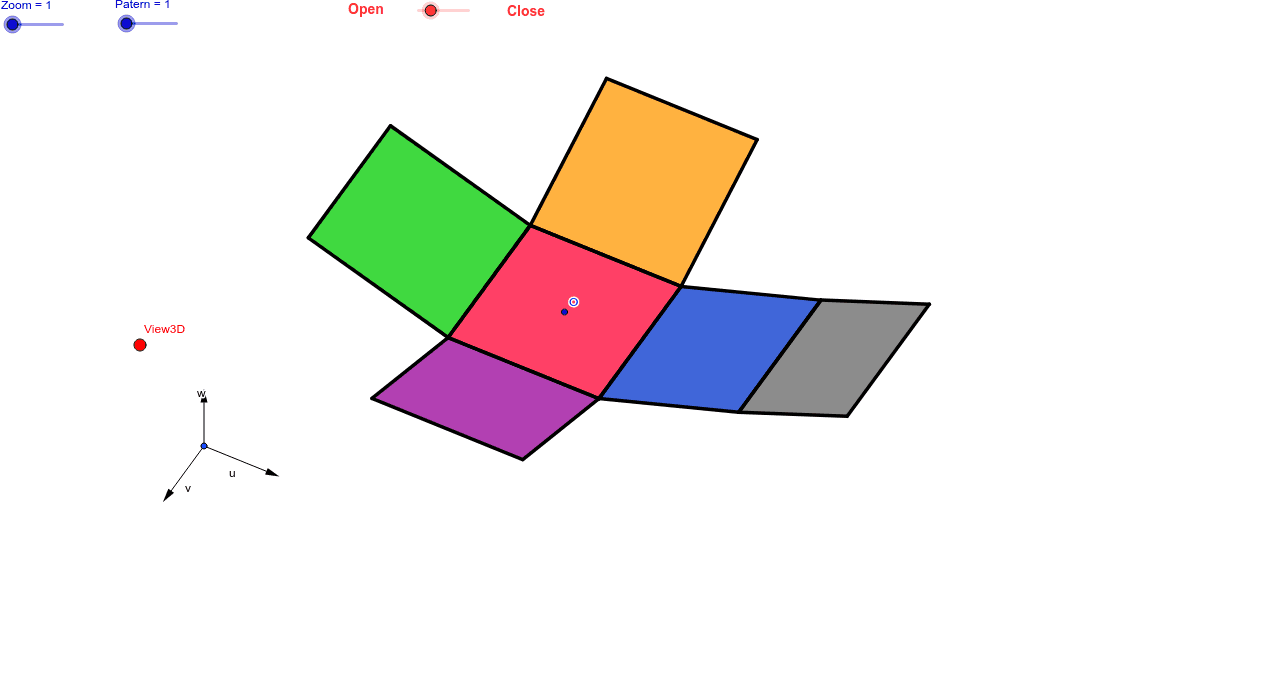
11 Patterns of a Cube? (Net of a Cube)
Loading the math board and drawing, please wait…
This example demonstrates 11 different patterns of a cube's net, allowing observation through sliders and 3D view. It involves core mathematical concepts like solid geometry, spatial visualization, and geometric transformations. The construction utilizes commands and objects such as Vector, OrthogonalLine, Polygon, Midpoint, Translate, Segment, and Mirror in GeoGebra. Suitable for high school geometry teaching and construction practice, enhancing spatial reasoning and hands-on skills.
GeoGebra Commands & Parameters
Vector(B_1, X) → uVector(B_1, Z) → wOrthogonalLine(View3D, yAxis) → a_1OrthogonalLine(View3D, xAxis) → b_1Vector(B_1, Y) → vPolygon(L, K, N, M) → poly1, l, k_1, n, mPolygon(K, P, Q, N) → poly2, k_2, p, q, n_1Polygon(L, M, S, R) → poly3, l_1, m_1, s, rPolygon(N, V, W, M) → poly4, n_2, v_1, w_1, m_2Polygon(K, T, U, L) → poly5, k_3, t, u_1, l_2Polygon(B, Q, P, A) → poly6, b_2, q_1, p_1, a_2Midpoint(R, M) → DTranslate(S, Vector[-(2.0 * v)]) → S'Segment(S, C) → eTranslate(M, Vector[-(2.0) * v]) → M'Segment(M, E) → fSegment(E, C) → hTranslate(N, Vector[-(2.0) * v]) → N'Translate(Q, Vector[-(2.0) * v]) → Q'_1Segment(Q, F) → iSegment(N, G) → jSegment(G, F) → d_1Translate(Q, Vector[-(2.0) * v]) → Q'_2Translate(B, Vector[-(2.0) * v]) → B'_1Segment(B, I) → e_1Segment(I, H) → f_1Segment(H, Q) → g_1Translate(K, Vector[2.0 * v]) → K'Translate(P, Vector[2.0 * v]) → P'_1Segment(P, J) → h_1Segment(J, A_1) → i_1Segment(A_1, K) → j_1Segment(B, H_1) → s_1Segment(H_1, C_1) → cSegment(C_1, A) → r_1Midpoint(N, P) → D_1Midpoint(k_1) → F_1Translate(A, Vector[2.0 * v]) → A'Translate(P, Vector[2.0 * v]) → P'Segment(A, G_1) → t_1Segment(G_1, I_1) → c_2Segment(I_1, P) → d_2Segment(J, K_1) → f_2Segment(P, L_1) → e_2Segment(L_1, K_1) → g_2Segment(M, W) → h_2Mirror(L_1, F_1) → O_1Mirror(K_1, F_1) → P_1Segment(M, M_1) → i_2Segment(N_1, J_1) → j_2Segment(J_1, M_1) → p_2Polygon(M, E, C, S) → poly7, q_2, r_2, s_2, t_2Polygon(Q, N, G, F) → poly8, q_3, n_3, g_3, f_3Polygon(B, Q, H, I) → poly9, b_3, q_4, h_3, i_3Polygon(J, A_1, K, P) → poly10, j_3, a_3, k_4, p_3Polygon(C_1, A, B, H_1) → poly11, c_3, a_4, b_4, h_4Polygon(G_1, I_1, P, A) → poly12, g_4, i_4, p_4, a_5Polygon(K_1, J, P, L_1) → poly13, k_5, j_4, p_5, l_3Polygon(M, M_1, J_1, N_1) → poly14, m_3, m_4, j_5, n_4