
单位分数的可视化
几何画板及绘图内容加载中,请稍等……
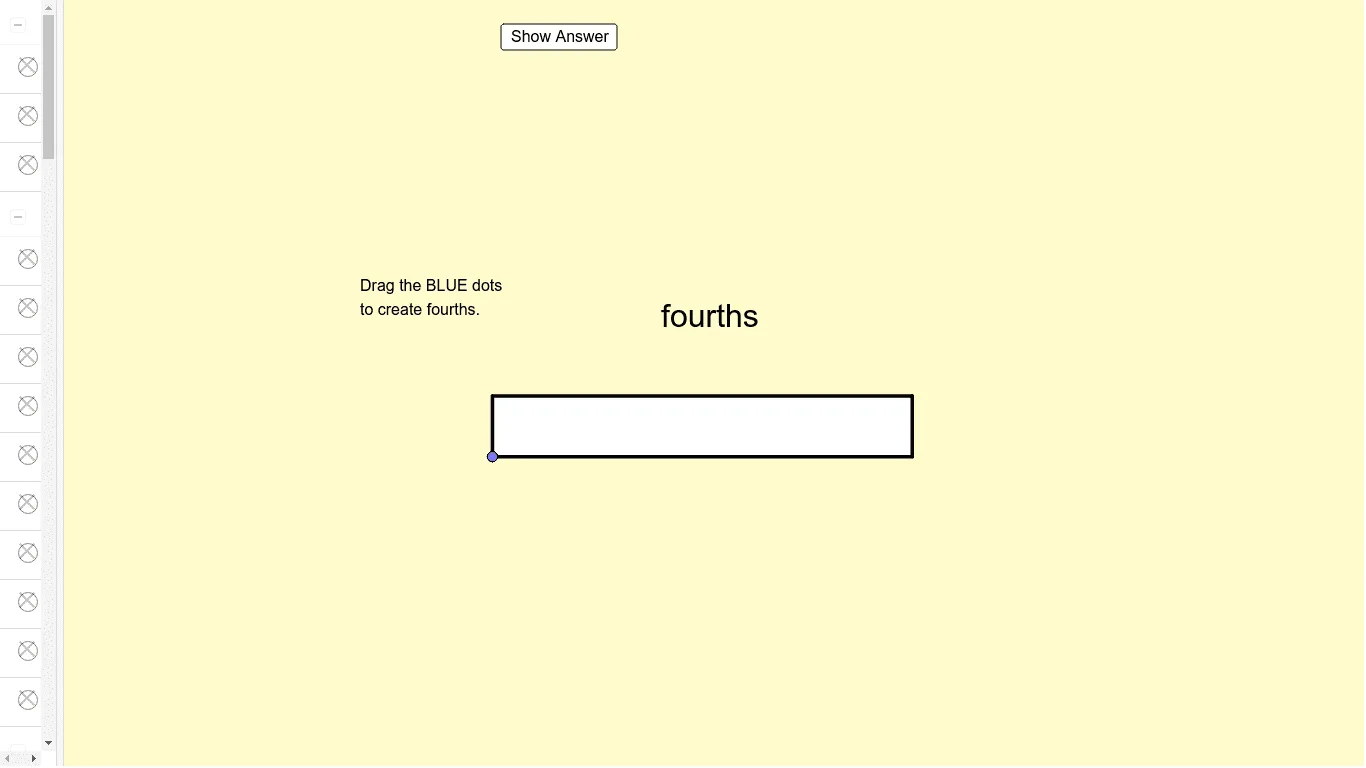
①本范例通过动态演示单位分数的几何表示,直观展示分数的构成与面积关系;②涉及核心数学概念包括单位分数定义、分数加法、几何面积计算、解析几何;③构造要点:使用Random, Element, Sequence命令生成随机单位分数,通过Segment, Point, OrthogonalLine, Intersect命令绘制几何图形,Polygon命令构建面积模型;④适合初中及以上数学教学,用于分数概念深化与几何直观培养。
GeoGebra 命令及参数
Random(5, 12) → lengthoftapeRandom(1, 6) → chooserElement(list2, chooser) → denominatorSequence((x(A) + (i * fractionwidth), y(A) + tapeheight), i, 0, denominator) → DotsTopSequence((x(A) + (i * fractionwidth), y(A)), i, 0, denominator) → DotsBottomSequence(Segment[Element[DotsBottom, i], Element[DotsTop, i]], i, 1, denominator + 1) → drawverticalsSegment(Element[DotsBottom, 1], Element[DotsBottom, denominator + 1]) → horizontalbottomSegment(Element[DotsTop, 1], Element[DotsTop, denominator + 1]) → horizontaltopSegment(Element[DotsBottom, 1], Element[DotsTop, 1]) → verticalleftSegment(Element[DotsBottom, denominator + 1], Element[DotsTop, denominator + 1]) → verticalrightPoint(horizontalbottom) → BPoint(horizontalbottom) → COrthogonalLine(C, horizontalbottom) → fPoint(horizontalbottom) → DPoint(horizontalbottom) → EPoint(horizontalbottom) → FPoint(horizontalbottom) → GPoint(horizontalbottom) → HPoint(horizontalbottom) → IPoint(horizontalbottom) → JPoint(horizontalbottom) → KOrthogonalLine(B, horizontaltop) → gOrthogonalLine(D, horizontaltop) → hOrthogonalLine(E, horizontaltop) → iOrthogonalLine(F, horizontaltop) → jOrthogonalLine(G, horizontaltop) → kOrthogonalLine(H, horizontaltop) → lOrthogonalLine(I, horizontaltop) → mOrthogonalLine(J, horizontaltop) → nOrthogonalLine(K, horizontaltop) → pIntersect(f, horizontaltop) → LIntersect(g, horizontaltop) → MIntersect(h, horizontaltop) → NIntersect(i, horizontaltop) → OIntersect(j, horizontaltop) → PIntersect(k, horizontaltop) → QIntersect(l, horizontaltop) → RIntersect(m, horizontaltop) → SIntersect(n, horizontaltop) → TIntersect(p, horizontaltop) → USegment(C, L) → qSegment(B, M) → rSegment(D, N) → sSegment(E, O) → tSegment(F, P) → aSegment(G, Q) → bSegment(H, R) → cSegment(I, S) → dSegment(J, T) → eSegment(K, U) → f_1Sequence(Element[DotsTop, i], i, 2, denominator) → DotsTopRevealedPolygon(Element[DotsBottom, 1], Element[DotsBottom, denominator + 1], Element[DotsTop, denominator + 1], Element[DotsTop, 1]) → poly1, g_1, h_1, i_1, j_1