
泰森多边形生成范例
几何画板及绘图内容加载中,请稍等……
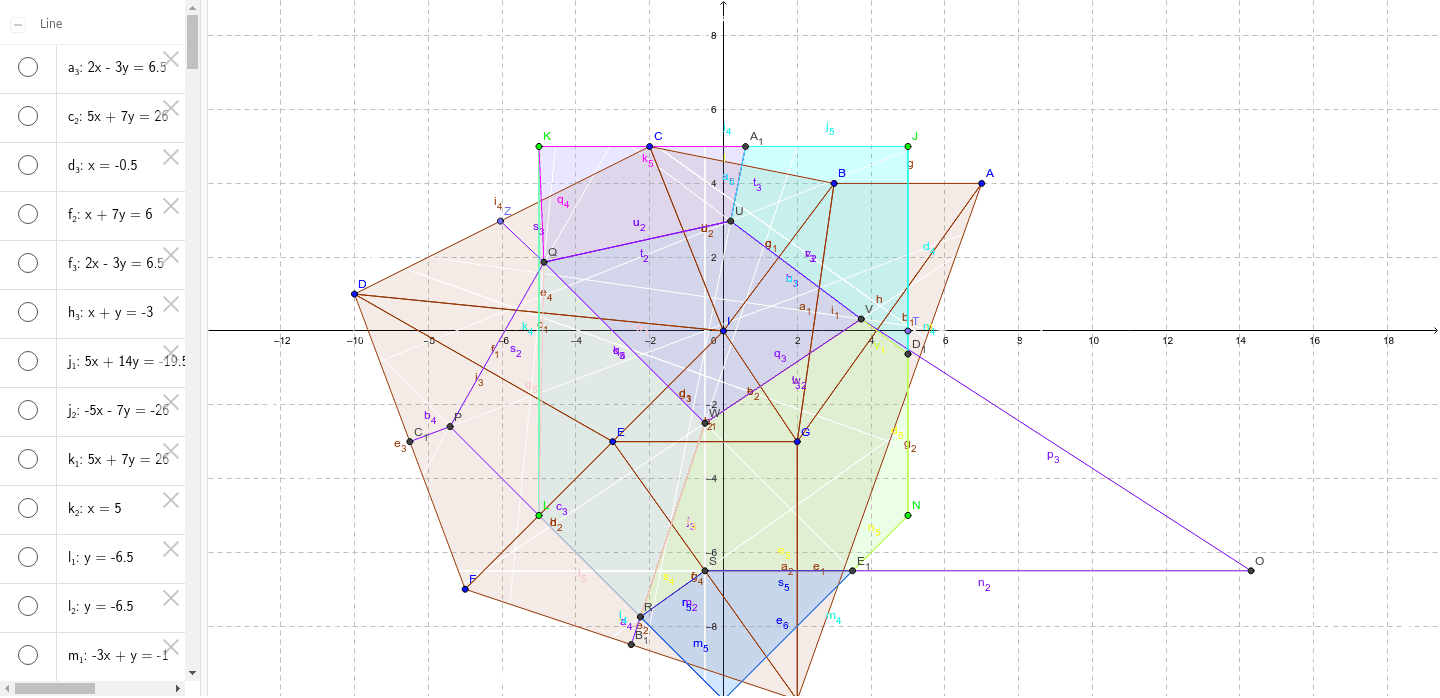
①本范例演示如何根据一组样本点生成泰森多边形;②涉及的核心数学概念包括多边形构造、向量、二维解析几何;③作图要点:使用 GeoGebra 命令 Polygon(多边形)、Segment(线段)、LineBisector(角平分线)、Intersect(交点)、Point(点);④适合高中数学教学或几何作图学习。
GeoGebra 命令及参数
Polygon(C, B, I) → poly1, i, c, bPolygon(A, B, G) → poly2, g, a_1, b_1Polygon(I, G, B) → poly3, b_2, i_1, g_1Polygon(G, H, A) → poly4, a_2, g_2, hPolygon(E, I, G) → poly5, g_3, e, i_2Polygon(E, H, G) → poly6, g_4, e_1, h_1Polygon(F, E, H) → poly7, h_2, f, e_2Polygon(D, F, E) → poly8, e_3, d, f_1Polygon(I, D, E) → poly9, e_4, i_3, d_1Polygon(C, D, I) → poly10, i_4, c_1, d_2Segment(L, M) → jSegment(K, L) → kSegment(K, J) → lSegment(N, J) → mSegment(M, N) → nLineBisector(D, F) → pLineBisector(D, E) → qLineBisector(F, E) → rLineBisector(D, I) → sLineBisector(E, I) → tLineBisector(A, H) → j_1LineBisector(A, G) → k_1LineBisector(G, H) → l_1Intersect(j_1, k_1) → OIntersect(p, q) → PIntersect(q, s) → QLineBisector(F, H) → m_1LineBisector(H, E) → n_1Intersect(r, m_1) → RLineBisector(H, E) → p_1LineBisector(E, G) → q_1LineBisector(G, H) → r_1Intersect(l_1, n_1) → SLineBisector(H, G) → s_1LineBisector(H, A) → t_1LineBisector(A, G) → c_2LineBisector(B, G) → f_2LineBisector(G, A) → j_2LineBisector(A, B) → k_2Point(m) → TLineBisector(H, G) → l_2Segment(R, S) → m_2Segment(S, O) → n_2LineBisector(C, B) → p_2LineBisector(C, I) → q_2LineBisector(I, B) → r_2Intersect(p_2, q_2) → USegment(P, Q) → s_2Segment(Q, U) → t_2LineBisector(G, I) → a_3Intersect(f_2, r_2) → VSegment(U, V) → b_3Segment(R, P) → c_3LineBisector(E, G) → d_3LineBisector(G, I) → f_3LineBisector(I, E) → h_3Intersect(t, m_1) → WSegment(R, W) → j_3Segment(Q, W) → k_3Segment(W, V) → l_3LineBisector(H, G) → m_3LineBisector(G, A) → n_3Segment(V, O) → p_3Segment(V, W) → q_3Segment(V, U) → r_3Point(i_4) → ZSegment(Q, Z) → s_3Intersect(p_2, l) → A_1Segment(U, A_1) → t_3Intersect(m_1, e_2) → B_1Segment(R, B_1) → a_4Intersect(p, e_3) → C_1Segment(P, C_1) → b_4Polygon(M, N, J, K, L) → poly11, m_4, n_4, j_4, k_4, l_4Polygon(K, A_1, U, Q) → poly12, k_5, a_5, u, q_4Intersect(k_2, r_2) → D_1Polygon(D_1, J, A_1, U, V) → poly13, d_4, j_5, a_6, u_1, vIntersect(t, l_1) → E_1Polygon(D_1, N, E_1, S, R, W, V) → poly14, d_5, n_5, e_5, s_4, r_4, w, v_1Polygon(E_1, M, R, S) → poly15, e_6, m_5, r_5, s_5Polygon(R, W, Q, L) → poly16, r_6, w_1, q_5, l_5Polygon(W, V, U, Q) → poly17, w_2, v_2, u_2, q_6