
用圆和直线构造椭球体
几何画板及绘图内容加载中,请稍等……
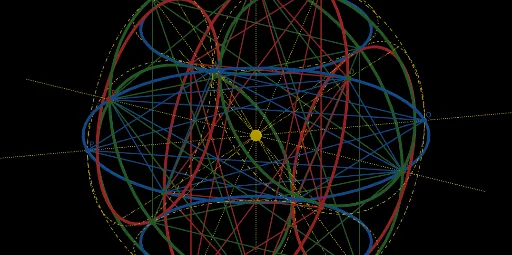
这个范例展示了如何使用圆和直线构造椭球体。它涉及圆、直线和线性方程的核心数学概念。通过使用GeoGebra命令如Circle、Intersect、Point等,可以构建出椭球体的几何模型。适合高中数学教学和学习,特别是解析几何和立体几何的内容。
GeoGebra 命令及参数
Circle(O, 30, zAxis) → cCircle(O, 30, yAxis) → dCircle(O, 30, xAxis) → eAngularBisector(D, O, B) → sAngularBisector(C, O, B) → tAngularBisector(A, O, E) → aAngularBisector(E, O, B) → bAngularBisector(D, O, F) → f_1AngularBisector(D, O, E) → g_1Circle(O, 20, zAxis) → c_1Circle(O, 20, xAxis) → d_1Circle(O, 20, yAxis) → e_1Intersect(yAxis, c_1, 1) → GIntersect(yAxis, d_1, 2) → HIntersect(c_1, e_1, 1) → JIntersect(zAxis, e_1, 1) → KIntersect(zAxis, d_1, 2) → LCircle(K, 20, zAxis) → h_1Circle(L, 20, zAxis) → k_1Circle(J, 20, xAxis) → p_1Circle(H, 20, yAxis) → r_1Circle(G, 20, yAxis) → s_1Point(c) → MIntersect(s, c, 2) → NIntersect(t, c, 1) → PIntersect(t, c, 2) → QSegment(D, B) → i_1Segment(B, C) → j_1Segment(C, A) → l_1Segment(A, D) → m_1Segment(Q, M) → n_1Segment(M, P) → t_1Segment(P, N) → a_1Segment(N, Q) → b_1Segment(Q, B) → f_2Segment(Q, C) → g_2Segment(A, M) → h_2Segment(A, P) → i_2Segment(M, C) → j_2Segment(B, N) → k_2Segment(D, P) → l_2Segment(D, N) → m_2Intersect(g_1, e, 1) → RIntersect(g_1, e, 2) → SIntersect(f_1, e, 2) → TIntersect(f_1, e, 1) → USegment(R, T) → n_2Segment(T, S) → p_2Segment(S, U) → q_2Segment(U, R) → r_2Segment(D, E) → s_2Segment(E, C) → t_2Segment(C, F) → a_2Segment(F, D) → b_2Segment(U, E) → c_2Segment(U, C) → d_2Segment(T, D) → e_2Segment(T, F) → f_3Segment(S, D) → g_3Segment(S, E) → h_3Segment(R, F) → i_3Segment(R, C) → j_3Intersect(b, d, 1) → VIntersect(a, d, 1) → WIntersect(b, d, 2) → ZIntersect(a, d, 2) → A_1Segment(A_1, V) → k_3Segment(V, W) → l_3Segment(W, Z) → m_3Segment(Z, A_1) → n_3Segment(B, E) → p_3Segment(E, A) → q_3Segment(A, F) → r_3Segment(F, B) → s_3Segment(B, W) → t_3Segment(B, Z) → a_3Segment(V, F) → b_3Segment(F, W) → c_3Segment(V, A) → d_3Segment(E, A_1) → e_3Segment(E, Z) → f_4Segment(A_1, A) → g_4Intersect(c_1, e_1, 2) → ICircle(I, 20, xAxis) → q_1Line(B, A) → h_4Line(D, C) → i_4Line(E, F) → j_4Circle(P, V, M) → c_4Circle(W, Q, Z) → d_4Circle(V, R, W) → e_4Circle(M, R, Q) → k_4Circle(Z, U, A_1) → p_4Circle(N, S, P) → q_4