
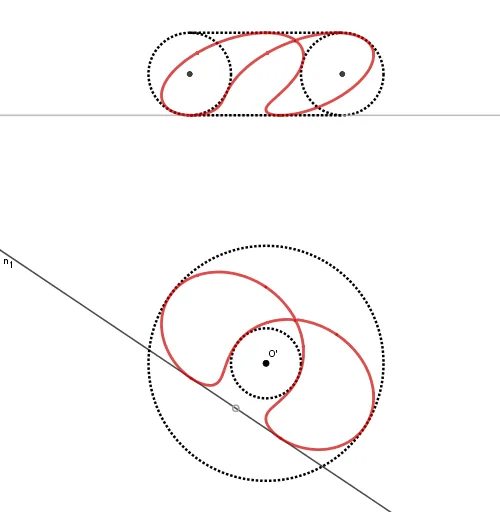
环面交线的第二轮廓点
几何画板及绘图内容加载中,请稍等……
本范例演示了环面交线的第二轮廓点。涉及的核心数学概念包括解析几何和几何作图。通过使用GeoGebra命令如Line, Point, Circle, Intersect等,可以构造环面的交线并找到其第二轮廓点。适合高中数学教学和学习使用。
GeoGebra 命令及参数
Line(O', A) → fPoint(f) → BCircle(O', B) → cPoint(f) → CCircle(O', C) → dOrthogonalLine(O', f) → gMidpoint(B, C) → DOrthogonalLine(D, f) → hPoint(g) → EOrthogonalLine(E, g) → iIntersect(h, i) → FCircle(F, Segment[D, C]) → eMirror(e, g) → e'Mirror(h, g) → h'_1Intersect(e', h'_1, 2) → GIntersect(e, h, 2) → HSegment(G, H) → jIntersect(e', h'_1, 1) → IIntersect(e, h, 1) → JSegment(I, J) → kLine(O', K) → lOrthogonalLine(K, l) → n_1Line(I, J) → n_2Line(G, H) → pPoint(l) → LOrthogonalLine(L, l) → qOrthogonalLine(K, f) → rOrthogonalLine(L, f) → sIntersect(r, n_2) → MIntersect(s, p) → NSegment(M, N) → tPoint(t) → P_2OrthogonalLine(P_2, g) → aIntersect(e', a) → Q, P_0''pIntersect(e, a) → S, TIntersect(a, g) → UCircle(O', Segment[U, Q]) → c_1Circle(O', Segment[U, P_0''p]) → d_1OrthogonalLine(P_2, i) → bIntersect(l, b) → VOrthogonalLine(V, l) → f_1Center(e') → I_1Intersect(d_1, f_1) → P', ZIntersect(c_1, f_1) → A_1, B_1Locus(P', P_2) → ponthalmaz1Locus(A_1, P_2) → ponthalmaz2Locus(B_1, P_2) → ponthalmaz3Locus(Z, P_2) → ponthalmaz4OrthogonalLine(Z, f) → g_1OrthogonalLine(B_1, f) → h_1OrthogonalLine(A_1, f) → i_1OrthogonalLine(P', f) → j_1Intersect(g_1, a) → C_1Intersect(h_1, a) → D_1Segment(P_0''p, S) → k_2Intersect(i_1, a) → E_1Intersect(j_1, a) → P''Locus(P'', P_2) → ponthalmaz5Locus(E_1, P_2) → ponthalmaz6Locus(D_1, P_2) → ponthalmaz7Locus(C_1, P_2) → ponthalmaz8Point(n_1) → OOrthogonalLine(O, n_1) → mIntersect(q, m) → PMirror(m, O') → m'Intersect(n_1, m') → RIntersect(q, m') → WOrthogonalLine(O, n_2) → nOrthogonalLine(P, n_2) → k_1OrthogonalLine(R, n_2) → l_1OrthogonalLine(W, p) → m_1Intersect(n, n_2) → F_1Intersect(k_1, p) → G_1Intersect(l_1, n_2) → H_1Intersect(m_1, p) → J_1Polygon(P, W, R, O) → q1, h', w, r_1, oPolygon(F_1, G_1, J_1, H_1) → q2, s_1, h'', a_1, b_1OrthogonalLine(O', l_1) → e_1Intersect(e_1, q) → K_1Intersect(e_1, n_1) → L_1Segment(L_1, K_1) → v'OrthogonalLine(L_1, n_2) → g_2OrthogonalLine(K_1, n_2) → h_2Intersect(g_2, n_2) → M_1Intersect(h_2, p) → N_1Line(O', P') → q_1Segment(L_1, M_1) → i_2Segment(K_1, N_1) → j_2Segment(M_1, N_1) → v''Intersect(e', v'') → O_1, P_1Intersect(e, v'') → Q_1, R_1OrthogonalLine(O_1, p) → m_2OrthogonalLine(P_1, p) → p_2OrthogonalLine(Q_1, n_2) → q_2OrthogonalLine(R_1, n_2) → r_2Intersect(r_2, e_1) → S_1Intersect(q_2, e_1) → T_1Intersect(p_2, e_1) → U_1Intersect(m_2, e_1) → V_1Segment(O_1, V_1) → s_2Segment(U_1, P_1) → t_2Segment(Q_1, T_1) → a_2Segment(S_1, R_1) → b_2
AI 绘图提示语参考
绘制一个环面的第二轮廓点。首先,创建一个通过点O'和A的直线f,然后在f上取点B和C,分别以O'为圆心,B和C为半径画圆c和d。接着,构造与f正交的直线g,并找到B和C的中点D,再以D为圆心,f为轴构造直线h。通过一系列交点和镜像操作,最终得到环面的第二轮廓点P2。
以上提示语为根据原始绘图命令整理而来,仅供参考。